

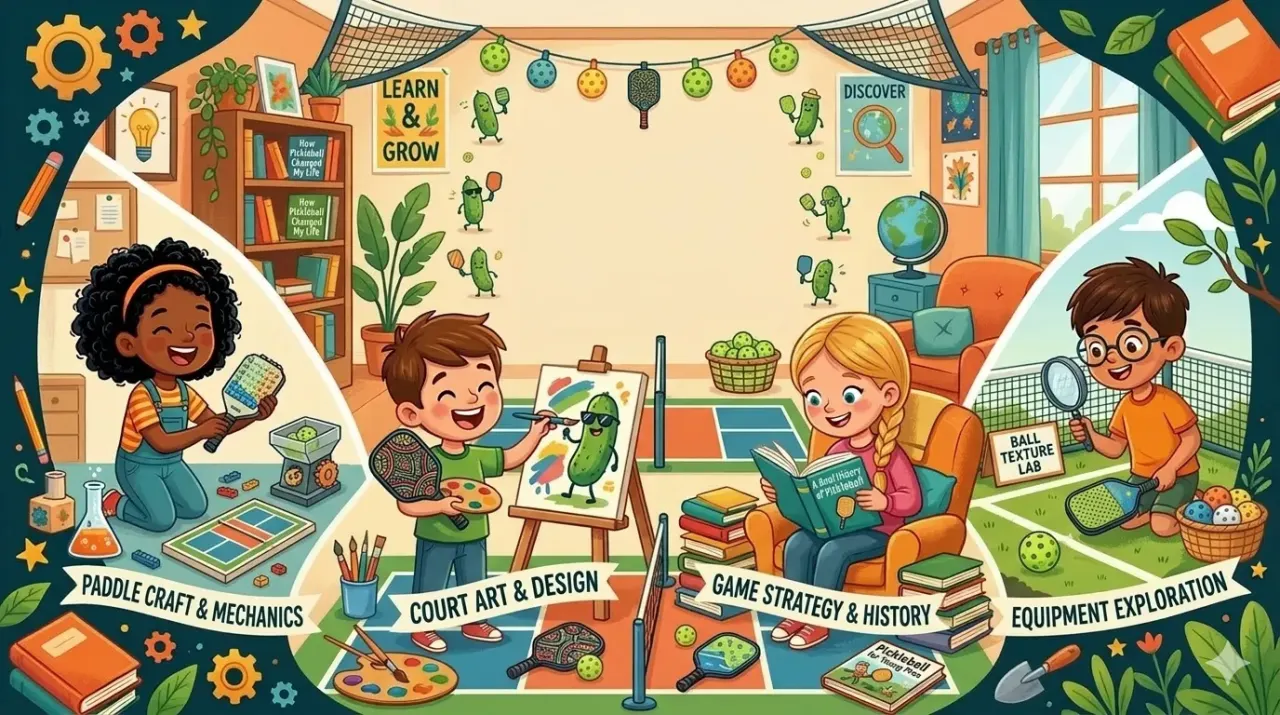
Homeschooling gives families an extraordinary gift: the freedom to design learning around a child’s unique interests, learning style, and pace. But great homeschooling goes far beyond textbooks and worksheets. The best homeschool activities blend academic rigor with hands-on exploration, creativity, physical movement, and real-world experience. Whether you’re brand new to homeschooling or looking to shake things up, this guide covers the most effective and enjoyable activities to keep your learners thriving all year long.
🏓 Put Down the Worksheet. Pick Up a Paddle. Homeschool PE doesn’t have to mean laps around the backyard. Pickleland’s Homeschool Open Play sessions are built for homeschool families — weekday-friendly, beginner-welcome, and genuinely a blast. Reserve your spot → today! And moms, you can play too: moms open play is Tuesdays and Thursdays, 1–4pm.
1. Project-Based Learning (PBL)
One of the most powerful tools in a homeschool parent’s arsenal is project-based learning. Instead of learning in silos, students tackle a real-world problem or question over several days or weeks. A child fascinated by weather might build a weather station, track data, research meteorology, and present findings — covering science, math, writing, and public speaking in one project. PBL encourages deep thinking, self-direction, and genuine curiosity.
2. Nature Journaling and Outdoor Science
Regular time outdoors transforms learning. Nature journaling — sketching plants, insects, clouds, or animals with notes and observations — builds scientific thinking and artistic skill simultaneously. Pair it with identification guides, magnifying glasses, and field trips to parks or nature preserves. Seasonal studies (tracking the life cycle of a garden, observing bird migration) give children a sense of time, change, and ecological relationships that no screen can replicate.
3. Read-Alouds and Living Books
Charlotte Mason educators have long championed ‘living books’ — well-written, narrative-driven books that bring history, science, and literature to life. Daily read-alouds, even for older children, build vocabulary, comprehension, and a love of stories. Choose books that spark conversation: historical fiction set during the American Revolution, a biography of Marie Curie, or a novel that raises ethical questions. Great literature does more for writing ability than most formal grammar programs.
4. Cooking and Kitchen Math
The kitchen is one of the best homeschool classrooms. Cooking teaches fractions (halving or doubling a recipe), measurement, chemistry (baking reactions), nutrition science, reading comprehension, and planning skills. Assign your child a weekly meal or snack project. Let them plan, shop, prep, and serve. The real-world stakes make learning stick in ways that worksheets rarely do. Older students can explore the economics of grocery budgets and the history of cuisine.
5. Art, Music, and Creative Expression
Creative subjects are not extras — they are core to cognitive development. Drawing, painting, sculpture, music, drama, and creative writing develop spatial reasoning, emotional intelligence, fine motor skills, and the ability to communicate complex ideas. Incorporate art history studies alongside art-making. Learn an instrument — even basic ukulele or recorder — to build mathematical thinking and memory. Schedule time for free creative play where children make art for the joy of making.
6. Physical Activity and Movement
Physical education is a critical and often under-planned part of homeschooling. Children need daily movement not just for health, but for focus, mood regulation, and brain development. Options range widely: backyard games, bike rides, swimming lessons, martial arts, dance classes, team sports, yoga, and hiking. Many homeschool families are discovering pickleball as an ideal activity — it’s social, teaches strategy and coordination, and is accessible to all ages and fitness levels. Programs specifically designed for homeschoolers offer structured skill-building and group play in a welcoming environment.
7. Community Service and Real-World Learning
Volunteering and service projects connect children to their community and develop empathy, responsibility, and civic awareness. Help at a local food pantry, plant a neighborhood garden, participate in a beach or park cleanup, or fundraise for a cause your child cares about. These experiences also generate rich material for portfolios and, eventually, college applications. The lessons learned through serving others are among the most lasting of any education.
8. Educational Field Trips
Homeschoolers have a unique advantage: they can visit museums, historical sites, farms, science centers, factories, courthouses, and community institutions on any weekday when crowds are light. Make field trips an intentional part of your curriculum. Prepare beforehand with background reading and questions to explore. Debrief afterward with narration, journaling, or a creative project inspired by what they saw. A trip to a living history museum can make a whole unit on colonial America come alive.
9. Coding, Technology, and Maker Projects
Digital literacy is essential for the modern world. Introduce age-appropriate coding through platforms like Scratch, Code.org, or Python tutorials. For hands-on makers, robotics kits, electronics projects, 3D printing, and DIY engineering challenges blend STEM skills with creativity and problem-solving. The maker mindset — tinker, fail, iterate, improve — is one of the most valuable things a child can develop. Many libraries and makerspaces offer free access to tools and guidance.
10. Co-ops, Clubs, and Group Learning
Learning alongside peers is irreplaceable. Homeschool co-ops — where families share teaching responsibilities — provide group classes, social connection, accountability, and specialization. Clubs around robotics, chess, drama, debate, book discussions, and sports give children a sense of belonging and friendly competition. Structured group activities also prepare children for the collaborative environments they’ll encounter in college and careers.
The best homeschool is one that fits your family and evolves with your children. Mix and match these activities, follow your child’s curiosity, and don’t be afraid to try something new. The freedom to personalize education is the greatest advantage of homeschooling — use it fully.