
If you’ve been playing pickleball for a while, you’ve probably heard the buzz around a shot called the “drip.” It’s one of the hottest topics in intermediate and advanced circles, and for good reason — it’s changing the way players approach the third shot. But what exactly is a drip shot in pickleball, and should you add it to your game?
The Drip Shot Defined
The drip shot — sometimes called the “hot drop” or “hybrid third shot” — is a combination of a drive and a drop shot. It lives in the middle ground between blasting the ball with full power and gently floating it into the kitchen. Think of it as hitting the ball at around 60% of your maximum power, with aggressive topspin, aimed directly at your opponent’s feet as they move toward the Non-Volley Zone (NVZ).
The name says it all: the ball “drips” down low and hard, making it extremely difficult to attack. Unlike a pure drive, which can sail long, and unlike a pure drop, which sits up and gives opponents time to set, the drip shot is designed to force an awkward, off-balance return — often a pop-up that you can put away for a winner.
Why the Drip Shot Is Gaining Popularity
Pickleball has evolved dramatically in recent years. Players are hitting harder, moving faster, and defending better than ever before. Traditional third-shot drops, while still valuable, are no longer sufficient on their own. Opponents have become skilled at attacking soft drops, and full-power drives can be countered by players with fast hands.
The drip shot fills that gap. It’s more aggressive than a drop, but controlled enough to keep the ball low and unattackable. When hit correctly, the topspin makes the ball dive sharply after crossing the net, catching transitioning opponents mid-step.
Professional players including Ben Johns and Catherine Parenteau have been spotted using this shot regularly on tour. When the best players in the world are deploying it, it’s worth paying attention.
How to Execute the Drip Shot
Here’s a step-by-step breakdown of how to hit a great drip shot:
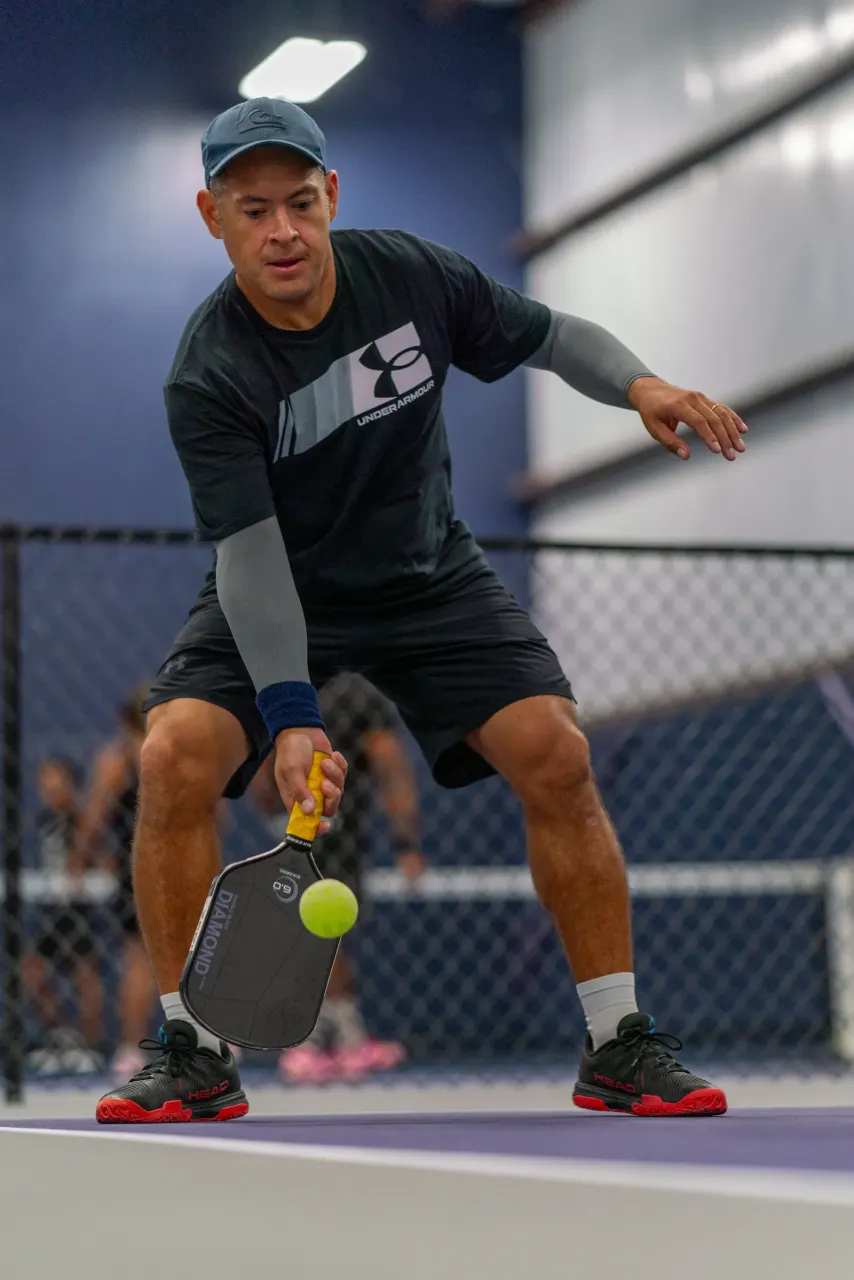
1. Set Up Like a Drive Start with the same setup you’d use for a third-shot drive. Keep your paddle up in the ready position, knees slightly bent, feet about shoulder-width apart. This is crucial because it disguises your intent — your opponent won’t know whether a drive or a drop is coming until the last moment.
2. Use an Open Stance Make sure your hips are open toward the opposite side of the court. A closed stance fights your body mechanics. An open stance lets you hit multiple spots on the court with ease.
3. Loosen Your Grip This might feel counterintuitive, but grip tension kills the drip shot. Aim for a grip strength of about 2-3 out of 10. A loose grip lets you brush up through the ball and generate that critical topspin. If your wrist and arm are tense, you lose the spin and the shot becomes flat.
4. Contact Point: Hit the Side of the Ball This is the key mechanical difference between the drip and a standard drop. With a regular drop, you contact near the bottom equator of the ball to create a high arc. With the drip, you brush more to the side of the ball. This creates a more horizontal trajectory — not looping upward, but dipping forward and down.
5. Use a Windshield Wiper Motion On the forehand, use a windshield wiper swing path — sweeping across and up through the ball. On the backhand, a compact flick works similarly. The high-to-low-to-high paddle path combined with outside contact is what generates that aggressive topspin dip.
6. Aim for the Feet Target your opponent’s feet, especially the player who is transitioning toward the net. Hitting 4-5 feet beyond the kitchen line at their feet forces them to bend, reach, and reply awkwardly. The result is often a weak pop-up that you and your partner can attack.
7. Follow Your Shot Forward After hitting the drip, move immediately toward the net. Unlike a soft drop where you might need to wait and assess, the drip shot creates pressure that should allow you to advance confidently.
When to Use the Drip Shot
The drip shot isn’t a replacement for the drop or the drive — it’s a third weapon in your arsenal. Here’s when to deploy it:
- When your opponent’s return lands short, giving you more time and court to work with
- When opponents are transitioning slowly and haven’t established position at the kitchen line
- In mixed doubles, especially when your partner is crashing the net after a strong serve
- When you want to break up predictable patterns — if you’ve been drop-drop-dropping all game, a well-timed drip disrupts your opponent’s rhythm
- Against aggressive returners who are standing deep and waiting to punish a soft drop
Avoid the drip shot when you’re in a tight, compressed position with little backswing room, or when opponents are already locked in at the kitchen. In those situations, a traditional drop or reset is usually the smarter play.
Practicing the Drip Shot
Like any advanced technique, the drip shot takes dedicated practice to develop. Here’s a simple drill to get started:
Have your partner stand at the kitchen line. Position yourself at or near your baseline. Set up two cones crosscourt on their kitchen line — that’s your target zone. Have your partner feed you balls, and work on landing your drip shot between the cones. Focus on grip looseness, the side-of-the-ball contact, and the windshield wiper follow-through.
Start slow. The goal isn’t pace — it’s shape. Once you can consistently land the ball in the target zone with topspin and a low, dipping trajectory, start increasing speed and adding movement patterns.
Level Up Your Pickleball at Pickleland
The drip shot is just one of dozens of skills that separate a 3.5 player from a 4.0+. If you want to accelerate your development, join us at Pickleland for clinics, open play, and DUPR-rated events where you can test new skills in real match scenarios. Whether you’re a beginner or a seasoned competitor, we’ve got the court time and community to help you grow.
Want to track your progress officially? Check out our guide to understanding your DUPR score and find out how rated play can sharpen your game faster than recreational sessions alone.