

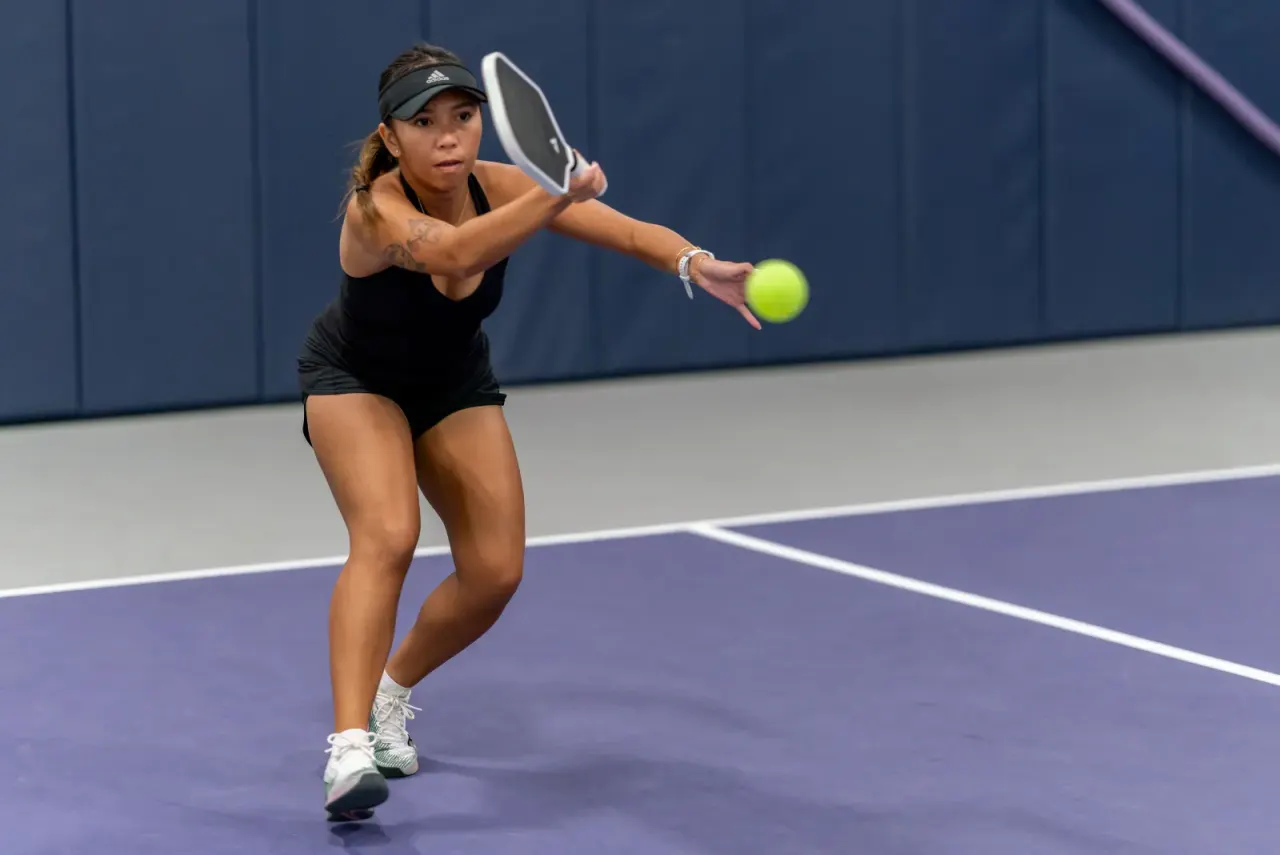
One of the most common things players say when they plateau is: “I’d practice more if I had someone to practice with.”
The good news: most of the foundational skills in pickleball can be trained solo. You don’t need a partner, a ball machine, or a scheduled session. All you need is a court, a bucket of balls, and 30 focused minutes.
Here are seven drills that will noticeably improve your game — and that you can do entirely on your own.
1. Wall Dinking
Target skill: Dink consistency, soft touch, compact swing
Find a wall — any solid surface — and tape or chalk a line 34 inches from the ground (net height). Stand about 7 feet from the wall, your equivalent of the kitchen line.
Dink the ball against the wall continuously, keeping each shot below the line. Focus on keeping the ball low, using a gentle push rather than a swing, and staying relaxed in your grip and arm.
Start by setting a target: 25 consecutive dinks below the line without a mishit. Once that’s comfortable, move to 50. Advanced players aim for 100+ in a row before considering it a warm-up drill.
Why it works: Wall dinking forces you to use soft hands and a pendulum motion. The immediate feedback (ball bouncing back too high = too much power) trains your touch faster than partner drilling at the same stage.
2. Serve Accuracy Targets
Target skill: Serve placement and consistency
Place four to six items (water bottles, cones, extra balls) in different zones of the service box — deep corners, middle deep, shallow cross-court. Give each target a point value based on difficulty.
Serve 20 balls to each target zone, tracking your percentage. Aim for 70% within the target zone on your primary serve before feeling confident in it.
Include both forehand and backhand serves if you use both. Don’t just work your comfortable serve — spend at least 30% of your reps on the serve you’re less confident with.
Why it works: Most recreational players never actually practice serves because it seems boring. Ten minutes of intentional serve work per session will make you measurably more accurate within two weeks.
3. Drop and Reset Drill
Target skill: Third-shot drop, transition ball control
Stand at the baseline with a bucket of balls. Drop one ball, let it bounce once, then hit a third-shot drop toward the kitchen. Aim to land the ball within the non-volley zone, preferably within 18 inches of the net.
Alternate between forehand and backhand drops. Track how many out of 20 land cleanly in the kitchen. Reset after 20 and try to improve your percentage.
Progress version: After hitting the drop, sprint forward to the kitchen line before the ball bounces. This conditions your footwork and timing for the transition, which is where most third-shot drops break down.
Why it works: The third-shot drop is the single most important shot in doubles pickleball. Drilling it solo — where you control the pace and can focus on technique without match pressure — accelerates improvement dramatically.
4. Ball Bounce Control
Target skill: Paddle control, touch, ball tracking
Stand on the court and bounce a ball on your paddle repeatedly, keeping it in the air. Simple in concept, powerful in practice.
Progress levels:
- Forehand face only: target 50 consecutive
- Backhand face only: target 50 consecutive
- Alternating forehand/backhand: target 40 consecutive
- Small controlled bounces (under 12 inches): target 30 consecutive
- Rolling the ball around the paddle rim between bounces: whenever you want a real challenge
Why it works: Ball bounce control directly builds the touch and paddle awareness that translates into soft hands at the kitchen. It also improves your ability to judge ball height on incoming shots — a subtle skill that matters more than it looks.
5. Footwork Ladder (No Ladder Required)
Target skill: Lateral quickness, split step timing, court coverage
Mark five positions on the court with cones or extra balls: far left, center-left, center, center-right, far right along the kitchen line. Call out a random sequence (center → far right → center-left → far left → center) and move to each position quickly, touching the marker with your paddle.
Do 10 sequences of five positions, resting 20 seconds between sets. Focus on staying low in a ready position, recovering to center between each touch, and landing with a balanced, split-step ready position.
Progress version: record yourself calling out positions at random intervals, then play it back and react to the audio. This adds the unpredictability of a real game.
Why it works: Most amateur players take too long to recover between shots. This drill builds the habit of explosive lateral movement paired with fast recovery — the same movement pattern you use on every defense-to-offense transition.
6. Return Placement Off a Bounce
Target skill: Return depth and direction
Stand at the baseline with a bucket of balls. Toss each ball to yourself, let it bounce, then practice return drives aimed at specific zones — deep backhand corner, deep center, deep forehand corner.
Hit 10 balls to each zone, then evaluate your grouping. Place a cone or marker at your target to give yourself a visual reference.
Why it works: The return of serve is the second most important shot in the game (after the serve itself). Practicing it solo builds the muscle memory for aimed returns rather than reactive ones.
7. Shadow Footwork
Target skill: Ready position, reaction footwork, court movement patterns
No ball needed for this one. Stand at the kitchen line in your ready position. Call out or think: “wide forehand” — then sprint wide right. Recover. “Wide backhand” — sprint left. Recover. “Overhead” — back-pedal two steps. Recover.
Do this for two-minute intervals, calling random shot types without a pause to return to center between each. After each interval, note where your feet feel heaviest — that’s your weak movement pattern.
Include the split step: time a small hop so you land just as you’d “hit” each shot, then push off immediately into recovery.
Why it works: Most footwork errors in pickleball aren’t about speed — they’re about habit. Players who haven’t drilled specific recovery movements default to standing and watching instead of moving. Shadow footwork burns the right recovery habits into muscle memory.
Twenty-five minutes with a bucket of balls and these drills will do more for your game than an equal amount of casual open play. Deliberate practice — even alone — is how the skill gaps close.
Pick two or three of these drills and add them to your warm-up routine for the next month. You’ll feel the difference before the month is out.