
Every fast-hands battle at the kitchen line feels like chaos — paddles flashing, balls ricocheting, points won and lost in under a second. But there’s a hidden pattern underneath it. When you speed a ball up and your opponent blocks it back, that counter almost never travels straight back at you. It deflects to one side, and which side is surprisingly predictable.
That pattern is called triangle theory, a concept popularized by pickleball content creator Pickleburner in 2023. Master it and you stop reacting to counters — you start waiting for them.
What the Triangle Actually Is
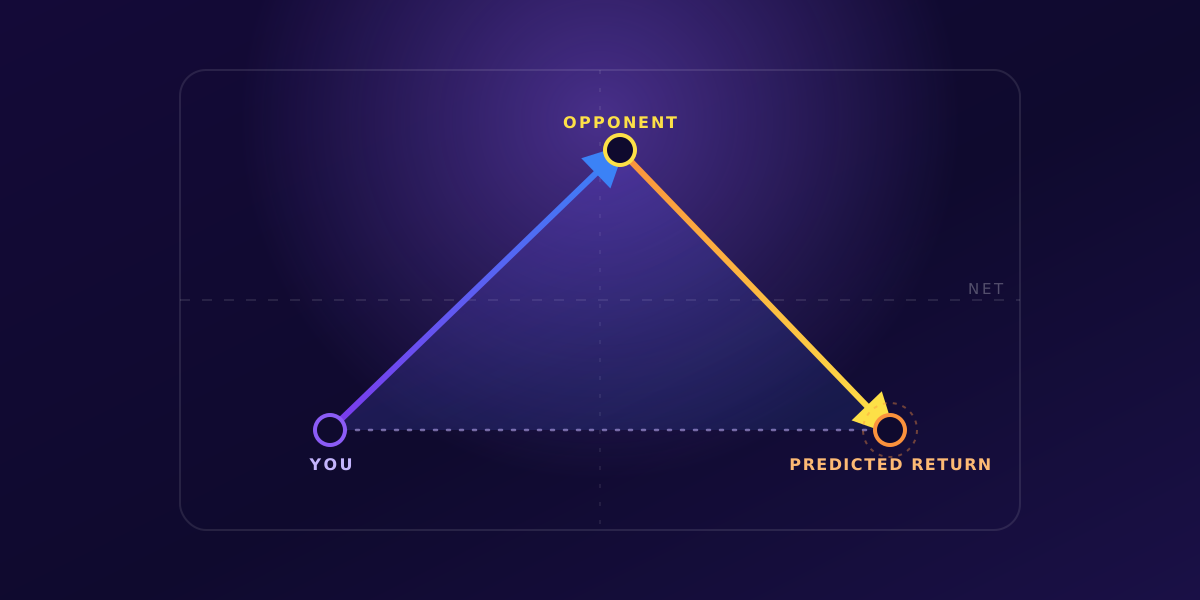
Picture a fast exchange. You’re both at the non-volley zone line. You flick a speedup at your opponent, they get a paddle on it and block it back. Triangle theory says those two ball paths — your attack and their counter — form two sides of a triangle. The third side is the base: the stretch of your body the returning ball crosses to reach its landing spot.
The insight is that the counter almost never retraces your line straight back. A jammed blocker can’t redirect a fast ball wherever they like — the paddle face is already set, and it deflects the ball off at an angle. Draw a line from your contact point, up to their paddle, and back down to where the ball actually returns, and you’ve drawn a triangle every time. The whole game is knowing, in advance, which corner that third point lands in.
The Golden Rule: Where the Counter Goes
Here’s the part worth memorizing. Against a right-handed opponent, the return side depends entirely on which stroke you jam:
Speed up to their FOREHAND
Counter comes back to your right
Speed up to their 1-H BACKHAND
Counter comes back to your left
Speed up to their 2-H BACKHAND
Counter comes back to your right
Notice what happens across those three panels. Jam the forehand and the ball crosses to your right. Jam the one-handed backhand and it crosses the opposite way, to your left. But jam a two-handed backhand — even though you’re hitting the same corner as the one-hander — and the ball comes back to your right again. Same target, opposite result. That reversal is the single most useful thing triangle theory teaches, so it gets its own section below.
Here’s the whole rule as a cheat sheet:
| You speed up to their… | Their counter returns to… | Pre-load your paddle… |
|---|---|---|
| Forehand | Your right (forehand side) | Right |
| One-handed backhand | Your left (backhand side) | Left |
| Two-handed backhand | Your right (forehand side) | Right |
(All directions assume a right-handed opponent. If you’re facing a lefty, mirror everything.)
Why the Two-Hander Breaks the Pattern
It looks like a contradiction: the one-handed and two-handed backhand are hit from the same side of the body, yet they send the counter in opposite directions. The reason is the paddle face at the moment of contact.
A one-handed backhand block, when it’s jammed, tends to open the paddle face across the body — the ball squirts off toward the blocker’s right, which is your left. A two-handed backhand, though, is really a second forehand: the bottom hand drives the paddle much like a forehand stroke, so a jammed two-hander deflects the ball the same way a forehand does — back to your right. If you don’t clock which backhand your opponent uses, you’ll pre-position to the wrong side against half the field. So on your first few dinks of a game, glance at their grip. One hand or two on the backhand? That one detail rewrites your whole plan.
Turning Theory Into Faster Hands
Triangle theory isn’t really about your hands being quicker — it’s about starting sooner. If you know the counter is coming to your right, you’re not waiting to see it and then reacting. You’re already moving your paddle into that lane as your own speedup leaves the strings. That head start is what looks, from the other side of the net, like superhuman reflexes.
The move: As you release a speedup at a righty's forehand, your paddle should already be drifting to cover your right hip. You're not guarding the whole court — you're guarding one side of your body, the side the triangle points to. Cover that lane early and the "unreturnable" counter becomes a sitter you punch away for the point.
This also tells you where to aim your own attack. If your partner is weak covering the middle, speed the ball up in a way that sends the counter toward you, not toward them. You get to choose which corner of the triangle the ball comes back to — so choose the one you’re ready for.
The 70% Catch: Disguise and Timing
Triangle theory is a tendency, not a law. It holds roughly 70% of the time, and only under one condition: your opponent can’t have time to think. Give a good player a beat to set up, and they’ll redirect the counter wherever they please, blowing the pattern apart. The rule only works when you take that beat away.
That means the quality of your speedup is everything:
- Disguise it. Make the speedup look like a dink right up until the last instant. If they read it early, they can prepare a counter that ignores the triangle entirely.
- Aim at the body. The dominant hip or shoulder jams them, forcing a reactive block instead of a clean, chosen redirect. A ball they have to fend off obeys the triangle; a ball they stroke does not.
- Commit to the speed. A slow, floaty speedup just hands them time. Fast and flat is what triggers the reflex block the pattern depends on.
Miss on any of those and you’re back to guessing. Nail all three and you’ve turned a coin flip into a 70/30 edge — which, over a full match of hands battles, decides games.
Drill It: Practice the Triangle
You can’t think your way to this mid-rally; it has to become instinct. A simple partner drill:
- Both players start at the kitchen line, dinking cross-court to warm up.
- On a ball of their choosing, the feeder speeds up only to your forehand. Your job: cover your right, counter-punch, reset.
- Do 20 reps reading forehand speedups, then switch the feeder to one-handed-backhand targets so you groove covering your left.
- Finally, mix the two randomly. Now you’re training the read — recognizing the target and loading the correct side without conscious thought.
After a few sessions, your paddle starts drifting to the right lane before your brain has named the shot. That’s the goal: the triangle becomes muscle memory.
The Bottom Line
Fast hands at the net aren’t magic — they’re anticipation. Triangle theory gives you the map: speed up to a righty’s forehand or two-handed backhand and the counter comes back to your right; speed up to their one-handed backhand and it comes back to your left. Read the grip, disguise the attack, and pre-load your paddle to the side the triangle points to. Do that and the wildest exchanges at the kitchen line start to feel like they’re happening in slow motion.
Want to drill this live with players who’ll push your hands? Come play at Pickleland — our open play and clinics are the perfect place to turn triangle theory into reflex.
Triangle theory was popularized by pickleball content creator Pickleburner (2023). Directional guidance and the ~70% figure are drawn from breakdowns at The Dink and PickleTip. Diagrams are original to Pickleland.