
Grab a paddle, step onto a court barely a third the size of a tennis court, and within minutes you’ll understand why pickleball has become one of the fastest-growing sports in America. It borrows the volleys of tennis, the net of badminton, and the touch of ping-pong, then wraps them around a lightweight plastic ball full of holes that anyone — kids, parents, or grandparents — can chase down on day one.
That low barrier to entry is the whole point. Pickleball rewards smart placement over raw power, so a clever beginner can hang with a stronger athlete by the second game. In this guide we’ll trace where the game came from, break down the rules and scoring, walk through the court and gear, and show you how to start playing with confidence.
What is Pickleball and Why is it called that?
In the summer of 1965, Joel Pritchard, Bill Bell, and Barney McCallum came up with the idea for pickleball on Bainbridge Island, Washington. However, its name caused a discussion that mixed history with humor.
Joan Pritchard first called it “pickle ball,” but the name comes from the mix of players who were left over from crew races’ “pickle boat” game. But another story came out saying that the name came from Pickles, the Pritchard family dog.
After many years and many different promises, the truth was still waiting to be found. If Pickles had been there when the sport started, it would have supported the dog-centered story.
Or was it just a silly story? A clear timeline was found by looking through records and talking to witnesses from the years 1965 to 1970.
The dog Pickles was born in 1968, many years after Pickleball was born and named. This investigation, which revealed where the game’s names came from, shows how much the Pritchard family cares about historical truth.
The Evolution of Pickleball
Initially a casual pastime among friends and families, Pickleball underwent significant evolution as it gained popularity. The game’s founders, including Pritchard and Bell, refined its equipment and rules, crafting specialized paddles and a larger ball with holes for enhanced gameplay consistency.
By the 1970s, Pickleball’s appeal extended beyond its originators’ circles. It found a place in local community centers and recreational programs, marking its transition from a backyard amusement to a recognized sport. The formation of the USA Pickleball Association (USAPA) in 1984 further solidified its status, introducing standardized rules and player rating systems.
The 1990s witnessed Pickleball’s international expansion, reaching countries like Canada and gaining traction across continents, including Australia and Europe. The establishment of the International Federation of Pickleball (IFP) in 2008 marked a pivotal moment, signifying Pickleball’s global presence and governance on an international scale.
Why Do People Like Pickleball So Much?
Pickleball has surged in popularity globally, attracting millions of players across diverse age groups and skill sets. From casual enthusiasts to seasoned competitors, the sport has transitioned from its humble backyard beginnings to dedicated courts in public spaces like parks, recreation centers, and fitness facilities.
One of the driving forces behind Pickleball’s recent surge is its appeal to retirees and older adults seeking a low-impact yet engaging physical activity. Its easy-to-learn nature, smaller court size, and slower ball speed compared to traditional racket sports make it accessible to a wide range of players.
The recognition of Pickleball’s growing influence was evident when it was featured in the National Senior Games in 2021, marking a milestone in its acceptance among older athletes. Additionally, the sport now has its own designated month for celebration, underlining its cultural significance and widespread participation.
What started as a simple family game has evolved into a multifaceted sport that blends elements from various disciplines. With its inclusive and social nature, Pickleball continues to captivate players of all ages and backgrounds, promising a vibrant future of growth and innovation.
How to Play Pickleball?
Pickleball is usually played in two different ways: pairs, where two players work together to make a team, and singles, where each player plays against themselves.
There are no changes to the rules or the size of the court between singles and pairs matches. This level of consistency makes sure that players have the same level of challenge and strategy whether they’re playing alone or with a team.
Scoring
Pickleball only lets the team that serves score points. Standard games go up to 11 points, and you need to win by 2 points to win. In events, games may go up to 15 or 21 points, but you still need a 2-point lead to win. The score determines where each player on the serving team stands.
The player who served first for that team will be on the right/even court while serving or receiving if the score is even (0, 2, 4, 6, 8, 10). Conversely, the player will serve or receive from the left (odd) court if the number is odd (1, 3, 5, 7, 9).
The Serve
Several rules guide how to play this important move during a pickleball serve. To start the serve, the player must hit the ball with an arm that moves in an upward arc.
Also, when the paddle hits the ball, it shouldn’t be above hip level, and the head of the paddle shouldn’t go above the highest point of the wrist.
There is, however, a variation called a “drop serve” in which these exact rules do not apply. Also, when the server hits the ball, their feet can’t touch the court or go past the imagined sideline or centerline.
At least one foot must be behind the baseline, either on the playing surface or the ground behind it. You have to hit the serve diagonally across the court and make sure it lands in the other diagonal court.
It’s important to note that each server can only try to serve successfully one time according to these rules.
Serving Sequence
In doubles pickleball, during the serving sequence, both players on the serving team can serve and score points until they make a mistake. The only time this doesn’t happen is during the first service sequence of each new game.
Also, the right/even court is where the first serve of each side-out starts. When the team that is serving scores a point, the server changes sides and serves from the left (odd) court.
As long as points are scored, this swapping will keep going. If the first server makes a mistake, their partner serves from the right side of the court until someone else makes a mistake. And if the second player makes a mistake, the serve goes to the other team, starting on the right (even) court.
Following this, both players on the other team can serve and score until they make two errors. It is the server’s job to serve from the right (even) court when the score is even and from the left (odd) court when the score is odd.
Notably, at the start of every game, only one partner on the serving team serves until there is a fault. At that point, the service goes to the receiving team.
Non-Volley Zone
The seven-foot-wide space surrounding the net sometimes referred to as “the kitchen,” is off-limits for volleying. You can’t stand in this region to punt the ball since that’s against the regulation that players can smash the ball too close to the net.
A player commits a fault if they enter the non-volley zone, touch the lines while volleying, or if their movement brings them or whatever they’re carrying into contact with the non-volley zone.
A player commits a foul if their momentum propels them into the non-volley zone after the ball is deemed dead. On the other hand, they are not limited to only the non-volley zone when they are not volleying the ball.
Two-Bounce Rule
Before returning the ball, the receiving team in pickleball must allow it to bounce twice. We refer to this as the “Two-Bounce Rule.” The serving team then has the same waiting period before hitting the ball back. Because of this, volleys cannot take place until the ball has bounced twice, once on each side.
After the initial few hops, either team has the option to volley the ball or play it off a bounce. The purpose of this regulation is to lengthen rallies and eliminate the serve-and-volley advantage.
Fault
In pickleball, a fault is any move that stops the game because it breaks the rules. The sending team gets a point whenever the receiving team makes a mistake. If the serving team makes a mistake, on the other hand, they lose the serve or get a side out.
Exploring the Standard Dimensions of a Pickleball Court
The size of a tennis court is very different from that of a pickleball court. A tennis court is 78 feet long and 36 feet wide, not counting the extra room players need to move around.
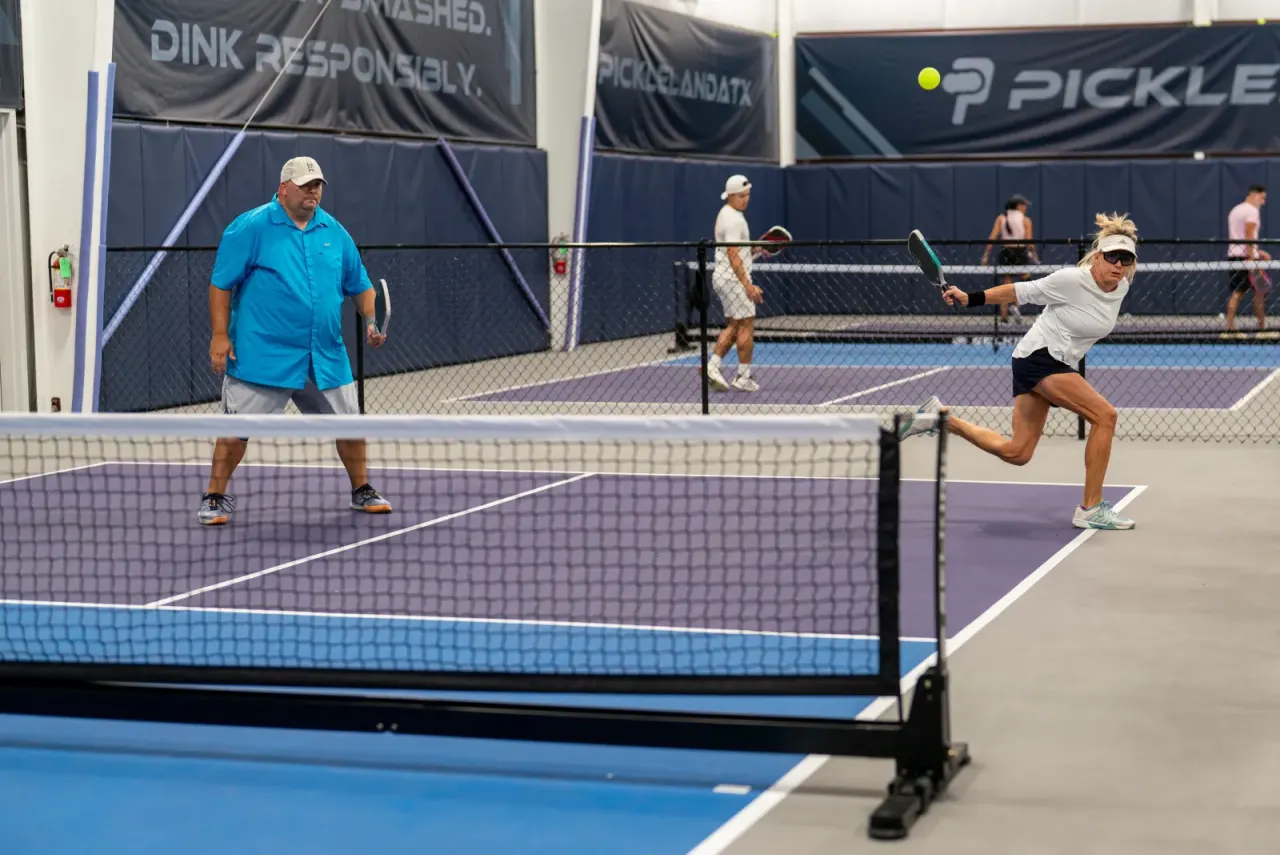
Additionally, a pickleball court is 44 feet long and 20 feet wide, not counting the space outside the lines.
The pickleball court is only about one-third the size of a tennis court, but it still has plenty of room for your game. Over time, these measurements have been improved so that players of all skill levels can enjoy the game.
It is important for players, managers, and anyone else who sets up pickleball courts to know these exact measurements.
Understanding the Height of a Pickleball Net
The height of a pickleball net is different from that of a tennis net. These differences are meant to make the game more fun. The net in pickleball is 36 inches high at the ends and 34 inches high in the middle.
This change in height, which may not seem important, has a big effect on how the game is played. The tennis net stays 42 inches high at the posts and drops to 36 inches in the middle. While the pickleball net has a lower height in the middle that makes a small slope.
This hill makes it harder to serve with too much power, so players have to focus on accuracy instead of brute force. The height of the net is placed in a way that makes pickleball games more difficult and helps players improve their skills. This makes accurate shots and smart play even more important.
A Fun, Strategic Game for All Ages
A paddle sport that blends badminton, ping pong, tennis, and tennis, pickleball is a unique hybrid. A netted court and solid paddles are used to play this game, which has a plastic ball with holes punched into it.
The goal of the game is to score points by rallying and volleying the ball into the other team’s court, beyond the net. It’s a great social activity that anyone can enjoy, regardless of age or ability level, so it’s no wonder it’s so popular.
Now that you have learned about what is pickleball and its background, why not consider joining by clicking this link?
Are you feeling more assured in your understanding of pickleball? Dive into the related articles for further understanding.
- Austin Local Pickleball Pros: Meet The Athletes Leading The Sport
- Why Pickleball Is Here To Stay: Fad Or Future?
- Understanding Pickleball DUPR Rating System