

The two-bounce rule in one sentence: the serve must bounce once before the receiver hits it, and the return must bounce once before the serving team hits it. After those two bounces, anyone may volley. It is Rule 10.A in the 2026 USA Pickleball Official Rulebook, and breaking it is a fault against whoever hit the ball too early.
People still call it the “double bounce rule,” which causes confusion, because in the rulebook a double bounce means something else: the ball bouncing twice on your side before you hit it. More on that below.
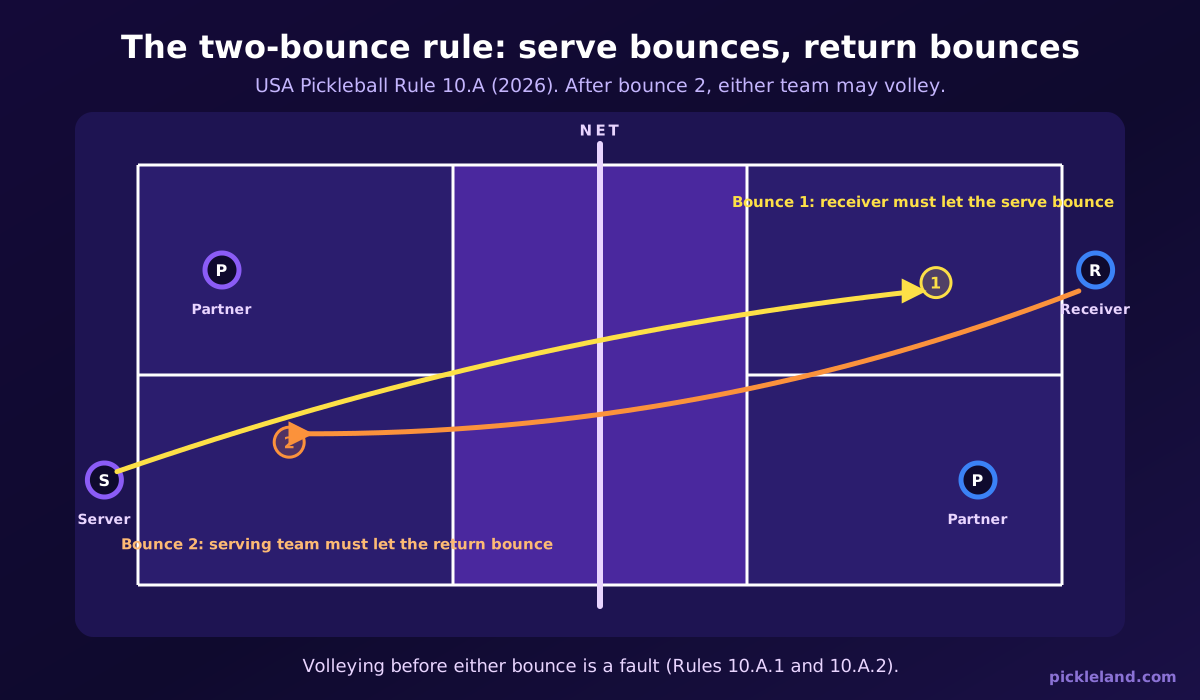
Source: 2026 USA Pickleball Official Rulebook, Rules 10.A and 14.A.1
The rule, exactly
The 2026 rulebook says the serve and the return of serve must each bounce before being returned (Rule 10.A). It then names two faults:
- Rule 10.A.1, fault against the receiver: the receiver hits the serve before it bounces.
- Rule 10.A.2, fault against the serving side: the server or the server’s partner hits the return before it bounces.
That’s all of it. The rule covers exactly two shots, the serve and the return. From the third shot on, both teams can volley or let the ball bounce, as they choose, as long as the volleying player is not in the kitchen.
Step by step: the first three shots of a rally
- The serve. The server hits diagonally into the receiver’s service court. The ball must clear the kitchen and its line (Rule 7.E). Bounce 1 happens in the receiver’s court.
- The return. The receiver lets the serve bounce and hits it back. The ball can go anywhere on the serving team’s end. Bounce 2 happens there.
- The third shot. The serving team lets the return bounce and hits the third shot. From this moment on, volleys are legal for everyone.
In doubles, “the serving team” means both players. If the server’s partner volleys the return because it floated up near them, that is a fault, even though the partner didn’t serve.
Two-bounce rule vs. double bounce: not the same thing
| Two-bounce rule | Double bounce | |
|---|---|---|
| Rule (2026) | 10.A | 10.B |
| What it requires | Serve and return must each bounce once before being hit | You must hit the ball before its second bounce on your side |
| When it applies | First two shots of each rally only | Every shot of every rally |
| The fault | Volleying the serve or the return | Letting the ball bounce twice before you hit it |
| Who faults | Receiver (10.A.1) or serving side (10.A.2) | The player who failed to return it (10.B.1) |
So “you must let it bounce” (two-bounce rule) and “you can’t let it bounce twice” (double bounce) are two separate rules. When someone at open play says “double bounce,” check which one they mean.
Why the rule exists
Without it, a server could serve and sprint to the net, and the receiver could charge forward and volley the serve. Points would be short and the server would have a big built-in edge, as in serve-and-volley tennis. The two-bounce rule takes that away. Its effects shape every rally:
- The serving team starts at the back. They must wait at or near the baseline for the return to bounce. That’s why the third shot matters so much: it’s the serving team’s first chance to move forward. The usual tool is a soft third-shot drop into the kitchen, which gives them time to come in.
- The receiving team gets to the net first. The receiver hits the return and walks in behind it. A deep return of serve gives them more time to get there.
- Long rallies at the kitchen line. Once both teams are at the net, play becomes dinking and resets, which is the part of pickleball most players love.
Edge cases players argue about
The serve was going out, so I caught it in the air. Still a fault. Rule 10.A.1 is about hitting the serve before it bounces. It doesn’t matter where the ball would have landed. Let it go and it’s the server’s fault if it lands out (Rule 7.E.1). Catching it is a fault too: a serve that hits the receiver before landing is a fault against the receiver (Rule 7.E.5).
The serve clipped the net and landed in. It’s in play, and the receiver still has to let it bounce. The 2026 rules say a served ball must clear the kitchen “with or without touching the net” (Rule 7.E). There are no service lets.
My partner volleyed the return without thinking. Fault against your team (Rule 10.A.2 names the server’s partner).
I swung at the return before it bounced and missed completely. A complete miss leaves the ball live (Rule 10.E), so if you then let it bounce and play it, the rally goes on. A tick off your paddle counts as a hit, and that would be a fault.
Does it apply in rally scoring? Yes. The provisional rally-scoring option changes how points are scored and who serves. Rule 14.A.1 says every other standard rule still applies. See our guide to rally scoring.
Does it apply in singles? Yes, in exactly the same way. See singles rules.
The five most common two-bounce mistakes
- Rushing in after the serve. Servers who drift toward the kitchen get caught with a deep return at their feet. Hold your spot behind the baseline until you see where the return lands.
- The partner volleys the return. The server’s partner often stands near the baseline and reaches for a high return out of habit. Both serving players must let it bounce.
- Short returns. A short return lets the serving team step in and hit an aggressive third shot. Aim deep and down the middle, then move in.
- Staying back after the return. The receiving team’s advantage is that it can reach the net first. If you hang back after returning, you give that away.
- Driving every third shot. A hard third shot can work, but it lets your opponents, who are already at the net, block it back at your feet. Mix in drops. Our third-shot drive guide covers when the drive is the right call.
Frequently Asked Questions
What is the two-bounce rule in pickleball?
The serve must bounce once before the receiver hits it, and the return of serve must bounce once before the serving team hits it. After those two bounces, players may volley. It is Rule 10.A in the 2026 USA Pickleball rulebook.
Is the two-bounce rule the same as the double bounce rule?
No. The two-bounce rule requires the serve and the return to bounce. A “double bounce” in the rulebook (Rule 10.B) is letting the ball bounce twice on your side before you hit it, which is a fault on any shot.
When can you volley in pickleball?
From the third shot onward, as long as you are outside the non-volley zone (kitchen) when you volley. The serve and the return can never be volleyed.
What happens if you volley the serve?
It’s a fault against the receiver (Rule 10.A.1), so the serving side wins the rally. This is true even if the serve would have landed out.
Does the server’s partner have to let the return bounce?
Yes. Rule 10.A.2 says it’s a fault if the server or the server’s partner hits the return before it bounces.
Why does pickleball have a two-bounce rule?
It removes the serve-and-volley advantage. The serving team must stay back for the third shot and the receiving team gets to the net first. That keeps rallies longer and is why the third-shot drop exists.