

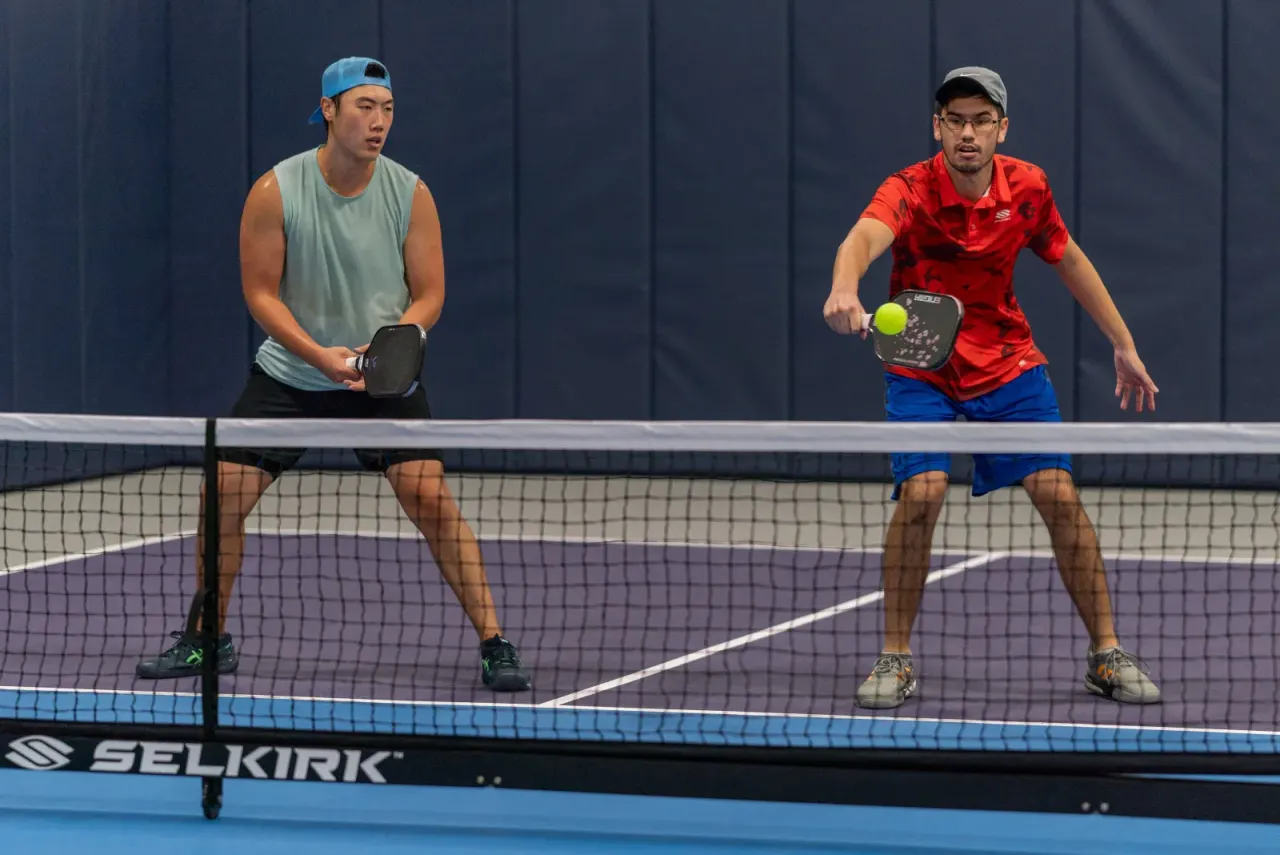
Win and you keep the court. Lose and you grab your paddle and head to the back of the line. That simple, high-stakes loop is what makes a challenge court the most addictive way to play pickleball — every game brings a new opponent, a fresh test, and the chance to prove you belong out there.
But that nonstop rotation only works when everyone knows how it runs. Below we break down how challenge courts are organized, the rules that keep games fair, and the strategies that will help you string together wins and stay on the court game after game.
What Is a Pickleball Challenge Court?
A challenge court is a court where play can continue at all times. You can find these courts at public courts, clubs, or pickleball events.
There are a lot of players that can fight against each other because of the unique format.
When two players challenge each other, the winner stays on the court while the challengers come in and out. This approach makes things more competitive and gives everyone a chance to show what they can do.
Challenge courts can look different, but the main idea behind them is to make a fun and competitive space where players can play against different people. They’re great for both new players who want to learn from more experienced ones and experienced players who want to get better by playing against a variety of opponents.
Common Pickleball Challenge Court Formats
Challenge courts can be set up in several different ways to suit different skill levels and keep the game interesting. Most of the time, these are the forms that are used:
Paddle Stack or “Next Up” System
The Paddle Stack system is one of the most popular ways to run a challenge court, especially in places where a lot of people go.
Game Mechanics:
When a player is ready to play, they put their paddles in a stack or rack. The players for the next game are shown by the next four paddles in line.
While the lost team has to put their paddles back in line after a game, the winning team can stay for another round.
- Advantage: This method is easy to understand and works well in busy places, letting players switch roles often.
- Disadvantage: People who want to play may have to wait for a few games, especially if the court is crazy busy.
Round Robin
The Round Robin format works well for tournaments or events where every player or team gets to play every other person or team.
Game Mechanics:
Every player in a pool plays against every other player in that pool. Points are earned by winning, losing, or following certain score rules.
In the end, the winner is the person or team with the most points.
- Advantage: Everyone is welcome, and there is plenty of time to play and a fair chance to fight.
- Disadvantage: This style takes more planning and time, so it’s not as good for casual or drop-in settings.
Winners Play
In this system, only the winners get to keep playing. The losers are replaced by a new group of challengers.
Game Mechanics:
People or teams that win a game stay on the court, and new challengers come in to take the place of the losers. A lot of the time, there is a limit, like three wins in a row, after which the winning team has to step down so that new people can join.
- Advantage: This setup keeps the excitement level high and makes sure there are always new opponents, so players can have a variety of experiences.
- Disadvantage: Players who win may still have to wait after hitting their limit for consecutive wins, depending on how many other players are waiting.
Key Rules of Pickleball Challenge Courts
There are special rules for challenge courts that are meant to make the games fair, fun, and interesting for everyone. Most of the time, these are the main rules that are followed:
1. Standard Game Rules Apply
On challenge courts, all normal pickleball rules apply, such as those for serving, scoring, mistakes, and the kitchen (non-volley zone). Most matches last 11 points, and the winner gets two points.
However, some courts may use different counting systems.
2. Rotational Play Rules
There are rules about how players can come and go from the court depending on the arrangement. In the Paddle Stack method, for example, teams that lose have to leave the court and put their paddles back in the stack.
Teams that win may get to play again.
3. Time Limits for Games
On some challenge courts, each game has a time limit, which is usually between 10 and 15 minutes. To keep games from going on too long, this is used.
This lets more people play in the time allotted.
4. Rules for Disputes
There may be arguments or disputes, especially when there is a lot of competition. A “gentlemen’s rule” says that teams should settle their differences peacefully.
This rule is used by many challenge courts. If players can’t agree on something, they can play the point again, or the challenge court organizer or judge, if they are available, can make the final decision.
5. Courtesy and Sportsmanship Rules
Challenge courts stress respect and good manners. Players must wait their time, be kind when they lose, and observe regulations that make the game fair for everyone.
Strategies for Succeeding on a Pickleball Challenge Court
Whether you’ve played challenge courts before or this is your first time, here are some tips to help you do well:
1. Play Smart, Not Hard
You need to be able to last as long as you can on a challenge court. Avoid using too much energy by playing smart instead of hard on every point.
Pay attention to placement, consistency, and care to get the upper hand on your opponents without wasting energy.
2. Observe and Learn from Others
While you’re waiting for your turn, watch how other people play. Pay attention to how they serve, return balls, and stand on the ground.
Examining the ways that possible opponents play can help you come up with good ways to beat them.
3. Communicate and Adapt Quickly
It’s important to talk to your partner when you’re playing doubles. Make sure your plans are clear, and be ready to change them quickly if things go wrong.
In challenge courts, you’ll often be playing against different people with different levels of skill, so it’s important to be able to adjust.
4. Practice the Basics Regularly
On a challenge court, you need to know how to serve, dink, and volley to play. Regular practice will make you more consistent and boost your confidence, which will let you handle a lot of different types of playing.
5. Keep a Positive Attitude
The point of challenging courts is to have fun and learn. Keep a good mood whether you win or lose.
Every game should be seen as a chance to learn and improve as a player.
Benefits of Playing on a Challenge Court
There are several good things about playing pickleball on a challenge court:
- It’s good for your game to play against a variety of opponents.
- Challenge courts are a great way to make new friends who love pickleball as much as you do.
- Testing your skills against other people over and over again builds your confidence and gets you ready for more serious competition.
- A challenge court is a fun and interesting way to stay healthy and busy.
Take on the Challenge and Level Up Your Game
Pickleball fans of all skill levels can enjoy a fun and active time on challenge courts. You can use them to show off your skills, meet new people, and play against each other in a friendly way.
Knowing challenge court rules, formats, and methods can help you enjoy every game, whether you’re a newbie or an expert looking to challenge yourself. Get your paddle, hit the court, and be ready for a battle.
To get yourself ready, get a membership and practice more of your skills. You can also read more of these articles to help you level up your pickleball game:
- Indoor Pickleball: The Ultimate Guide for Enthusiasts
- The Latest Pickleball Rules: Key Updates And Changes
- What Is Rally Scoring In Pickleball?
So, take on the challenge. Your next great game is waiting!