
The short version: stand behind the baseline on the correct side for your score, call the full score, then serve within 10 seconds. Serve diagonally so the ball clears the kitchen and its line and lands in the opposite service court. You can volley serve (underhand, contact below the waist, paddle head below the wrist, moving upward) or drop serve (let the ball bounce, then hit it any way you like). Spin is legal if the paddle puts it on, not your fingers.
All rule numbers below are from the 2026 USA Pickleball Official Rulebook. The 2026 edition renumbered everything, so the serving rules are now Section 7. Older articles that quote “Rule 4.A” are pointing at the 2025 book.
1. Where to stand (Rule 7.A)
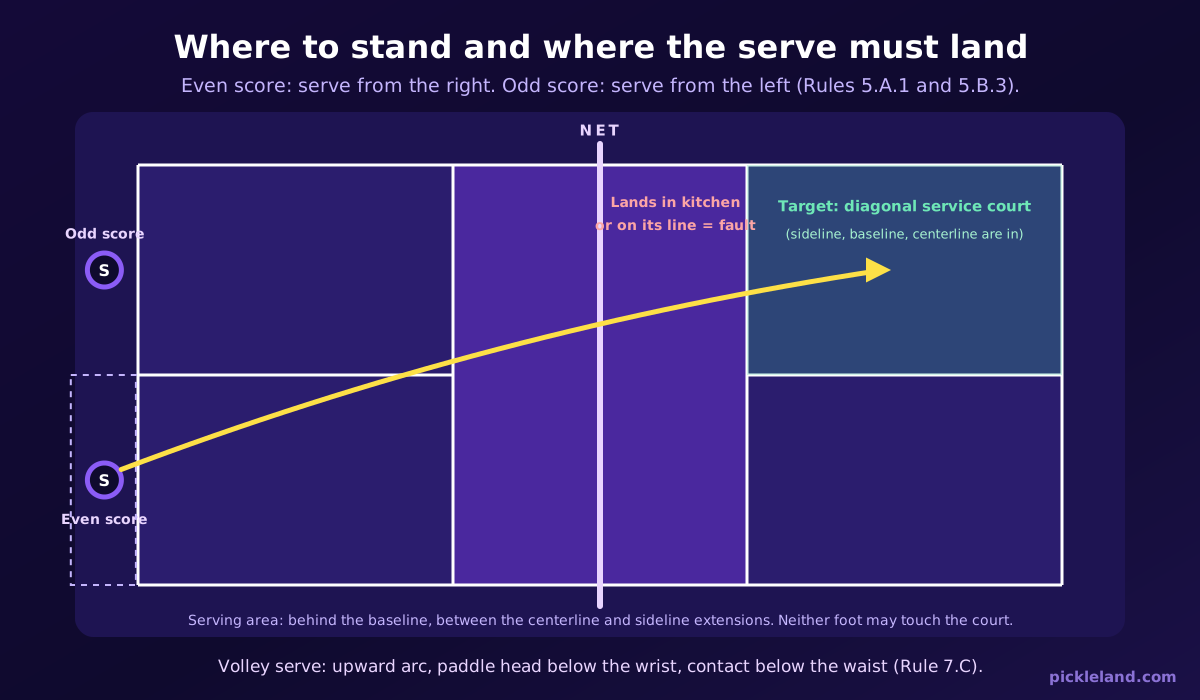
When you hit the serve:
- At least one foot must touch the ground in your serving area (7.A.1). A jump serve with both feet in the air is a fault.
- Neither foot may touch the court (7.A.2). The baseline is part of the court, so stepping on it is a foot fault.
- Neither foot may be outside the correct serving area (7.A.3). The serving area is behind the baseline, between the imaginary extensions of the centerline and the sideline (Rule 3.A.4.g).
Which side? It depends on your score. In singles, serve from the right when your score is zero or even, and from the left when it’s odd (Rule 5.A.1). In doubles, the player who started the game on the right is on the right when the team’s score is even (Rule 5.B.3).
Your opponents can call your service foot faults. It’s one of only two faults the rules let you call on the other team. The other is kitchen faults (Rule 9.B.3).
2. Before you serve: score call and the 10-second clock (Section 6)
- Call the whole score before you hit. Serving while the score is being called is a fault (6.C.1).
- Singles score is two numbers, yours then the receiver’s. Doubles is three: serving team, receiving team, server number. Every doubles game starts at “0–0–2” (Rule 6.B.2), because the first serving team only gets one server. More in how pickleball scoring works.
- You have 10 seconds after the score call ends to serve (6.D). Going over is a fault.
3. Releasing the ball (Rule 7.B)
- Release the ball with one hand or with the paddle only (7.B.1).
- No spin on the release. You may not spin or manipulate the ball as you let go of it, with your body or the paddle. The one exception is letting it roll off the paddle face by gravity. Spin from the paddle at contact is legal (7.B.2). If the receiver thinks you spun the release, they may call a replay before returning the serve (7.B.2.a).
- The release must be visible to the receiver. If they can’t see it, they may call a replay before returning (7.B.3).
4. The volley serve: three tests (Rule 7.C)
A volley serve is hit out of the air. In 2026 all three tests use the word “clearly,” which puts the burden on the server:
| Test | 2026 wording, simplified | Rule |
|---|---|---|
| Upward arc | The paddle must be moving in a clear upward arc at contact | 7.C.1 |
| Paddle head below wrist | The highest point of the paddle head must clearly not be above the highest part of your wrist joint | 7.C.2 |
| Below the waist | The ball must clearly be no higher than your waist at contact | 7.C.3 |
Forehand and backhand are both allowed (7.C.4). Break any of the three tests and it’s a fault (7.C.5). The 2025 rule asked for an upward arc of the arm. The 2026 rule puts it on the paddle, which is aimed at flat, side-arm “serves” that used to slip through. We cover that change in detail in 2026 rule changes.
5. The drop serve (Rule 7.D)
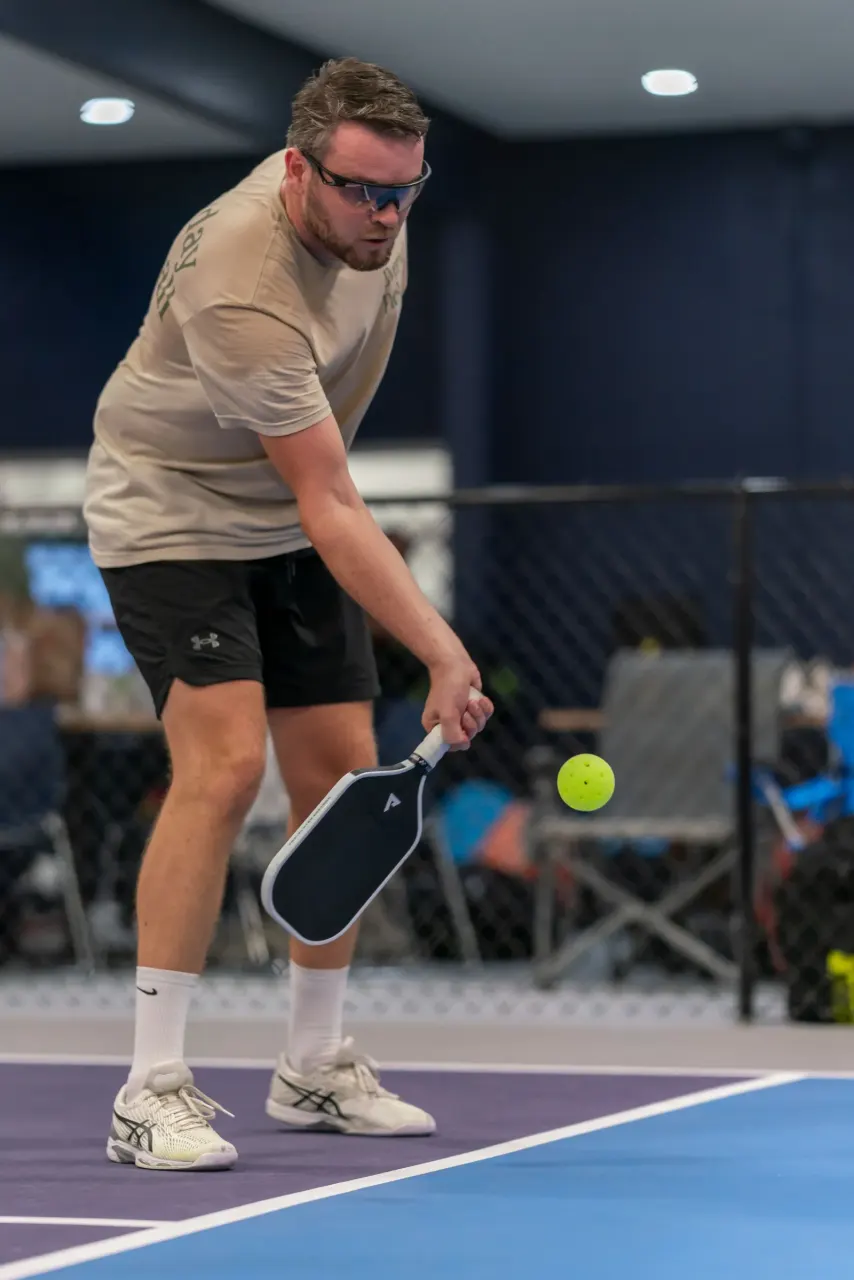
The drop serve is the easy way to avoid all three volley-serve tests. Drop the ball, let it bounce, and hit it. The only conditions:
- Drop it from a natural height (7.D.1). Don’t throw it up first.
- Don’t propel it. No tossing down or bouncing it hard (7.D.2).
- It can bounce any number of times, anywhere before you hit it (7.D.3, 7.D.4).
- Any stroke is legal after the bounce, forehand or backhand (7.D.5). The upward-arc, waist and wrist rules don’t apply.
If your volley serve keeps getting called, or you’re nervous about it in a refereed tournament, switch to the drop serve. Our drop serve rules guide goes deeper.
6. Where the serve must land (Rule 7.E)
Serve diagonally, to the service court opposite you. The ball must clear the kitchen, with or without touching the net, and land in that court. There are no lets on the serve. A ball that clips the net and lands in is in play.
| Where the serve lands | Ruling |
|---|---|
| In the diagonal service court | In |
| On the sideline, baseline or centerline of that court | In (those lines belong to the service court, Rule 3.A.4.f) |
| On the kitchen line | Out, fault on the server (Rule 8.C) |
| In the kitchen | Fault on the server (7.E.2) |
| Outside the correct service court | Fault on the server (7.E.1) |
| Hits a permanent object (ceiling, light) first | Fault on the server (7.E.3) |
| Hits the server’s partner | Fault on the server (7.E.4) |
| Hits the receiver or their partner before landing | Fault on the receiver (7.E.5) |
| Touches the net post or net support system | Fault on the server (13.B.1) |
7. After the serve
The receiver must let the serve bounce. The serving team must let the return bounce. That’s the two-bounce rule, and it’s why a serve that “looks catchable” still has to be left alone.
Serve faults: the full checklist
- Serving before the score call is finished (6.C.1)
- Taking more than 10 seconds after the score call (6.D.1)
- Both feet off the ground at contact (7.A.1.a)
- A foot touching the court, including the baseline (7.A.2.a)
- A foot outside the serving area’s sideline or centerline extension (7.A.3.a)
- Volley serve without a clear upward arc of the paddle (7.C.1)
- Volley serve with the paddle head above the wrist (7.C.2)
- Volley serve with contact above the waist (7.C.3)
- Drop serve released from an unnatural height (7.D.1)
- Drop serve that is thrown, tossed or bounced on purpose (7.D.2)
- Serve lands outside the correct service court (7.E.1)
- Serve lands in the kitchen or on the kitchen line (7.E.2, 8.C)
- Serve hits a permanent object before landing (7.E.3)
- Serve hits the server or the server’s partner (7.E.4)
- Serve touches the net support system (13.B.1)
Spin added on the release and a hidden release are replays, not faults, and only if the receiver calls them before returning.
Frequently Asked Questions
Do you have to serve underhand in pickleball?
For a volley serve, yes, in effect: the paddle must move upward, contact must be below your waist and the paddle head below your wrist. With a drop serve, none of those apply after the bounce. See can you serve overhand.
Can a pickleball serve hit the net?
Yes. Since lets were removed, a serve that touches the net and lands in the correct service court is in play. If it lands in the kitchen or out, it’s a fault.
Is the kitchen line in or out on a serve?
Out. A serve landing on the non-volley zone line is out (Rule 8.C). The sideline, baseline and centerline of the service court are in.
Can you put spin on a pickleball serve?
Yes, with the paddle at contact. You may not spin the ball with your hand or paddle as you release it (Rule 7.B.2).
How many serves do you get in pickleball?
One. There is no second serve if you miss. In doubles, each player on the serving team serves until they lose a rally, except at the start of each game, when only one player serves before the side out.
What is the 10-second rule in pickleball?
After the score is called, the server has 10 seconds to serve (Rule 6.D). If they take longer, it’s a fault.