

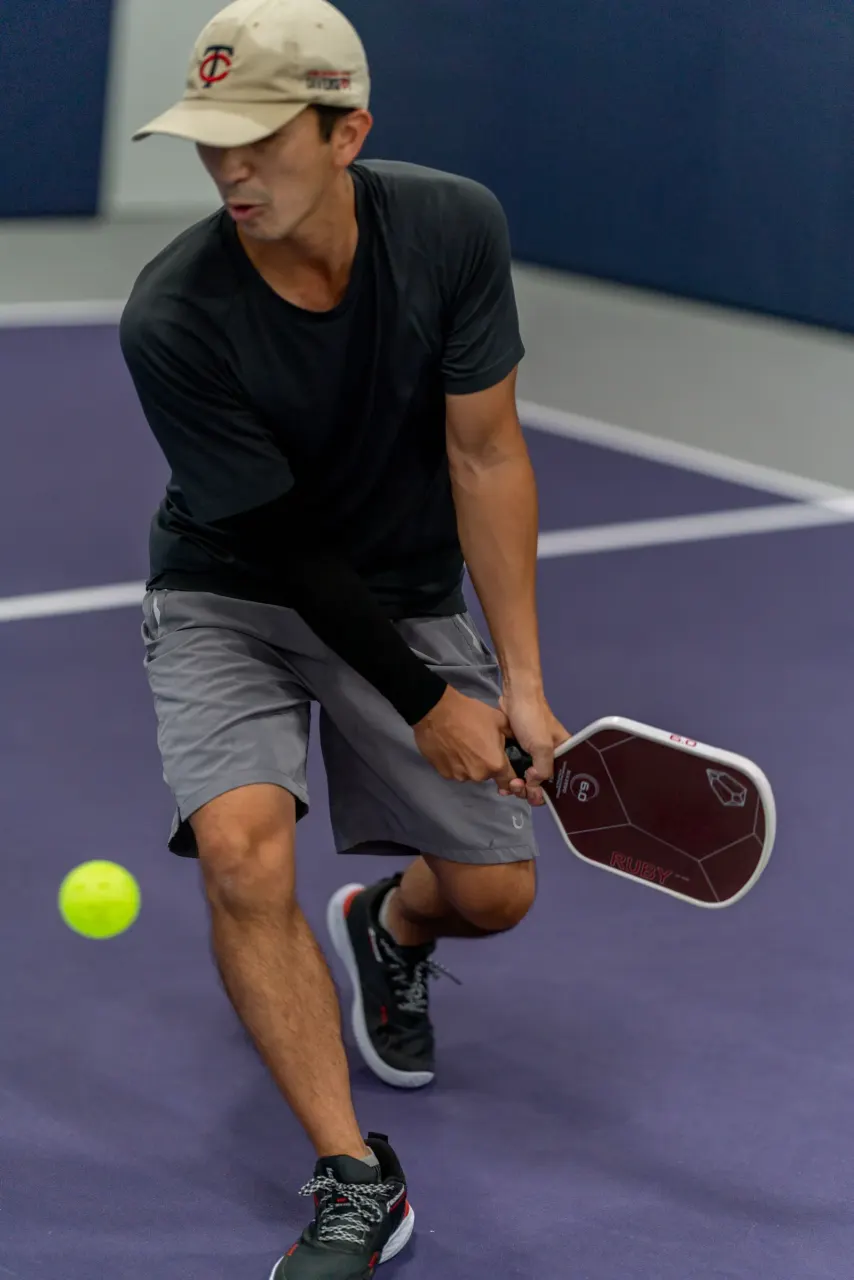
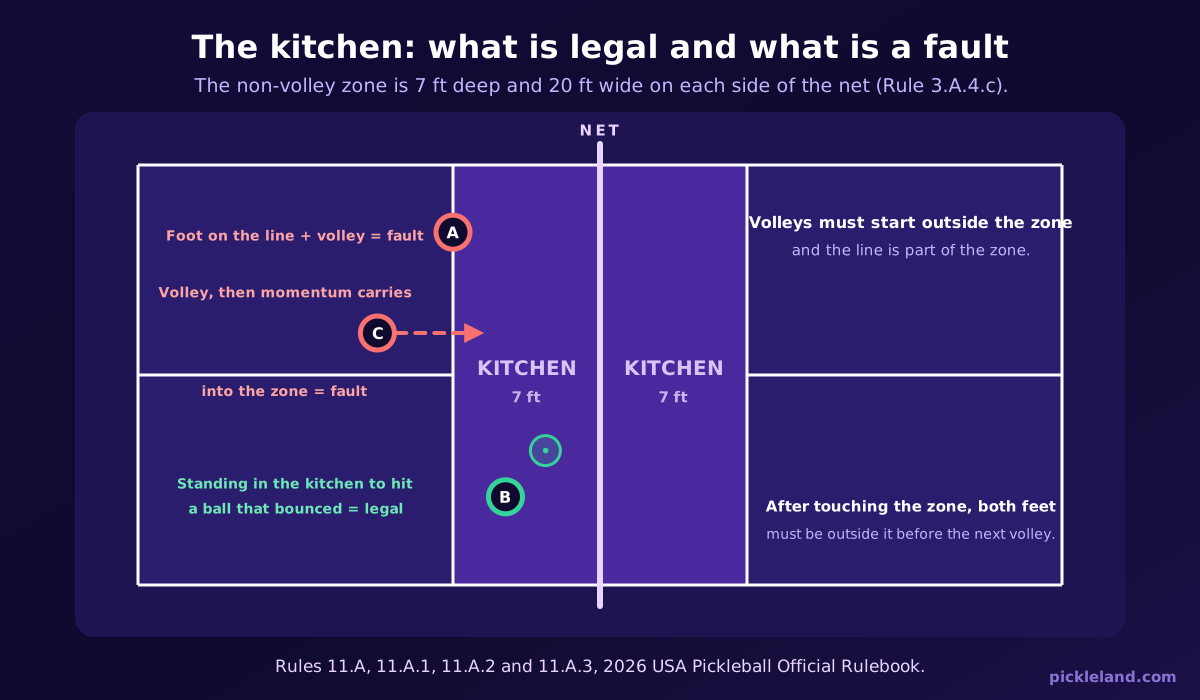
The kitchen rule in one sentence: you may not volley (hit the ball out of the air) while touching the kitchen or its line, and your momentum from a volley may not carry you into it afterward. You can stand in the kitchen whenever you like, and you can hit any ball that has bounced from inside it.
The kitchen’s official name is the non-volley zone (NVZ). Everything below comes from the 2026 USA Pickleball Official Rulebook, which renumbered its rules this year. The kitchen faults now live in Section 11.
Source: Dimensions from 2026 USA Pickleball rulebook Rules 3.A.1 and 3.A.4.c; area and share calculated by Pickleland (2 × 140 of 880 sq ft)
What the kitchen is
The non-volley zone is the 7-foot by 20-foot area on each side of the net (Rule 3.A.4.c). Three details in that rule settle most arguments:
- The lines are part of the zone. “All lines that bound the non-volley zone are part of the zone.” A toe on the kitchen line is a toe in the kitchen.
- It’s flat. The zone “is two-dimensional and does not extend above the playing surface.” You may reach your paddle over the kitchen to volley, as long as nothing touching you is touching the zone.
- It exists on both ends of the net, and the same rules apply in singles and doubles.
Two kitchens of 140 square feet each make up 280 of the court’s 880 square feet. Nearly a third of the court is a place where you can’t volley.
The four kitchen rules
| Rule (2026) | What it says, in plain words | Fault against |
|---|---|---|
| 11.A | Every volley must start outside the kitchen. You may touch the kitchen any other time. | – |
| 11.A.1 | If you, or anything touching you, touches the kitchen while you volley, it’s a fault. That includes your paddle, a hat that falls, and your partner if you’re touching them. | The volleying player |
| 11.A.2 | If momentum from your volley makes you touch anything that’s touching the kitchen, it’s a fault, even after the ball is dead. | The volleying player |
| 11.A.3 | After you touch the kitchen, both feet must be back on the court completely outside it before you volley again. | The volleying player |
The rulebook defines the act of volleying as starting when you hit the ball out of the air and ending “when the player’s movement from the follow-through action (i.e., momentum) stops.” That’s why a volley at the line that ends with a stumble into the kitchen two seconds later is still a fault, even though the rally is already over.
What is legal in the kitchen
The kitchen rule is about volleys only. All of these are legal:
- Standing in the kitchen while the ball is on the other side.
- Hitting a ball that has bounced while you’re standing in the kitchen. That’s what a dink is.
- Walking through the kitchen to get to a short ball.
- Reaching over the kitchen to volley, if your feet and everything else touching you stay out.
- Jumping from outside the kitchen and volleying in the air, as long as you land outside it. If you land on the line or in the zone, it’s a fault (11.A.2).
- The Erne. You may jump or run around the outside of the kitchen and volley from beside it. See what an Erne is.
Kitchen faults players argue about
“My paddle touched the kitchen after I volleyed.” Fault. Rule 11.A.1 covers anything in contact with the volleying player, and the act of volleying lasts through the follow-through.
“I volleyed, then my partner grabbed me, and my partner was in the kitchen.” Fault. 11.A.1 and 11.A.2 both mention the partner.
“I stepped out of the kitchen with one foot and volleyed.” Fault. 11.A.3 requires both feet to be fully outside the zone.
“The ball was dead before I stepped in.” Doesn’t matter if the step came from your volley’s momentum (11.A.2). Faults normally only happen while the ball is live. Kitchen momentum is the stated exception (Rule 9.B.1).
“Who calls kitchen faults when there’s no referee?” Players may call kitchen faults and service foot faults on an opponent. These are the only faults you can call on the other team (Rule 9.B.3). If the teams disagree, the rally is replayed (9.B.3.b). If you and your partner disagree, the call goes to your opponents’ benefit (9.B.3.c). Players should also call their own faults (9.B.2).
“Is a serve that lands on the kitchen line in?” No. That’s a serve rule, not a kitchen-volley rule, but it trips people up. A served ball landing on the kitchen line is out (Rule 8.C). After the serve, a ball landing on the kitchen line is in. See serve rules.
Why the kitchen exists
Without a non-volley zone, the best strategy would be to stand on top of the net and smash everything. The kitchen pushes the volleying player back 7 feet, which turns the net exchange into the soft game: dinks, resets and the speed-ups that come out of them. It’s also why pickleball works for players who can’t overpower opponents. Touch and patience win points.
How to stay out of kitchen trouble
- Set up a few inches behind the line. Toes on the line invites a foot fault on every volley. Even six inches gives your momentum somewhere to go.
- Keep your weight forward but balanced. Most kitchen faults come from leaning over to reach a low volley. If you can’t reach it without stepping in, let it bounce.
- After stepping in for a dink, step back out. You can’t volley again until both feet are outside (11.A.3). Get into the habit of resetting after every shot you hit from the kitchen.
- Watch the speed-up from inside the kitchen. If you dink from inside the kitchen and your opponent attacks, you’re stuck. You must let it bounce or get both feet out before you volley it.
- Practise with a line partner. Ask a friend to call your feet for ten minutes of dinking. Most players are surprised how often they’re on the line.
Frequently Asked Questions
Can you step in the kitchen in pickleball?
Yes. You can stand in the kitchen at any time. The only restriction is volleying: you can’t hit a ball out of the air while touching the kitchen or its line.
Is the kitchen line part of the kitchen?
Yes. Rule 3.A.4.c says all lines bounding the non-volley zone are part of the zone. A foot on the line while volleying is a fault.
Can you hit a bounced ball in the kitchen?
Yes. The kitchen only restricts volleys. Standing in the kitchen and hitting a ball after it bounces is legal and is the basis of dinking.
How big is the kitchen in pickleball?
7 feet deep and 20 feet wide on each side of the net, or 140 square feet each. The two kitchens make up 31.8% of the 20 × 44-foot court.
Can you volley if your paddle is over the kitchen?
Yes. The kitchen is two-dimensional and doesn’t extend into the air. What matters is whether you, or anything touching you, is touching the zone.
What happens if your momentum carries you into the kitchen after a volley?
It’s a fault, even if the ball is already dead (Rule 11.A.2). The act of volleying lasts until you regain balance and control.