
You can serve well, drive hard, and land a clean third-shot drop — but if you can’t dink, you’ll lose to anyone who can. The dink is pickleball’s defining shot: the primary weapon in the kitchen exchange that decides most points at every level from recreational to competitive. And it’s one of the few shots where patience and precision, not power, determine who wins the rally.
This guide breaks down everything that makes a dink work — grip, stance, contact mechanics, strategic decisions, and the mistakes that quietly cost points — so you can build a consistent kitchen game as fast as possible.
What Is a Dink?
A dink is a soft, controlled shot hit from the non-volley zone (the “kitchen”) — or just behind the kitchen line — that clears the net by a small margin and drops into the opponent’s kitchen. The ball travels in a gentle arc, stays low, and lands in the non-volley zone on the other side, preventing your opponents from attacking aggressively.
The goal of dinking is not to win the point outright. It’s to keep the ball in play at a height and pace where your opponents can’t attack — until they make an error, or pop the ball up high enough for you to put it away. Dinking is attrition, not attack.
Why Dinking Matters
In pickleball, most points are decided at the net in the kitchen exchange. Once both teams settle at the non-volley line, dinking is the primary tool for:
- Forcing an unforced error from your opponent (tired arms, rushed shots, loss of patience)
- Creating a “speed-up” opportunity when you draw a high ball from a well-placed dink
- Controlling pace and position, wearing down opponents who are eager to attack
Players who avoid dinking — always driving or attacking — give their opponents easy chances to block and reset. The shift from “I’ll blast my way through the kitchen” to “I’ll out-patient my opponent” is the single biggest leap most 2.5–3.5 players can make.
Grip and Paddle Angle
Your grip for dinking should be lighter than you think. Most coaches recommend a 3 or 4 out of 10 in grip pressure — think “holding a baby bird,” not a tennis racket on match point. Squeezing tight kills feel and makes you pop the ball.
Paddle Face Angle
The paddle face should be slightly open — tilted back a few degrees from vertical — so the ball lifts gently over the net with a small natural arc. Too closed and the ball dives into the net; too open and you’ve hit a lob.
Use a continental or semi-western grip. Don’t switch grips between forehand and backhand dinks — in a fast kitchen exchange, you don’t have time, and the continental grip handles both comfortably.
Stance, Balance, and Body Position
The right stance makes the difference between a clean dink and a forced pop-up.
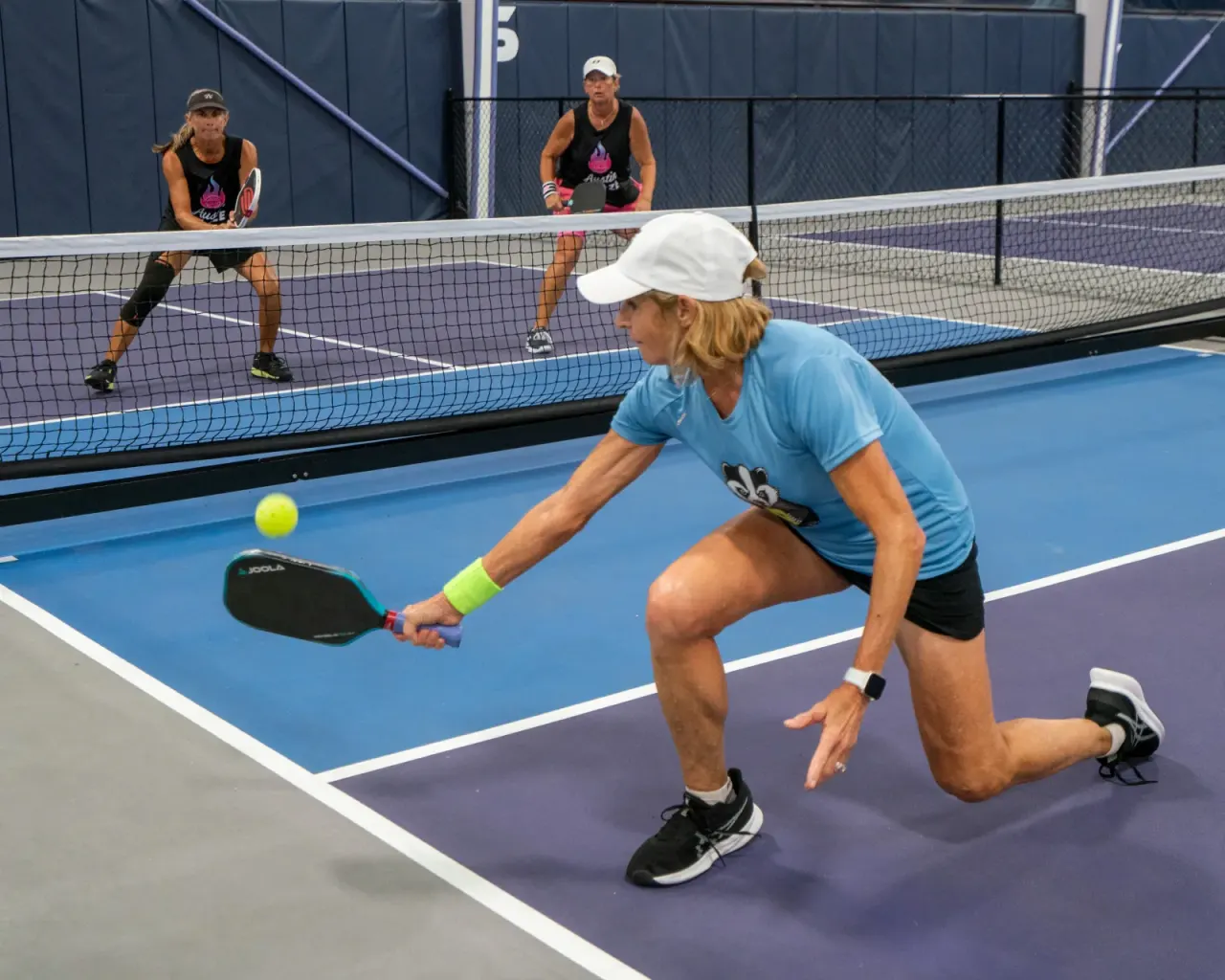
- Athletic ready position: Knees bent, weight on the balls of your feet, paddle up in front of you at roughly waist height.
- Get low: Bending at the hips while staying upright produces inconsistent contact angles. Bend your knees and sink your center of gravity — bring your paddle to the ball, not your torso.
- Feet shoulder-width apart, roughly square to the kitchen. If you’re reaching for a wide ball, step into it rather than leaning.
- Split-step: As your opponent’s paddle makes contact, do a small hop so you’re balanced and ready to move either direction when the ball arrives.
Contact Point and Swing Mechanics
The dink stroke is a small pendulum push — not a full swing, and not a punch. Here’s the sequence:
- Backswing: Minimal. The paddle shouldn’t go past your hip on the backswing.
- Contact: In front of your body, not beside or behind you. If the ball gets behind you, you lose control of the angle.
- Follow-through: Forward and slightly upward, ending at about waist height. The follow-through drives the ball’s arc, not the swing speed.
No wrist snap. Keep your wrist relatively firm through contact. Most players who pop dinks up or spray them wide are flicking the wrist unconsciously. The lift comes from the paddle angle and the upward follow-through, not from wrist action.
Dinking Strategy: Where to Put the Ball
Technique gets the ball over the net; strategy decides whether you’re building a winning rally or just exchanging shots. These are the placement principles that separate good dinkers from great ones.
Cross-Court vs. Down-the-Line
Cross-court dinks are the bread and butter. The diagonal flight path gives you a longer distance over the net — more clearance — and a wider target in the opponent’s kitchen. Default to cross-court when building a rally.
Down-the-line dinks are sharper angles that can pull an opponent out of position, especially if they’ve drifted toward the center. Use them as change-ups, not as your default.
Target the Backhand
Most players have a weaker backhand dink. Persistent dinking to the backhand forces a lower-quality return — often a ball that rises above net height, which you can then speed up with a volley. Make your opponent’s weaker side work overtime in a rally.
Move Them — Don’t Dink to One Spot
Repetitive dinking to the same location lets your opponent get comfortable and well-positioned. Move your opponent side-to-side: wide to the forehand, then cross-court to the backhand, then back. Each step they take is a chance to draw an off-balance shot.
The Dink-and-Attack Setup
A well-placed dink that rises above net height becomes attackable. Read the arc of your opponent’s shot as it leaves their paddle — if it’s coming at you above the net tape, step back slightly, load your weight, and drive the ball to their feet or body. That’s the dink-and-attack sequence: patient dinking until you draw a high ball, then pounce.
Common Dinking Mistakes (and How to Fix Them)
1. Hitting Too High
The ball floats above net height — a slow lob your opponent can put away. Usually caused by too much upward follow-through, a too-open paddle face, or a flicked wrist. Fix: Shorten the follow-through and keep the paddle face less open. Think “place it over the net,” not “lift it.”
2. Hitting Into the Net
Usually from a closed paddle face or making contact behind your body. When the ball gets past your ideal contact zone, the paddle angles downward. Fix: Move your feet early so you’re contacting the ball in front of your hips, and keep a slightly open paddle face.
3. Standing Too Upright
Dinking while standing tall forces you to reach down for the ball, which changes your swing plane and produces inconsistent contact. Fix: Bend your knees before the ball arrives and stay low throughout the exchange. Your thighs do the work, not your back.
4. Over-Gripping the Paddle
A tight grip kills touch and transmits every micro-twitch in your hand into the ball’s direction. Fix: Consciously loosen your grip before each rally starts. If you’re losing control of placement, grip pressure is often the culprit.
5. Dinking to One Spot
Predictable placement gives your opponent time to get comfortable and ready to attack. Fix: Vary your targets every 2–3 shots. Backhand corner, forehand corner, middle body — keep them guessing.
6. Attacking Low Balls
New players try to speed up every ball, including balls below net height. Driving a low ball almost always goes into the net or pops up for an easy counter. Fix: The hard rule — only attack balls that arrive above the net tape. Everything at or below net height gets dunk’d back softly.
Dinking Drills to Build Consistency
Cross-Court Dink Rally
You and a partner stand diagonally opposite at the kitchen line and maintain a cross-court dink rally. Target: 50 consecutive dinks without error. Focus entirely on consistency — no speedups, no variety, just clean contact and placement. This is the foundational drill every pickleball coach assigns, and for good reason.
Down-the-Line Challenge
Switch to straight-ahead dinks. The shorter flight path and smaller target margin make this drill harder, which is the point. 20 consecutive dinks straight ahead, then 20 cross-court, then alternate. Builds precision under different angles.
Target Dinking
Place a cone or water bottle in the backhand corner of the opponent’s kitchen. Hit 10 dinks aimed at it from the forehand side, then 10 from the backhand side. Switch targets to the forehand corner. The visual target trains your brain to aim, not just clear the net.
Dink Rally with One Speed-Up
Same as the cross-court dink rally, but either player can call “now” before their shot and speed it up once per point. The other player defends, resets, and the rally continues. Teaches you to dink patiently while staying alert for attack opportunities.
For a full set of structured drills covering dinking, fast hands, and serving, see our complete pickleball drills guide.
When to Attack vs. Stay in the Exchange
The most critical decision in a kitchen exchange: keep dinking or go for it?
The rule of thumb: only attack balls that arrive above the net tape. A ball below the tape that you try to drive will travel downward into the net — or pop up into your opponent’s sweet spot. If the ball is below the tape, dink it back softly.
Signs a ball is genuinely attackable:
- The ball is coming at you at or above net height
- Your opponent is off-balance, moving, or positioned wide
- The ball is in the middle of your opponent’s body (a body shot is hard to handle)
The players who win dink exchanges are almost never the ones who forced the earliest attack. They’re the ones who were patient enough to draw the high ball first. For a deeper look at how the dink fits into the third-shot sequence, check out our third-shot drop guide.
Frequently Asked Questions
What is the difference between a dink and a drop shot?
A drop shot (like the third-shot drop) is hit from mid-court or the baseline to land in the kitchen — it’s a transitional shot used to move forward. A dink is hit from at or near the kitchen line in an ongoing kitchen exchange. Both require soft touch and aim at the opponent’s kitchen, but they’re used at different stages of the point.
How do I stop popping the ball up when I dink?
The usual culprits are: wrist flip, too-open paddle face, or contact behind your body. Loosen your grip (3–4 out of 10), keep the wrist firm through contact, open the paddle face slightly less, and ensure you’re hitting the ball out in front of your hips. Record yourself from the side — you’ll usually spot the problem immediately.
Should I dink on my forehand or backhand?
Both — and you should be equally comfortable with each. Most players’ forehands are naturally more powerful, but in kitchen exchanges, the backhand dink is often more consistent because the stroke is compact and directly in front of the body. Don’t avoid your backhand; train it deliberately so it doesn’t become the hole in your game.
What is a speed-up in pickleball?
A speed-up is when a player suddenly drives the ball hard — usually from a dink-rally position — to catch the opponent flat-footed. It turns a slow exchange into a fast one. Speed-ups are most effective when the ball is above net height and your opponent is settled in a rhythm. Done on a low ball, they almost always backfire.
How long does it take to get good at dinking?
With deliberate practice — not just open-play rallying — most players see meaningful improvement in 2–4 weeks. The cross-court dink rally drill (50 consecutive shots without error) is a reliable benchmark. When you can hit 50 consistently, your technique is fundamentally sound. The strategic layer — when to attack, where to place the ball — develops over months of match play.
Is there a kitchen rule that affects dinking?
Yes — and it’s one of the most commonly violated rules for new players. You cannot volley (hit the ball out of the air) while standing in the kitchen, or while your momentum carries you into it after a volley. If you’re dinking, you must let the ball bounce inside the kitchen before stepping in to play it, OR you can step in after the ball has bounced. See our complete kitchen rules guide for the full breakdown.
Work on Your Dink Game at Pickleland
The dink is learnable — it’s touch and positioning, not raw athletic talent. But it does require deliberate repetition on a real court, ideally with a partner or coach watching your mechanics.
At Pickleland, our 9 indoor climate-controlled courts in Pflugerville are purpose-built for the kind of focused drilling that builds a kitchen game. Our pro coaches — including Kasia Carr (DUPR 4.9, Selkirk-sponsored) and Coach Katie (DUPR 4.7) — run clinics and private lessons designed to compress weeks of trial-and-error into a few sessions. DUPR-sorted open play means you’re always competing against players at your level, so every rally is useful practice.
Book a clinic, schedule a private lesson, or rent a court to drill with your own group. If you’re coming regularly, a Pickleland membership gives you free morning drills, unlimited open play, and 7-day priority booking — everything you need to get your dink game where you want it.