

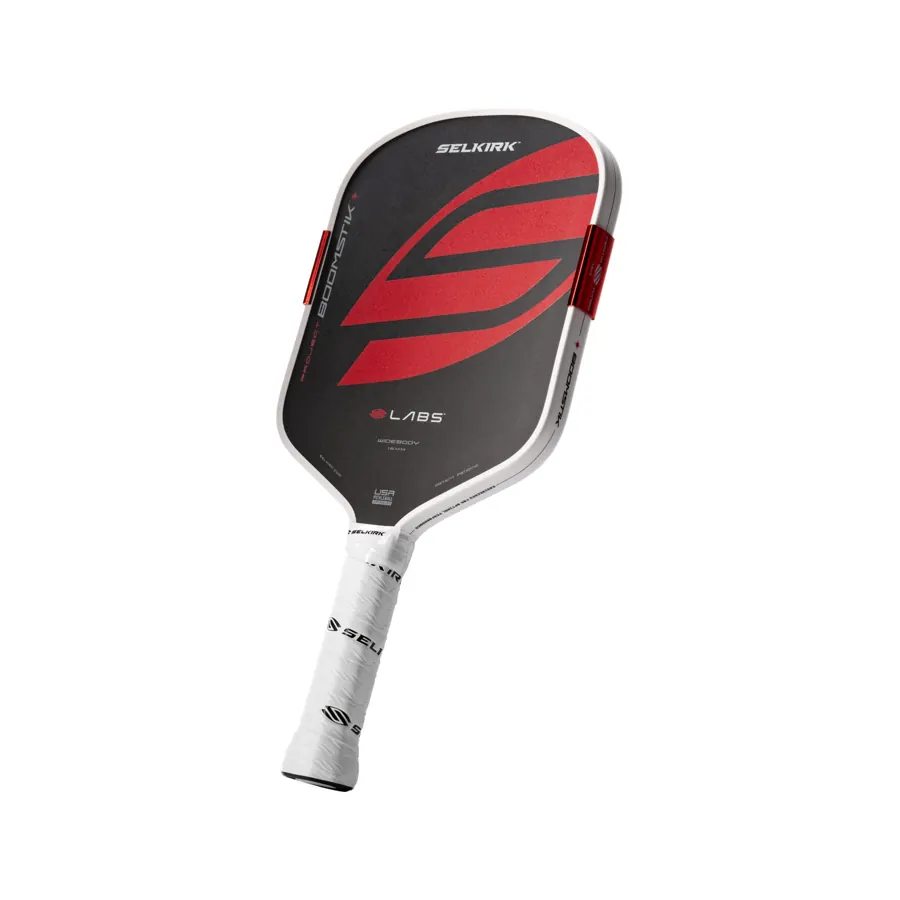
The Selkirk LABS Project Boomstik launched in August 2025 as Selkirk’s all-foam power paddle, and it has been on almost every “best power paddle” list since. We haven’t put it through a lab ourselves. What we did was read the people who have, line up their measurements, and note where they agree and where they don’t. Five independent testers are covered here, and two of them published instrument data.
The verdict
Buy it if you already have a dependable soft game and want a paddle that ends points: drives, counters and overheads that come off the face with very little effort. Every tester we read put its power near the top of the market, and most called the sweet spot one of the largest in its class.
Skip it if your drops and resets are still a work in progress, you like a soft, quiet, muted feel, or you want to tune the paddle’s weighting yourself. The weights come pre-installed and Selkirk says removing them can damage them.
Which shape: the widebody is the forgiving, quicker-handling version, and the elongated trades some of that for reach and even more power. More on that below.
Specs
Source: Selkirk spec sheet, selkirk.com
Selkirk calls the core BoomCore: a foam center ringed by an EVA “power ring” and fused together, which it says has no break-in period and no core crush. The face is three layers of T700 carbon fibre with Selkirk’s InfiniGrit texture. Handles are 5.6 inches on the widebody and 5.8 inches on the elongated. Two weight clips are clamped to the edge guard at the factory; Selkirk calls this the MOI Tuning System and describes it as semi-permanent (Selkirk).
Lab numbers
Pickleball Effect runs every paddle it reviews through the same instruments: a Briffidi SW1 for swingweight and twistweight, and a radar gun for serve speed, punch-volley speed and spin (method). Its percentiles compare each paddle against roughly 300 scored paddles in its database.
The dark tick on each bar is the average for that paddle shape in Pickleball Effect's database. Higher swingweight adds plow-through and power but slows your hands at the kitchen; higher twistweight means more stability on off-center hits.
Source: Pickleball Effect paddle database (widebody and elongated pages), 2025-2026; averages from the same database, checked October 2026
Percentiles rank the paddle against the roughly 300 paddles Pickleball Effect has scored, so the tick at 50 is the median paddle.
Source: Pickleball Effect paddle database; percentiles vs. about 300 scored paddles; averages from the same database, checked October 2026
For context, the average swingweight across Pickleball Effect’s whole database is 114.2 and the average twistweight is 6.39. So the widebody swings like a typical paddle while resisting twist far better than most, and the elongated is noticeably heavier through the swing (widebody, elongated).
Different labs land in the same neighbourhood, which is a good sign the numbers are real:
| Selkirk spec | Pickleball Effect | Pickleball Studio | |
|---|---|---|---|
| Swingweight, widebody | 112 ± 2 | 113 | 113 |
| Swingweight, elongated | 118 ± 2 | 121 | 118 |
| Twistweight, widebody | 8.2 ± 0.3 | 7.72 | 8.21 |
| Twistweight, elongated | 7.2 ± 0.3 | 6.92 | 6.91 |
| Static weight, widebody | 8.0-8.4 oz | 8.3 oz | 8.49 oz |
| Static weight, elongated | 8.0-8.3 oz | 8.4 oz | 8.27 oz |
| Spin, widebody | Not published | 1,980 rpm | 2,026 rpm |
| Spin, elongated | Not published | 1,989 rpm | 2,041 rpm |
Sources: Selkirk, Pickleball Effect, Pickleball Studio. Each lab uses its own rig, so compare numbers within a column rather than across columns.
Pickleball Studio also weighed what the clips do: with them removed, it measured swingweight falling to 107 on the elongated and 102 on the widebody, and it counted the two clips at 7.5 grams each (Pickleball Studio).
What the testers found
Power
This is the one point of total agreement. Pickleball Effect’s Braydon Unsicker put the Boomstik among the strongest power paddles in his database and said pace comes easily, though you have to swing with intent to get all of it (Pickleball Effect). Chris Olson at Pickleball Studio found it hit harder than the JOOLA Pro IV and called serves and drives effortless. Pickleheads gave power a 10 out of 10, and WearTesters wrote that the paddle “lives up to its name” on groundstrokes and volleys (WearTesters).
Control and touch
Here the testers split, and the split tracks skill level. Pickleheads’ Stephen Mijangos, a 5.0 player, found dinks, drops and resets hard to keep low because of how much pop the 16mm face has, and scored control 8 out of 10 (Pickleheads). Pickleball Effect said resets under pressure were easy, while touch shots needed more precision because the ball leaves the face hot. Pickleball Studio called the soft game predictable but harder below roughly a 4.5 level. WearTesters was the most positive, saying it was more controllable than expected against evenly matched players, while noting some high pop-ups when under attack.
The reading across all four: the Boomstik is controllable if your hands are already good. It does not hand you touch you don’t have.
Spin
Spin is good, not class-leading. Pickleball Effect measured about 1,980 rpm and said the paddle played spinnier on court than that number suggests. Pickleheads scored spin 10 out of 10 and credited the InfiniGrit texture. Pickleball Studio’s readings were a little higher, at 2,026 rpm (widebody) and 2,041 rpm (elongated). For what those numbers mean in practice, see our spin explainer.
Forgiveness and sweet spot
Testers rate this as one of the most forgiving power paddles available. Pickleball Effect called its sweet spot one of the biggest in the power category, and gave the series a 99% forgiveness rating. Pickleball Studio said mishits kept their stability and power. Pickleheads agreed the sweet spot was large, especially on the widebody, and highlighted the widebody’s high twistweight. The trade-off, which Pickleball Effect points out, is maneuverability: the perimeter weight that makes it stable also makes it slower in fast hand battles.
Feel and sound
Everyone describes a stiff, crisp, hollow-sounding hit, closer to an older carbon “Gen 3” paddle than to the soft, dense foam paddles that came before it. Pickleball Studio called it the stiffest foam core it had tested that year. WearTesters said the hollow feel took some getting used to. If you want a quiet, muted paddle, this isn’t it.
Durability
The core is the reassuring part. Pickleball Effect saw no break-in drift after 10 hours of play, and Selkirk covers the paddle with a limited lifetime warranty for original US buyers (Selkirk).
The edge guard is the open question. Pickleball Effect noted early player reports of the edge guard lifting where the weight clips sit, though its own paddle was fine. Pickleball Studio had it happen on one test unit after a few sessions; Selkirk told the reviewer it was an early-production issue, which the reviewer couldn’t confirm. Selkirk’s warranty language explicitly lists edge guard looseness and cracking among covered defects. On the face, Pickleball Effect rates InfiniGrit at its Tier 3 for grit durability: longer-lasting than plain raw carbon, short of the best textures it has tested.
Reviewer consensus
| Reviewer | Verdict | Standout | Knock |
|---|---|---|---|
| Pickleball Effect | 4.9 overall; top-tier power paddle | 98th-percentile firepower (elongated), huge sweet spot | Touch shots need precision; loud, stiff feel |
| Pickleball Studio | 7/10 | Hits harder than a JOOLA Pro IV; stable on mishits | Edge guard loosened on one unit; weights hard to remove |
| Pickleheads | 4.5/5 | Power and spin both scored 10/10 | Drops and resets hard to keep low; expensive |
| WearTesters | 9.5/10 | More control than expected for its power | Hollow feel; some pop-ups under attack |
| The Dink | Widebody for most rec players | Widebody swings lighter and is more stable | Elongated asks more of you |
Pickleball Effect disclosed that Selkirk sent its test paddles. Ratings are each outlet's own scale.
Pickleball Effect summed it up this way: the Boomstik is “built to win points, not just fill shelves.” Pickleball Studio’s 7/10 is the outlier, and its write-up explains why: the reviewer loved the power and the widebody’s sweet spot, but wasn’t sure he could control it in high-pressure tournament play and docked it for the edge-guard scare.
Widebody vs. elongated
Both shapes share the same core, face, thickness and weight system. What changes is where the mass sits.
- Widebody (15.95 × 8 in, 5.6 in handle). Lower swingweight and much higher twistweight in every lab. Pickleball Studio found it quicker in hand and better on defence, with a larger sweet spot and less reach. The Dink’s Alex Weaver recommends it for most recreational players and compares the two shapes to a Range Rover versus a Ferrari (The Dink).
- Elongated (16.5 × 7.45 in, 5.8 in handle). More reach and the most power: Pickleball Effect ranks its firepower in the 98th percentile versus the widebody’s 92nd. It is also heavier through the swing and less forgiving toward the tip and throat, and Pickleball Effect notes that the heavier swingweight makes quick net exchanges harder.
Rule of thumb from the testers: if you play mostly doubles at the kitchen line and value hand speed and stability, the widebody. If you want reach, play singles, or use a two-handed backhand and want the longer handle, the elongated. Our paddle weight guide explains why swingweight matters more than static weight here.
For tournaments, Selkirk notes it offers a UPA-approved elongated version without the weight clips for eligible US PPA events, by request (Selkirk).
Try it before you buy
All paddle sales at Pickleland are final, so we’d rather you hit with it first. Both Boomstik shapes are in the demo rack at the front desk: a demo rental is $8, and you can take it into open play or onto a court you’ve booked. If you want to compare it with other paddles in one go, our Paddle Demo Day is a coached drill session where you rotate through demo paddles, and the demo fee is credited if you buy a paddle that day.
See how demos work on the paddle demo page, or browse the full wall in the paddle shop. Pickup at the club in Pflugerville is free, and we deliver locally within 10 miles. We don’t ship beyond that.
Still deciding between power and all-court? Read our Selkirk Omni review, which compares the two directly, and our best pickleball paddles roundup, where the Boomstik is our power pick.
FAQ
Is the Selkirk Boomstik worth it?
For an intermediate-to-advanced player who wants maximum power with a forgiving face, the testers mostly say yes: three of the four outlets that gave a score rated it highly, and every review we read praised the power and the sweet spot. It’s harder to justify if your soft game isn’t there yet, because the extra pop makes drops and dinks harder to keep down. Pickleball Studio, the most cautious reviewer, suggested its value depends on whether the materials hold up over time.
How long does a Selkirk Boomstik last?
No reviewer has published long-term wear data yet. What we know: the all-foam core is designed not to crush, Pickleball Effect saw no break-in drift over 10 hours, and Selkirk backs it with a limited lifetime warranty for original US buyers that covers defects like face cracks and edge-guard looseness. The InfiniGrit texture outlasts plain raw carbon in Pickleball Effect’s testing, but grit does wear with play. Our guide to when to replace a paddle covers the signs to watch for.
Why is the Selkirk Boomstik so expensive?
It’s a Selkirk LABS paddle, and it stacks several premium pieces: a fused foam-and-EVA core, a three-layer T700 carbon face, the InfiniGrit surface, factory-installed perimeter weights, and a limited lifetime warranty. Pickleheads and Pickleball Studio both flagged the price as high for the category. Whether it’s worth the premium comes down to how much you value the warranty and the out-of-the-box weighting.
Is the Boomstik a good paddle for beginners?
Most testers say no. Pickleheads and Pickleball Effect both point it at advanced players who can already control soft shots, and WearTesters warned that its ball speed can be a hazard in the hands of beginners. WearTesters did argue that improving intermediates can handle it against similarly skilled opponents.
Can you remove the Boomstik’s weights?
Selkirk describes the weight clips as semi-permanent and warns that removing them could damage them. Pickleball Studio found them effectively permanent and said taking them off risks the edge guard. If you want a Selkirk foam paddle with movable weights, that’s the Omni.