
The short answer: the top two players in the world make seven figures, a handful more clear half a million, and most touring pros earn far less than that. Many of them barely cover their travel costs. In 2026 the money also changed shape. The tours moved pay away from guaranteed contracts and toward prize money, so what a pro earns now depends much more on how they finish each week.
Below are the 2026 numbers, the publicly disclosed figures for the biggest names, how the pay structure works, and what it costs to chase it.
Source: DinkBank (2026 season data as of Oct 9, 2026, and Q1 2026 report, both estimates); DUPR Road to Pro, Feb 2026
The top 10 earners of 2026
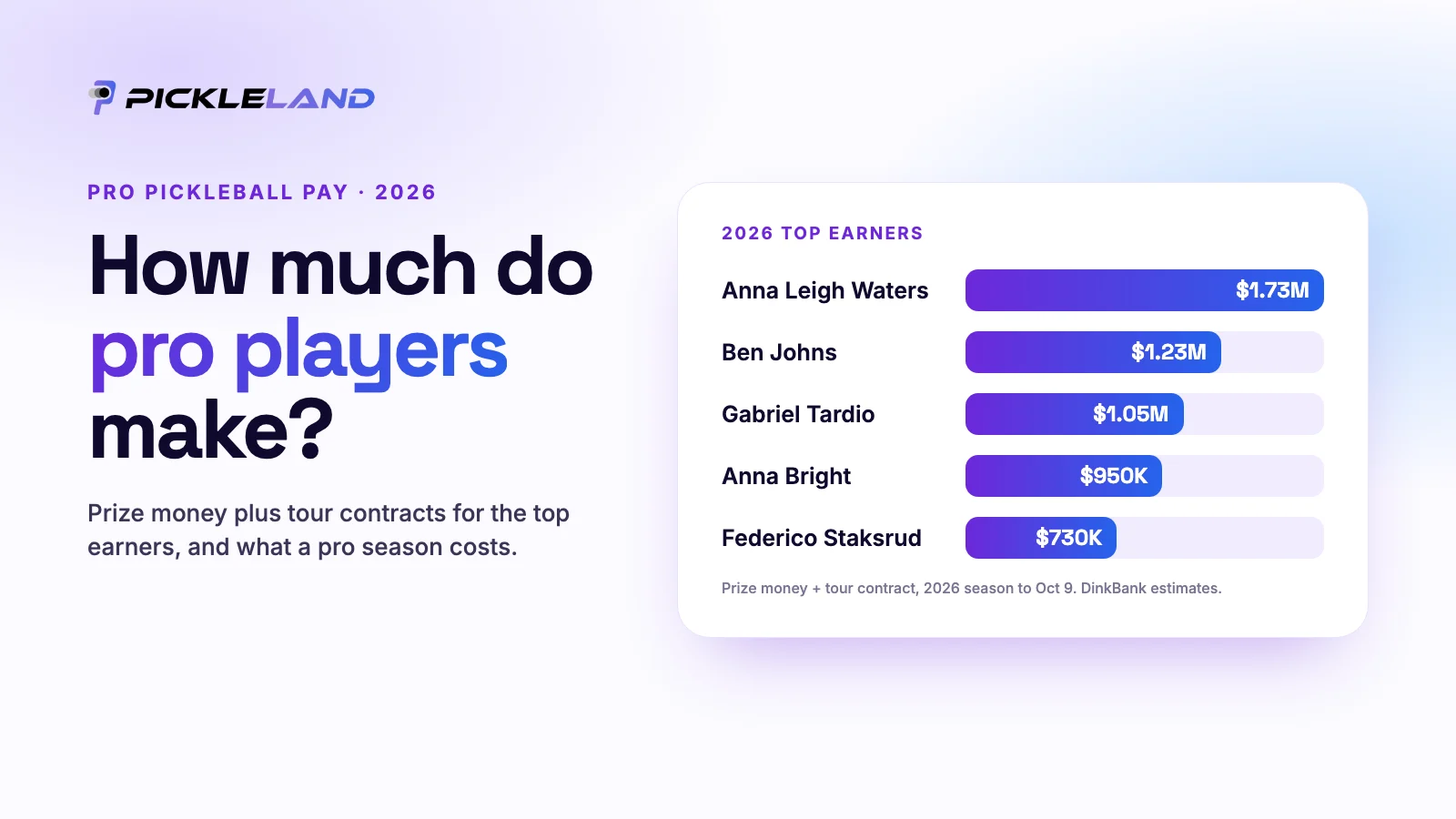
DinkBank, an independent tracker, adds up prize money and base contract pay across the PPA Tour, Major League Pickleball (MLP) and the APP. These are its 2026 season figures as of October 9, 2026, so the season isn’t finished yet.
| # | Player | Prize money | Contract | Total |
|---|---|---|---|---|
| 1 | Anna Leigh Waters | $980,500 | $750,000 | $1,730,500 |
| 2 | Ben Johns | $567,263 | $666,700 | $1,233,963 |
| 3 | Gabriel Tardio | $252,080 | $800,000 | $1,052,080 |
| 4 | Anna Bright | $653,000 | $296,700 | $949,700 |
| 5 | Federico Staksrud | $479,527 | $250,000 | $729,527 |
| 6 | Christian Alshon | $180,350 | $291,700 | $472,050 |
| 7 | Hayden Patriquin | $310,600 | $150,000 | $460,600 |
| 8 | JW Johnson | $217,697 | $216,700 | $434,397 |
| 9 | Catherine Parenteau | $158,650 | $266,700 | $425,350 |
| 10 | Jorja Johnson | $243,801 | $166,700 | $410,501 |
Source: DinkBank 2026 season leaderboard, retrieved October 9, 2026. DinkBank verifies some figures against official sources and estimates others. Contract figures are base retainers only and exclude endorsements, appearance fees and off-court income, which for the top players is often the bigger number.
A few things stand out. Waters leads on prize money as well as overall. Gabriel Tardio has the largest contract on the list but sits third because his prize money is lower. And the gap between #1 and #10 is about four to one, before sponsorships, which widen it further.
For a player-by-player look at career wealth, see our net worth of the top pickleball pros and the top pickleball players ranking.
Who is the highest paid pickleball player?
Anna Leigh Waters. She leads DinkBank’s 2026 prize-plus-contract table, and she was already the sport’s top earner in 2024. That year her agent, Kelly Wolf, told Forbes she would earn more than $3 million including endorsements (Pickleball.com, September 2024).
Her endorsement income has likely grown since. In January 2026 she signed a long-term paddle deal with Franklin after seven years with Paddletek (The Dink). The same month she became the first pickleball athlete on Nike’s global roster, with an apparel and shoe deal (The Kitchen). Neither deal’s value was disclosed. Pro player and commentator Zane Navratil projected the Franklin deal at a minimum of $10 million over at least three years (his newsletter, December 2025). That’s his estimate, not a reported number.
Ben Johns is the other confirmed seven-figure earner. He told CNBC in May 2024 that he was making at least $2.5 million a year from his pickleball salary and endorsements. That was up from $250,000 in 2021 and about $50,000 in 2018, when nearly all of it was prize money (CNBC via NBC Boston). He has a lifetime sponsorship with JOOLA. CNBC said the value of his deals wasn’t clear.
How pro pickleball pay works in 2026
A pro’s income has four parts.
1. Prize money. You get paid for where you finish at PPA Tour events, MLP events and international events. The United Pickleball Association (UPA), which owns both the PPA Tour and MLP, announced in June 2025 that starting in 2026 it would pay $15 million a year in prize money across the two tours, $11 million of it guaranteed, plus $5 million a year in international prize money. It put total player earnings at up to $31 million a year (Pickleball.com).
2. Tour and league contracts. These are guaranteed retainers for committing to play. The UPA restructured them for 2026. The final-year guarantees on 2024–2026 contracts were spread evenly over 2026–2028, so a $300,000 guarantee for 2026 became $100,000 a year for three years. Players were offered extensions in tiers (Gold, Standard, and New/Futures) during signing windows in the second half of 2025.
3. Sponsorships. Paddle, apparel, shoe and lifestyle deals. For the stars these are the largest income source, and they’re almost never disclosed. Below the top tier, many “sponsorships” are free gear, a royalty on paddle sales, or a small stipend.
4. Teaching and content. Clinics, camps, private lessons and YouTube or social media. For most touring pros this is what pays the rent.
Prize money is up, guarantees are down
DinkBank’s first-quarter 2026 report shows how big the shift has been. All of its figures are estimates (DinkBank Q1 2026 report):
Source: DinkBank Q1 2026 report (estimates)
Source: DinkBank Q1 2026 report (estimates)
Prize money in Q1 2026 came to about $2.68 million, nearly triple the year before. Contract pay fell by about two-thirds, so total player pay for the quarter was down about 57%. DinkBank also reports that the PPA has stopped issuing new Gold Card contracts, the tier with the highest guaranteed rates. In its view, mid-ranked players around 20th to 50th face the hardest adjustment. They aren’t winning the big checks, and their guarantees shrank.
What it costs to play pro
Prize money is gross income. The expenses come out first, and they don’t care whether you won.
A touring player writing in DUPR’s Road to Pro series in February 2026 listed their 2025 costs, their fourth year on tour (DUPR):
| Expense (2025 season) | Cost |
|---|---|
| Flights | $3,550 |
| Meals | $3,252 |
| Trainer / coaching | $3,165 |
| Lodging | $2,194 |
| Rental car / transportation | $2,017 |
| Registration / entry fees | $1,877 |
| Gas | $262 |
| Stated season total | $19,000–$20,000 |
Source: DUPR, Road to Pro Part II (Feb 26, 2026). The listed lines add up to about $16,300; the author's stated total is higher and the post doesn't itemize the difference. The same post lists about $14,210 for a first-year pro.
That’s a lean season. A 2024 breakdown by The Kitchen put PPA Tour entry at about $500 per event, with average round-trip flights around $450 and hotel stays around $200 a night, often for four nights because of qualifying rounds (The Kitchen). A player who enters a full PPA schedule pays far more than one who picks a few events.
Can you make a living off pickleball?
As a touring pro, only near the top. The top 10 above all clear $400,000 in prize money and contract pay alone. Below the top tier, prize money is uneven and guarantees shrank in 2026. Travel can easily eat $15,000–$20,000 a season. Many touring pros make their living from teaching, clinics and sponsor stipends, and treat the tour as the marketing that makes those possible.
As a pickleball professional more broadly, yes. Coaching, running clinics, directing programs at clubs, and creating content are real jobs, and they don’t depend on beating the world’s best every weekend.
Is it hard to go pro in pickleball?
Turning pro just means entering pro draws, and anyone good enough to qualify can do that. Earning as a pro is hard. You need results that win prize money or attract sponsors, and the 2026 restructuring rewards results more than ever. If you’re thinking about it, our guide to how to become a pro pickleball player covers the path, and APP vs PPA vs MLP explains how the tours fit together.
Frequently Asked Questions
Who is the highest paid pickleball player?
Anna Leigh Waters. She leads DinkBank’s 2026 prize money and contract table at about $1.73 million as of October 9, 2026, before endorsements. In 2024 her agent told Forbes she’d earn more than $3 million including sponsorships.
How much does Ben Johns make?
Johns told CNBC in 2024 that he was making at least $2.5 million a year from salary and endorsements combined. In DinkBank’s 2026 season data he’s second, with about $1.23 million in prize money and contract pay, not counting sponsorships.
Can you make a living off pickleball?
The top touring pros make a very good living. Most others combine tour income with coaching, clinics and sponsorships, because travel costs can run $15,000–$20,000 a season. Teaching and running programs are steady pickleball careers in their own right.
Is it hard to go pro in pickleball?
Entering pro events is open to anyone who qualifies. Making money as a pro is much harder. In 2026, pay depends more on results than on guaranteed contracts.
How much prize money do pro pickleball events pay?
DinkBank estimates that the average pro event paid about $335,000 in prize money in the first quarter of 2026, up from about $91,000 a year earlier. Totals vary a lot by event.