

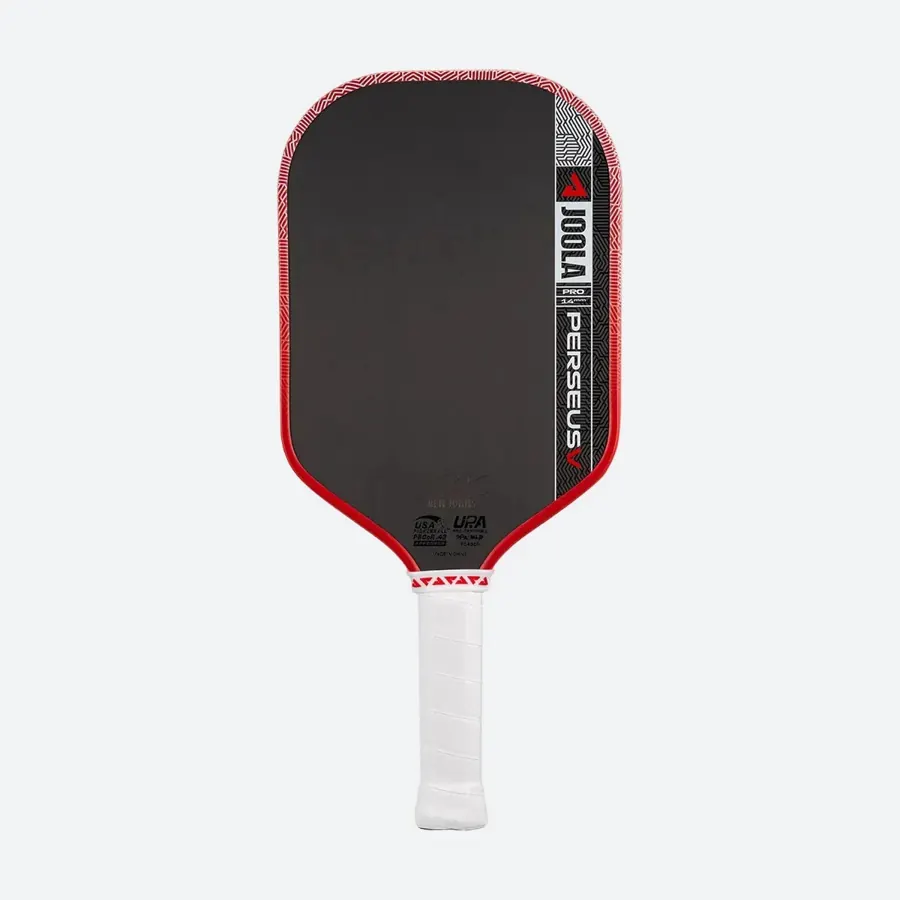
The Perseus is the elongated paddle in JOOLA’s Ben Johns line, and the Pro V is its 2026 update. JOOLA calls it Ben Johns’ paddle of choice, and Pickleball.com’s September 2026 rundown of what the top 20 pros play lists Johns on the Perseus Pro V 16mm (JOOLA, Pickleball.com). We haven’t lab-tested it ourselves. Here’s what independent testers measured, where they agree, and why their scores range from 6 out of 10 to a perfect 5 out of 5.
The verdict
Buy it if you generate your own pace and want a controlled, predictable elongated paddle with good spin and a softer feel than JOOLA’s previous Perseus. Testers consistently describe it as a control-leaning refinement, not a power upgrade.
Skip it if you want the paddle to supply the power, you already own a Perseus Pro IV in good shape, or long-term durability is your priority. It’s still a polypropylene honeycomb paddle, and no tester was ready to call it durable yet.
Which thickness: most testers recommend the 16mm, which is also what Johns plays. The 14mm is for players who want a stiffer, more direct response and accept a smaller sweet spot.
Specs
Source: JOOLA spec sheet, joola.com
JOOLA lists three technologies: KineticFrame, a slimmer throat designed to flex on contact; the Propulsion Core, its polypropylene core with carbon fibre and EVA foam; and a Hyperfoam Edge Wall, foam injected around the perimeter to enlarge the sweet spot. Grip circumference is 4.25 inches on Ben Johns editions; JOOLA lists 4.125 inches for the Simone Jardim 16mm build. Both thicknesses are USA Pickleball and UPA-A certified, with a 12-month warranty that requires registration (JOOLA).
Lab numbers
Pickleball Effect measures every paddle on the same rig and ranks it against about 300 scored paddles (method). Its data page covers the 16mm; we haven’t found a published independent lab test of the 14mm. Scales match our Boomstik, Omni and Loco reviews.
The dark tick on each bar is the average for that paddle shape in Pickleball Effect's database. Higher swingweight adds plow-through and power but slows your hands at the kitchen; higher twistweight means more stability on off-center hits. Percentiles rank the paddle against the roughly 300 paddles Pickleball Effect has scored, so the tick at 50 is the median paddle.
Source: Pickleball Effect paddle database, 2026; percentiles vs. about 300 scored paddles; averages from the same database, checked October 2026
For context, Pickleball Effect’s averages for elongated paddles are a 117.6 swingweight and 6.11 twistweight, so the Pro V is typical in swing and slightly more stable than average. Its balance point of 244 mm sits a little higher than the elongated average of 241.7 mm. In the same database, the previous Perseus Pro IV 16mm sits at the 80th percentile for firepower, against the Pro V’s 63rd (Pickleball Effect).
Pickleball Studio’s numbers for the 16mm are close: 116 swingweight, 6.04 twistweight, 242 mm balance and 8.04 oz, with spin measured higher at 2,170 rpm (Pickleball Studio).
What the testers found
Power
Pickleball Effect and Pickleball Studio agree the Pro V isn’t more powerful than the Pro IV, and Pickleball Effect found it a little less punchy. Pickleball Effect found less immediate pop and said you need to swing with intent to get offense out of it. It then ran a small test: four players at different DUPR levels hit eight full-effort serves with each paddle. The two strongest players saw essentially no difference, while the 4.3-rated player served about 1.7 mph slower with the Pro V (Pickleball Effect). Its framing: the Pro IV gives you assisted power, and the Pro V rewards faster, cleaner swings.
Pickleball Studio put power roughly level with the Pro IV and called it mid-tier against newer power paddles. Pickleheads, the most positive reviewer, scored power 9 out of 10 but described it as power from dwell rather than raw speed, and said it isn’t in the Boomstik’s league.
Control and touch
This is where the Pro V earns its keep. Pickleball Effect found more control on dinks, resets and third-shot drops, better absorption of pace, and fewer of the unpredictable “hot” shots some players got from the Pro IV. Pickleheads scored control 9 and said it works well for resets and shaping shots, while not being as soft as a pure control paddle. Pickleball Studio was the dissenter: it didn’t notice a meaningful accuracy gain from the KineticFrame throat.
Spin
Spin is a strength. Pickleheads gave it a 10 and called it an elite spin paddle. Pickleball Effect measured about 2,060 rpm and labelled that very high, and Pickleball Studio’s reading was higher still. Pickleball Effect noted the Pro V measured slightly more spin than the Pro IV, but said the difference didn’t show up on court. Our spin explainer puts these numbers in context.
Forgiveness
Pickleheads scored forgiveness 9 and said off-center hits held up better than on the Pro IV. Pickleball Studio, comparing the Pro V line’s two thicknesses, found the 16mm more forgiving and better at pocketing the ball. Pickleball Effect noted the paddle swings more head-light than expected, and its recommended setup adds 3 grams of tape on each side just above the handle.
Feel
Testers agree it is softer and more muted than the Pro IV. Pickleball Effect described a softer, more solid contact and a quieter sound than the Pro IV’s sharper crack. Pickleball Studio called it softer than the Pro IV but still on the stiffer side for a carbon honeycomb paddle, and said the difference narrows after break-in.
Durability
This is the shared reservation. The Pro V is still a polypropylene honeycomb paddle, and Pickleball Studio said that leaves it prone to core crush. JOOLA added a carbon layer near the top of the paddle to strengthen a common failure point, which both Pickleball Effect and Pickleball Studio called unproven so far. Pickleheads said it’s too early to tell, but flagged the delamination problems that affected earlier JOOLA paddles. On the face, Pickleball Effect rates the surface Tier 4 for grit durability, a standard peel-ply texture that wears faster than the newer durable grits. For signs of wear, see when to replace your paddle.
Reviewer consensus
| Reviewer | Verdict | Standout | Knock |
|---|---|---|---|
| Pickleheads | 5.0/5 | Elite spin; plush, connected 16mm feel | Incremental over the Pro IV; durability unproven |
| Pickleball Effect | 4.1 overall | More control and consistency than the Pro IV | Less built-in power; raw-texture face |
| Pickleball Studio | 6/10 | Softer feel for a carbon honeycomb paddle | Minimal update; prone to core crush |
Scores are each outlet's own scale. Pickleheads tested the elongated Perseus; Pickleball Effect's data covers the 16mm.
The spread looks wide, but the three reviews describe the same paddle. All three call it an incremental step from the Pro IV, with more control and a softer feel rather than more power. They differ on whether that’s worth paying for. Pickleheads compared it to a new iPhone: excellent, but not a reason to replace one that still works. Pickleball Studio was blunter: “The Pro V plays well, but is overpriced.” Pickleball Effect landed in between, concluding that “JOOLA didn’t fall behind with the Pro V,” and recommending it for strong players with good mechanics, roughly 4.5 and up.
14mm vs. 16mm
JOOLA’s spec gap is small on paper: 7.9 oz for the 14mm against 8.1 oz for the 16mm, same shape and handle. On court, testers describe the usual thickness trade-off:
- 16mm. More forgiving on off-center hits and better at pocketing the ball, according to Pickleball Studio, which preferred it across the Pro V line. Pickleheads did its hands-on testing on the 16mm and praised its connected, cushioned feel. It’s also the thickness Pickleball.com lists for Ben Johns.
- 14mm. Stiffer and more predictable, but Pickleball Studio found the sweet spot noticeably smaller and the edges rough without added weight. JOOLA offers the 14mm only in Johns’ Blaze Red signature edition.
There’s also a broader reason the 16mm has become the default. Pickleball Effect’s July 2026 analysis of its database found that modern 16mm paddles now produce the firepower that used to require a thinner core. On the previous-generation Perseus Pro IV, its 16mm actually out-scored the 14mm on firepower (81st vs. 73rd percentile in that analysis) (Pickleball Effect). We haven’t seen equivalent independent data for the Pro V’s two thicknesses, so treat that as a pointer, not a measurement. Our 13mm vs. 16mm guide walks through the trade-off in more detail.
Our suggestion: start with the 16mm unless you already know you like a thinner, firmer paddle. Better still, hit both, since we stock both.
Try it before you buy
Pickleland sales are final, so demo first. Both the 14mm and 16mm Perseus Pro V are in the demo rack at the front desk for an $8 rental, which makes this one of the easiest thickness comparisons you can do: take one into open play, then swap. Our Paddle Demo Day is a coached session where you rotate through demo paddles, and the demo fee is credited if you buy a paddle that day.
See the paddle demo page for how it works, or the paddle shop for everything on the wall. Pickup in Pflugerville is free, and we deliver locally within 10 miles; we don’t ship beyond that.
For background, read about Ben Johns, the history of JOOLA, and how polypropylene honeycomb compares with foam in our core materials guide.
FAQ
Is the Perseus Pro V Ben Johns’ paddle?
Yes. The Perseus is the elongated shape in JOOLA’s Ben Johns line, JOOLA describes the Pro V as his paddle of choice, and it sells a Ben Johns signature edition in Blaze Red in both 14mm and 16mm. Pickleball.com’s September 2026 survey of top pros lists Johns using the Perseus Pro V 16mm.
Which thickness does Ben Johns use?
The 16mm, according to Pickleball.com’s September 2026 rundown of the top 20 players’ paddles.
Is the Perseus Pro V better than the Pro IV?
It’s more controlled, not more powerful. Pickleball Effect and Pickleball Studio both found the Pro V softer and more predictable, while the Pro IV is easier for generating offense, especially for players below about 4.5. In Pickleball Effect’s database the Pro IV 16mm scores higher for firepower. Pickleheads and Pickleball Studio both said Pro IV owners whose paddles are still in good shape don’t need to upgrade.
Is the Perseus Pro V foam or honeycomb?
Honeycomb. JOOLA describes a polypropylene core with carbon fibre and EVA foam, plus foam injected into the edge wall, and testers treat it as a carbon honeycomb (Gen 3) paddle. Pickleheads listed “anyone wanting a foam core” among those who should look elsewhere.
How long does the Perseus Pro V last?
No reviewer has published long-term wear data yet. JOOLA added carbon reinforcement near the top to address a common failure point, but testers call that unproven, and Pickleball Studio notes honeycomb paddles remain prone to core crush. JOOLA’s warranty is 12 months with registration. The textured carbon face is rated Tier 4 for grit durability by Pickleball Effect, so expect spin to fade with heavy use.