

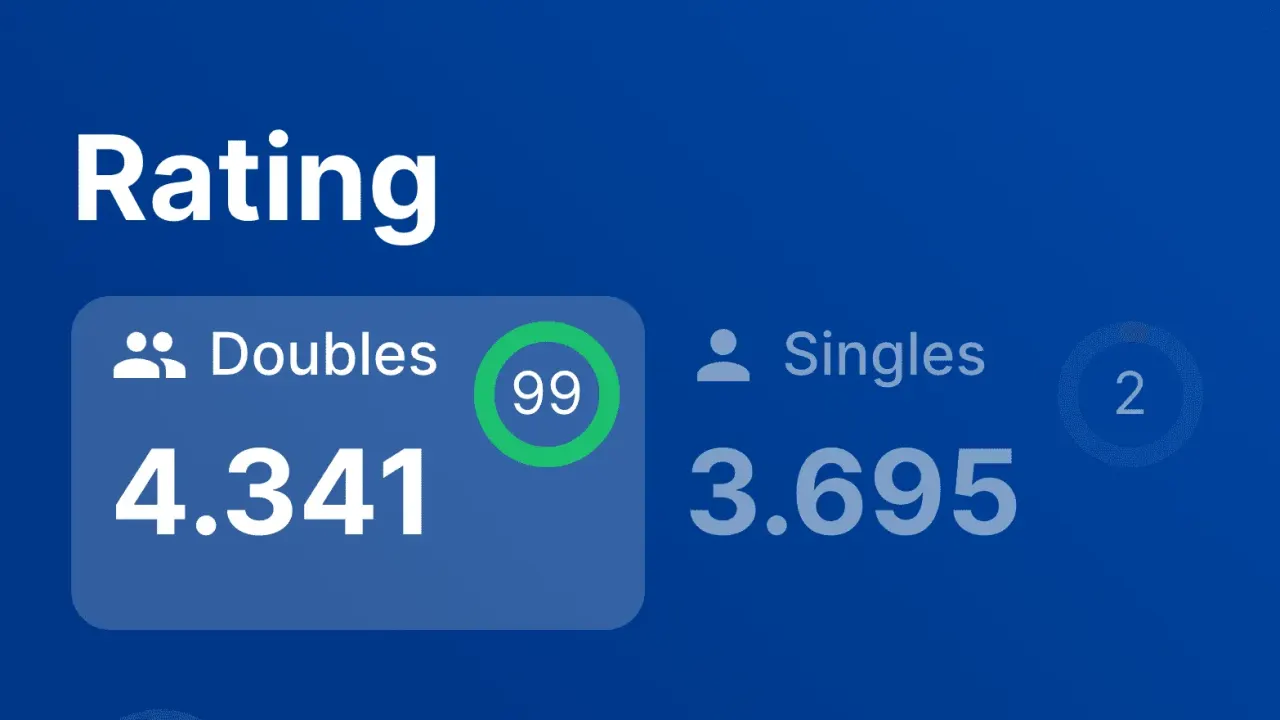
In one sentence: the DUPR Reliability Score is a percentage from 1 to 100, shown next to your rating, that tells you how well your rating reflects your current skill. It goes up as you add matches, especially club and tournament matches against a variety of partners and opponents, and it goes down if you stop playing. It updates every Tuesday (DUPR Help Center, updated October 2026).
The score doesn’t change your rating. It changes how much your rating can be trusted, and how much it moves after each match.
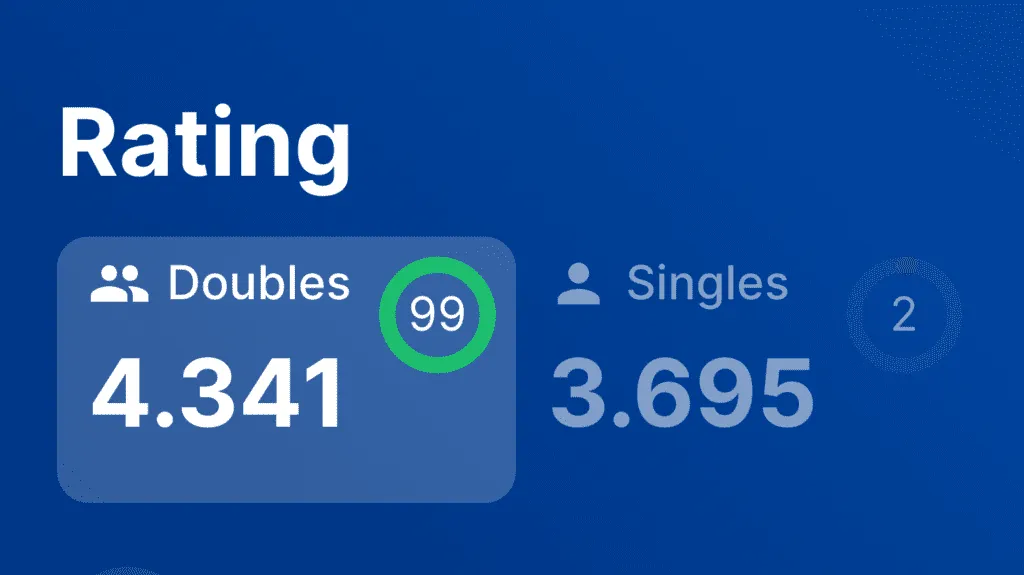
The same player, two very different levels of confidence: a doubles rating at 99% reliability and a singles rating at 2%. Each format has its own score.
Source: DUPR Help Center, What is the Reliability Score? (updated Oct 20, 2026); DUPR blog, DUPR Reliability Score (May 28, 2024)
What DUPR says the score is
From DUPR’s own help article:
- It “measures a player’s progress toward reaching a reliable rating based on their match history and connectivity to the broader DUPR population.”
- It’s “calculated as a percentage between 1 and 100.”
- Singles and doubles each have their own score.
- It doesn’t directly affect your DUPR rating.
- Clubs use it as an eligibility threshold for events, and it decides eligibility for club ranking lists and the overall rankings on DUPR.com.
When DUPR launched the score in May 2024, it said players “who have a score of at least 60% have a reliable rating” (DUPR blog, 2024). The current help article doesn’t name a threshold, and each club sets its own.
What raises it, and what lowers it
DUPR’s formula “takes into account factors such as the number of matches played (and the match source), plus the variety of partners and opponents over the last 6–12 months.”
| Raises your score | Lowers your score, or slows it down |
|---|---|
| More matches in the last 6–12 months | A long gap with no matches (the score “begins to decrease”) |
| Club matches and results from verified data partners (tournaments) | Only self-posted matches, which DUPR treats as lower-confidence data |
| Many different partners and opponents | Always playing the same three people |
| Playing on a regular schedule | Bursts of matches followed by months off |
DUPR’s advice is to upload matches “on a consistent basis” and play club and tournament events where you can.
How reliability changes how your rating moves
This is the practical part. DUPR rates players with a modified Elo system, comparing how you did with how you were expected to do (How is the DUPR rating calculated?). Your reliability affects how far each result moves you:
- Low reliability: fewer or older results, so the system is still learning. Your rating moves a lot after each match.
- High reliability: lots of recent data, so the system is confident. Each match moves you less.
That’s why two partners can win the same match and gain different amounts. They always move in the same direction, but by different amounts depending on each player’s history (DUPR Help Center). It also explains why a new player’s rating swings for the first few weeks.
It works the other way too. Matches against unrated or low-reliability players have a smaller effect on a high-reliability player’s rating (DUPR Help Center).
How to raise your reliability score
- Play recorded matches every week. Consistency over 6–12 months beats a big weekend.
- Play club matches and tournaments. Club-submitted and verified results carry more weight than self-posted ones.
- Mix up partners and opponents. Round robins and open play with rotating partners are ideal.
- Check on Wednesday, not Monday. The score only updates on Tuesdays.
- Track singles separately. If you want to enter singles events, you need singles matches. Your doubles score won’t help. See singles vs doubles DUPR.
Reliability score vs. half-life
You’ll still see “half-life” mentioned in older DUPR discussions. Both ideas describe the same principle: recent matches count more and old ones fade. DUPR’s current help center explains it through the Reliability Score and the rating’s recency weighting: “A match played today influences your rating more than one played six months ago.” More in our DUPR half-life explainer.
Frequently Asked Questions
What is a good DUPR reliability score?
DUPR said at launch that 60% or higher means a reliable rating. Clubs set their own thresholds for events, so check with the organizer.
How often does the DUPR reliability score update?
Every Tuesday. Matches played on a Wednesday won’t show in your reliability score until the following Tuesday.
Does the reliability score change my DUPR rating?
No. It changes how confident DUPR is in your rating, and how much each new match moves it, but not the rating itself.
Why is my DUPR reliability score going down?
Your score begins to decrease after an extended period without matches. Recording matches again brings it back up.
Are singles and doubles reliability scores separate?
Yes. Each format has its own rating and its own reliability score.
Do recreational matches count toward reliability?
Self-posted matches count, but club matches and verified results build reliability faster, according to DUPR.