
A good first pickleball paddle has three things: a wide face (about 7.75 to 8 inches) so off-center hits still go over, a mid weight (roughly 7.7 to 8.2 ounces) so it is neither whippy nor tiring, and a 16mm core so the ball comes off softly enough to control. Shape, spin texture and power technology can wait until you know how you play. The six paddles below all come from our pro shop wall and are picked on the numbers their makers publish.
One note on method: Pickleland is an indoor club in Pflugerville with a pro shop, not a test lab. Every measurement in this post is the manufacturer’s published spec, checked on the maker’s own site on October 9, 2026. Prices and availability are on the live cards, because both change.
Beginner paddle picks at a glance
| Paddle | Face width | Core | Weight | Why it fits a beginner |
|---|---|---|---|---|
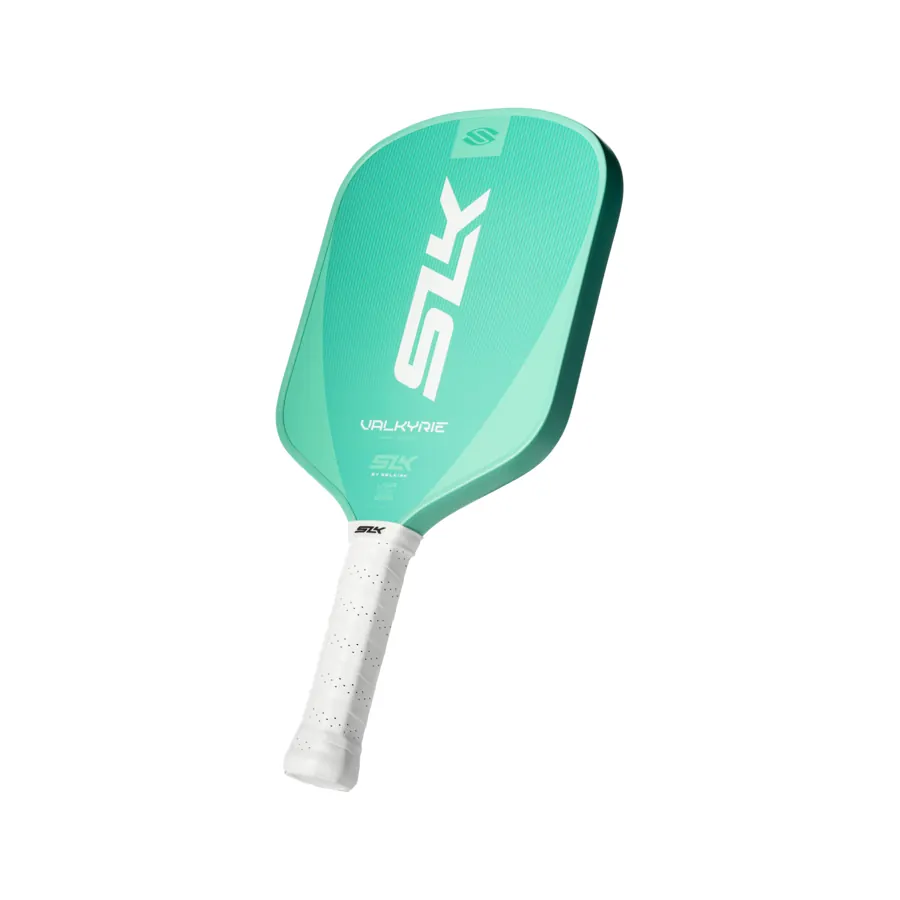
| Selkirk SLK Valkyrie Widebody | 8 in | 16mm | 7.9 to 8.1 oz | Hits all three targets: wide, mid weight, thick core |
| Selkirk SLK HALO Power | 7.85 in | 16mm | 7.7 to 8.0 oz | Lightest listed weight range of the six, with a carbon fiber face |
| Avoura Rhapsody 13 | 8.37 in | 13mm | 8.1 oz | Widest face we stock; published twist weight of 7.76 |
| JOOLA Agassi Pro 16mm | 7.5 in | 16mm | 8.1 oz | Longer shape with a sweet spot JOOLA extends toward the edges |
| Selkirk SLK Geo Elongated | 7.45 in | 14mm | 7.8 to 8.1 oz | For beginners arriving from tennis or racquetball |
| Diadem Warrior BluCore v3 | 7.4 in | 19mm | 8.5 oz | Solid foam core for players who want one paddle to last |
All figures are manufacturer-published specs, checked October 9, 2026. Listed weights vary slightly from paddle to paddle.
What a first paddle needs
A forgiving width
New players miss the middle of the paddle a lot. That is normal. A wider face gives you more hitting area on either side of the center line, and it resists twisting in your hand when contact is off to one side. Makers put a number on that resistance called twist weight: higher means the face stays squarer on a mishit.
You can see the pattern in the specs of the paddles we stock. Selkirk publishes a twist weight of 7 for the 8-inch-wide SLK Valkyrie and 6.7 for the 7.45-inch-wide SLK Geo. The widest paddle on our wall, the 8.37-inch Avoura Rhapsody 13, lists 7.76. Wide paddles are usually called “widebody” or “standard” shape. Narrow, long ones are “elongated”, and they trade forgiveness for reach.
A mid weight
Most paddles sold today sit between about 7.3 and 8.3 ounces, the band usually called midweight. That is the right place to start. A very light paddle feels quick but gets pushed around by hard shots, and a heavy one adds power while asking more of your arm over a two-hour session. Our paddle weight guide covers the trade-off in detail. If you later want more weight, adding it is easy. Taking it off is not.
A 16mm core
Core thickness is the distance between the two faces. A thicker core (16mm) absorbs more of the ball’s energy, which makes dinks, drops and blocks easier to keep in the court. A thinner core (13mm or 14mm) sends the ball back faster, which is useful once your swing is consistent and frustrating before then. The longer comparison is in 13mm vs. 16mm paddles.
What you can ignore for now
Spin-focused textures, power rings, tuned swing weights and pro signature models are real things, but none of them fix a late backswing. Neither does spending more. Buy the forgiving paddle, play twenty times, then decide what you wish it did better.
The six picks
Selkirk SLK Valkyrie Widebody 16mm
This is the paddle on our wall that most cleanly matches the checklist. Selkirk’s spec sheet lists it at 15.95 by 8 inches with a 16mm polymer honeycomb core, 7.9 to 8.1 ounces, a 4.25-inch grip and a 5.6-inch handle. Its published swing weight is 110 and twist weight is 7, so it is easy to swing and steady on off-center contact. The face is fiberglass, which gives a little free pop to players who do not swing hard yet. It is also one of the lower-priced paddles we carry.
Selkirk SLK HALO Power
The HALO Power uses a shape Selkirk calls Max: 16 by 7.85 inches, so nearly as wide as a widebody. Selkirk lists it at 7.7 to 8.0 ounces with a 16mm core and a carbon fiber face. The handle is 4.85 inches, the shortest of any paddle we stock, which leaves more of the paddle’s length for the face. That suits a one-handed player. If you already know you want two hands on your backhand, look at a longer handle instead.
Avoura Rhapsody 13
The Rhapsody 13 breaks the 16mm rule on purpose. Its core is 13mm, but Avoura makes up for it with width: at 8.37 inches across and 15.5 inches long, it is the widest paddle in our shop, and its published twist weight of 7.76 is among the highest we list. Swing weight is 110 and the grip is 4.1 inches around, which helps smaller hands. Expect a livelier response than the 16mm picks. Choose it if you want the biggest target and are comfortable with a little more pop.
JOOLA Agassi Pro 16mm
Some beginners want a longer paddle for the reach, especially taller players. The Agassi Pro is 16.5 by 7.5 inches with a 16mm core, 8.1 ounces and a 5.5-inch handle per JOOLA’s spec sheet. It earns its place because JOOLA describes its sweet spot as extended toward the upper edges and bottom corners, which offsets some of the forgiveness you give up with a narrower face. The 5.5-inch handle also leaves room for a second hand.
Selkirk SLK Geo Elongated 14mm
The Geo is the pick for a beginner who is not new to racquets. It is elongated (16.5 by 7.45 inches), has a 14mm core and a raw carbon fiber face, and Selkirk lists a 5.8-inch handle, a swing weight of 113 and a twist weight of 6.7. Those numbers describe a faster, less forgiving paddle than the Valkyrie. If you have years of tennis behind you and already find the middle of a racquet without thinking, that is a fair trade. If not, start wider and thicker. Tennis players can read more in our paddles for tennis players guide.
Diadem Warrior BluCore v3
The Warrior is the outlier. Diadem lists it at 8.5 ounces with a 19mm core, 16.4 by 7.4 inches, a 5.7-inch handle and a 4.125-inch grip. That is heavier and narrower than the checklist calls for. It is here because the core is solid foam rather than honeycomb, and Diadem says that construction resists core crush and delamination and backs the core with a lifetime warranty. If you are hard on gear and would rather buy once, it is worth a look. Hit with one first: 8.5 ounces is noticeable.
How to pick between them
- No racquet-sport background: Valkyrie or HALO Power.
- You want the largest possible target: Rhapsody 13.
- You are tall or want reach, and still want 16mm: Agassi Pro 16mm.
- You played tennis or racquetball for years: Geo.
- You want durability above everything: Warrior.
If you would rather answer a few questions than read spec sheets, the paddle finder does the sorting for you. To see any two or three of these next to each other, open them in the paddle comparison tool. And if you live near Austin, the simplest test is to demo a paddle on our courts before buying it.
Brand new to the sport itself? Our first time playing page covers the rules, scoring and the kitchen in one read, so the paddle is the only thing left to figure out.
FAQ
What weight pickleball paddle should a beginner use?
A midweight paddle, roughly 7.7 to 8.2 ounces. It is light enough to react with at the net and heavy enough to stay stable against a hard shot. Five of the six picks above fall in that range by their makers’ published specs. The Diadem Warrior, at 8.5 ounces, is the exception.
Is a 16mm or 14mm paddle better for beginners?
16mm for most people. The thicker core takes pace off the ball, which keeps dinks and blocks from flying long. A 13mm or 14mm core is a reasonable first choice only if you come from another racquet sport and want a faster response.
Do beginners need an expensive paddle?
No. A beginner benefits most from width, a sensible weight and a thick core, and those show up at the lower end of the price range too. The step that matters is moving off the paddle that came in a starter set. For more budget options, including ones we do not stock, see our affordable paddles roundup.
Should a beginner buy an elongated paddle?
Usually not as a first paddle. An elongated shape adds reach and leverage but narrows the face, so mishits are punished more. It makes sense for a beginner with a strong tennis background, or one who wants a long handle for a two-handed backhand.
What grip size should a beginner choose?
Most paddles come in one grip size, and nearly everything we stock is between 4.1 and 4.25 inches around. If you are between sizes, go smaller, because an overgrip can build a handle up but nothing shrinks it. The measuring method is in our grip size guide.