

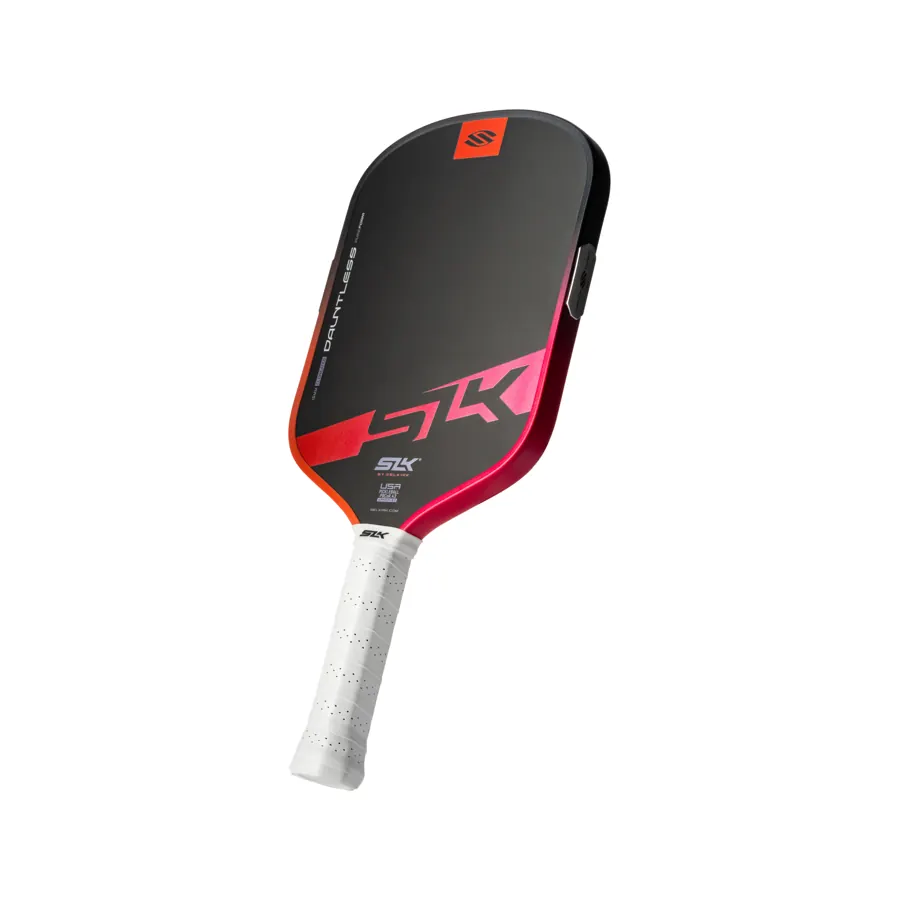
At 3.0 to 4.0 you stop buying a paddle that hides your misses and start buying one that fits how you win points. Three choices matter most: shape (widebody, hybrid or elongated), core thickness (14mm for pace, 16mm for touch) and handle length (5.5 inches or more if you hit a two-handed backhand). The six paddles below cover those choices, and every number comes from the maker’s published spec sheet.
We sell these in the Pickleland pro shop in Pflugerville. We do not lab-test paddles, so nothing here is a measurement of ours. Prices and availability are on the cards.
Six intermediate picks compared
| Paddle | Shape (L x W) | Core | Handle | Pick it if you |
|---|---|---|---|---|
| Selkirk SLK Dauntless Elongated | Elongated, 16.5 x 7.45 in | 16mm | 5.8 in | Want reach with a control lean |
| JOOLA Kosmos Pro V 16mm | Hybrid, 16.3 x 7.7 in | 16mm | 5.25 in | Cannot decide between reach and forgiveness |
| JOOLA Scorpeus Pro IV 14mm | Widebody, 16 x 8 in | 14mm | 5.25 in | Win points in hand battles at the kitchen |
| JOOLA Hyperion Pro IV 16mm | Elongated, 16.5 x 7.5 in | 16mm | 5.5 in | Hit a two-handed backhand |
| Selkirk SLK ERA Power Widebody | Widebody, 15.95 x 8 in | 16mm | 5.6 in | Like to drive the ball but still mishit sometimes |
| Avoura Rivelle | Hybrid, 16.25 x 7.75 in | Not published | 5.5 in | Want a hybrid that swings light |
Manufacturer-published specs, checked October 9, 2026. Avoura does not list a core thickness for the Rivelle on its product page.
What changes when you leave a starter paddle
A beginner paddle has one job, which is forgiveness. We covered that in paddles for beginners. Once you are winning and losing points for specific reasons, the paddle should match those reasons.
Shape becomes a real choice
There are three families, and the dimensions tell you which one you are holding.
- Widebody (about 16 by 8 inches): the largest sweet spot and the steadiest face on blocks and counters. Best for doubles players who live at the kitchen line.
- Elongated (about 16.5 by 7.5 inches): more reach and more leverage on serves, drives and overheads, with a narrower face. Best for singles, for tall players and for anyone who attacks from the baseline.
- Hybrid (in between): JOOLA’s Kosmos Pro V is 16.3 by 7.7 inches and Avoura’s Rivelle is 16.25 by 7.75. You give up a little of each extreme and get a paddle that works in both singles and doubles.
Published twist weights show what width buys. Selkirk lists the widebody ERA Power at 7.3 and the elongated version of the same paddle at 6.6. The higher number means the face turns less on off-center hits.
Thinner or thicker core
At this level, both thicknesses are legitimate. A 16mm core keeps the ball on the face a touch longer and takes pace off, which helps resets and third-shot drops. A 14mm core returns the ball faster, which helps counters and put-aways and demands cleaner contact. It is usually lighter too: JOOLA lists the Hyperion, Perseus and Kosmos Pro V at 7.9 ounces in 14mm and 8.1 ounces in 16mm.
A rule of thumb that holds up: if your errors are balls sailing long, go 16mm. If your problem is that you cannot finish points, try 14mm. The full breakdown is in 13mm vs. 16mm paddles.
Handle length for a two-hander
A two-handed backhand needs room for the second hand. About 5.5 inches is the practical minimum, and more is more comfortable. Of the paddles we stock, Selkirk’s elongated models publish the longest handles at 5.8 inches, Diadem’s are 5.7, and JOOLA’s Hyperion and Perseus are 5.5. Widebody and hybrid shapes usually run shorter: 5.25 inches on the Scorpeus and Kosmos.
If your backhand is one-handed, a shorter handle is not a drawback. It leaves more of the paddle’s length for the hitting surface.
Swing weight starts to matter
Static weight is what a scale reads. Swing weight describes how heavy the paddle feels in motion, and it is the number to compare once you notice your hands being late at the net. Among the paddles in our shop with a published figure, swing weight runs from 109 to 121. Lower is quicker, higher hits a heavier ball. You can sort every paddle by it on our paddle specs table, and the swing weight calculator shows what lead tape would do to a paddle you already own.
The picks
Selkirk SLK Dauntless Elongated 16mm
The Dauntless is an elongated paddle built to lean toward control, which is an unusual and useful combination for a player moving up. Selkirk’s spec sheet lists 16.5 by 7.45 inches, a 16mm foam core, 7.7 to 8.1 ounces, a 5.8-inch handle, a swing weight of 118 and a twist weight of 6.9. The face is T700 raw carbon fiber. The long handle fits a two-hander, and the thick core keeps the extra leverage from turning into balls hit long.
JOOLA Kosmos Pro V 16mm
JOOLA describes the Kosmos as the reach of its Perseus combined with the wider sweet spot of its Scorpeus. The numbers agree: 16.3 by 7.7 inches sits between the two. It is 8.1 ounces in 16mm with a 5.25-inch handle and a 4.25-inch grip. If you split your time between singles and doubles and do not want to own two paddles, a hybrid is the easy answer.
JOOLA Scorpeus Pro IV 14mm
This is the hands paddle. A full 8 inches wide and 16 inches long, with a 14mm core and a listed weight of 7.9 ounces, it pairs a full widebody face with the quicker core. JOOLA aims it at defensive players and fast exchanges. The 5.25-inch handle is on the short side for two hands, and the grip is 4.125 inches. It is a Pro IV model, the generation before JOOLA’s current Pro V line.
JOOLA Hyperion Pro IV 16mm
JOOLA’s spec sheet lists a 5.5-inch handle on an aerodynamic elongated face of 16.5 by 7.5 inches. It weighs 8.1 ounces in 16mm with a 4.25-inch grip. Pick it if you have added a two-handed backhand, or plan to, and want the thicker core while you learn to control the extra reach.
Selkirk SLK ERA Power Widebody
Power paddles tend to be elongated, which makes them less forgiving. The ERA Power also comes in a widebody. Selkirk lists it at 15.95 by 8 inches, 8.0 to 8.3 ounces and a 16mm core, with a swing weight of 109 (tied for the lowest published figure in our shop) and a twist weight of 7.3. The core is polypropylene surrounded by EVA foam, and the face layers fiberglass with raw carbon fiber. It suits a player who has started driving third shots and wants help finishing without giving up a big sweet spot. There is an elongated version with a 5.8-inch handle and a swing weight of 118 if you would rather have the reach.
Avoura Rivelle
The Rivelle is Avoura’s hybrid: 16.25 by 7.75 inches, 7.8 to 8.2 ounces, a 5.5-inch handle and a 4.1-inch grip, the smallest circumference among the paddles we stock. Avoura publishes a swing weight of 109 and a twist weight of 6.09. That is a quick paddle with a two-hander-friendly handle, made in the USA. The lower twist weight means it rewards clean contact more than the widebodies above.
Ready for more paddle
If you are closer to 4.0 than 3.0 and want a current flagship, the Selkirk OMNI is the all-court option on our wall. It comes in widebody and elongated, and our Selkirk OMNI review roundup collects what independent reviewers found. For a broader list across brands, see the best pickleball paddles.
To line up any of the six, use the comparison tool. Specs narrow the field, and a session on court picks the winner, so demo before you buy if you can get to Pflugerville.
FAQ
When should I upgrade from a beginner paddle?
When you can name what your paddle is not doing. “My resets pop up”, “I am late in hand battles” and “I want two hands on my backhand” each point to a specific spec: a thicker core, a lower swing weight, a longer handle. If you cannot name the problem yet, the paddle is probably not it.
Is 14mm or 16mm better for a 3.5 player?
Most 3.5 players do better with 16mm, because unforced errors still decide more points than winners at that level. Try 14mm if your soft game is already reliable and you want more speed on counters.
What handle length do I need for a two-handed backhand?
About 5.5 inches or longer. Published handle lengths among the paddles we stock range from 4.85 to 5.8 inches, so check the number before you buy. Shape names alone do not tell you.
Does an intermediate player need a raw carbon fiber face?
Not strictly, but most paddles at this level have one. Raw carbon is the common choice for spin and a controlled feel, while fiberglass adds pop. Our carbon fiber vs. fiberglass explainer goes through the difference.