

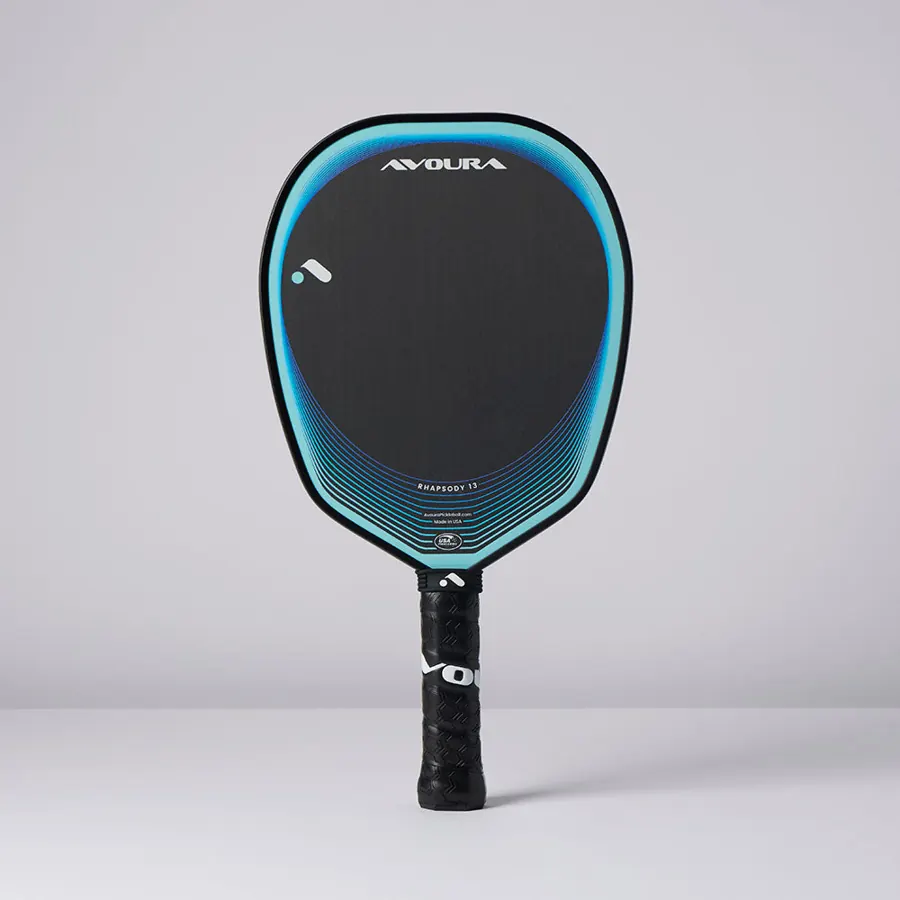
A widebody pickleball paddle is about 16 inches long and 8 inches wide, the widest face you can build while staying close to the classic length. The extra width raises twist weight, which is the paddle’s resistance to turning in your hand when you hit off-centre. Of the widebodies we stock, the Avoura Rhapsody 13 is the widest at 8.37 inches, the Selkirk LABS Project Boomstik Widebody has the highest published twist weight at 8.2, and the SLK ERA Power Widebody has the lowest published swing weight at 109.
We do not lab-test paddles. Every number here is the maker’s published spec, and each pick is on the list because of a specific number.
Widebody paddle spec chart
| Paddle | Length x width | Twist weight | Swing weight | Weight | Handle |
|---|---|---|---|---|---|
| Avoura Rhapsody 13 | 15.5 x 8.37 in | 7.76 | 110 | 8.1 oz | 5.25 in |
| Selkirk LABS Project Boomstik Widebody 16mm | 15.95 x 8 in | 8.2 | 112 | 8.0-8.4 oz | 5.6 in |
| Selkirk OMNI Widebody | 15.95 x 8 in | 7.9 | 112 | 7.9-8.2 oz | 5.6 in |
| SLK ERA Power Widebody | 15.95 x 8 in | 7.3 | 109 | 8.0-8.3 oz | 5.6 in |
| SLK Valkyrie Widebody 16mm | 15.95 x 8 in | 7.0 | 110 | 7.9-8.1 oz | 5.6 in |
| JOOLA Scorpeus Pro V 16mm | 16 x 8 in | Not published | Not published | 8.2 oz | 5.25 in |
Maker-published specs, checked October 9, 2026. Length includes the handle. Sorted by width, then twist weight. The full list is on the paddle specs table.
What widebody means
“Widebody” is a maker’s label for the roughly 16 by 8 inch outline. Some brands call the same outline “standard.” JOOLA lists the Scorpeus Pro V as Standard, and the previous-generation Scorpeus Pro IV, at the same published 16 by 8 inches, as Widebody.
The width is limited by the rulebook. USA Pickleball’s 2026 Official Rulebook, Rule 3.D.2, says the combined length and width of a paddle, including any edge guard and butt cap, must not exceed 24 inches (USA Pickleball rulebook, PDF). An 8 inch wide paddle can be 16 inches long at most. To go wider than 8 inches, a maker has to go shorter, which is what Avoura did with the Rhapsody 13: 8.37 inches wide, 15.5 inches long.
For how this outline compares with hybrid and elongated shapes, see pickleball paddle shapes explained.
Why width matters: twist weight
When the ball lands toward the edge of the face, the paddle tries to rotate around its long axis. Twist weight is the number for how hard it resists. Higher means the face stays squarer on a mishit and the ball goes closer to where you aimed.
Width is the main driver, because a wider face puts more material further from the centre line. Selkirk publishes both shapes of the same model, so the effect is easy to isolate:
- OMNI: widebody twist weight 7.9, elongated 6.9.
- LABS Project Boomstik 16mm: widebody 8.2, elongated 7.2.
- SLK ERA Power: widebody 7.3, elongated 6.6.
The widebody is ahead by 0.7 to 1.0 in every pair. It also swings lighter: 112 against 118 for the OMNI and Boomstik, and 109 against 118 for the ERA Power. So a widebody is both more stable and quicker to move. What you give up is about half an inch of reach.
That trade suits doubles players who spend most of a game at the kitchen line, newer players who do not yet find the centre every time, and anyone who blocks and resets more than they drive.
The picks
1. Avoura Rhapsody 13: the widest face
Avoura publishes the Rhapsody 13 at 8.37 inches wide, the widest paddle we stock by more than a third of an inch, on a 15.5 inch length with a 5.25 inch handle. Its published twist weight is 7.76 and its swing weight is 110, at a listed 8.1 ounces. The core is 13mm, thinner than the 16mm cores on the rest of this list. Avoura says it has the largest sweet spot in pickleball; that is the maker’s claim, and the width is the spec behind it. It is the shortest paddle here, so it is the one that gives up the most reach.
2. Selkirk LABS Project Boomstik Widebody: the highest twist weight
Selkirk lists the Boomstik Widebody 16mm with a twist weight of 8.2. That is the highest published twist weight of any paddle we stock. Dimensions are 15.95 by 8 inches with a 5.6 inch handle, swing weight is 112 and listed weight is 8.0 to 8.4 ounces, the heaviest range on this list. For what independent reviewers measured and thought, read our Selkirk Boomstik review roundup.
3. Selkirk OMNI Widebody: nearly as stable, lighter on the scale
Same 15.95 by 8 inch outline, same 5.6 inch handle and the same published swing weight of 112 as the Boomstik. Twist weight is 7.9, the second highest we stock, and the listed weight range is lower at 7.9 to 8.2 ounces. It is a 16mm paddle built on Selkirk’s PureFoam core, which Selkirk positions as its all-court foam paddle.
4. SLK ERA Power Widebody: the lightest swing
The ERA Power Widebody publishes a swing weight of 109. That ties for the lowest published swing weight of any paddle we stock, which makes it the pick if hand speed is why you want a widebody. Twist weight is 7.3, listed weight is 8.0 to 8.3 ounces, and the outline is Selkirk’s usual 15.95 by 8 inches. Note the gap between scale weight and swing weight here: it is not the lightest paddle on this list to hold, but it is the lightest to swing.
5. SLK Valkyrie Widebody: the lightest on the scale
The Valkyrie Widebody 16mm has the lowest listed weight range here at 7.9 to 8.1 ounces, with a swing weight of 110 and a twist weight of 7.0. It has a fiberglass face over a 16mm polypropylene honeycomb core. Its twist weight is the lowest of the Selkirk widebodies in the chart, though still above every elongated Selkirk shape we stock except the Boomstik.
6. JOOLA Scorpeus Pro V 16mm: the full 16 by 8
The Scorpeus is published at exactly 16 by 8 inches, which uses the whole 24 inch allowance, with a 5.25 inch handle. JOOLA lists the 16mm at 8.2 ounces and the 14mm at 8.0 ounces. It is the widest and shortest shape in JOOLA’s Pro V line, and JOOLA positions it for doubles players who win points with blocks, resets and counters. JOOLA does not publish twist weight or swing weight, so it is ranked here on dimensions alone.
Comparing them side by side
The paddle comparison tool lines up three paddles at once. The Rhapsody 13, Boomstik Widebody and Scorpeus Pro V are a good set to start with, since they are three different answers to how wide a paddle should be.
Two cautions when you read the numbers. Each maker measures on its own equipment, so a small gap between two brands may not be real, while a gap between two paddles from one brand is like for like. And a paddle’s listed weight is a range: two paddles of the same model can differ, which shifts swing weight a little too.
If you want more stability than a paddle ships with, a strip of lead tape on each edge raises twist weight. The swing weight calculator shows the effect before you commit. Better still, hit with a demo paddle first.
FAQ
What is a widebody pickleball paddle?
A paddle built around a face about 8 inches wide and about 16 inches long. Selkirk publishes its widebodies at 15.95 by 8 inches, JOOLA’s Scorpeus is 16 by 8, and the Avoura Rhapsody 13 is 15.5 by 8.37.
Are widebody paddles better for beginners?
For most, yes. A wider face has a higher twist weight, so off-centre hits stay on line more often, and widebodies also tend to swing lighter than elongated versions of the same paddle.
What is twist weight?
A measure of how much a paddle resists rotating around its long axis on an off-centre hit. Higher is more stable. The published twist weights of the paddles we stock run from 5.83 to 8.2, and the top of that range is all widebodies.
How wide can a pickleball paddle be?
There is no separate width limit. Rule 3.D.2 of the 2026 USA Pickleball rulebook caps length plus width at 24 inches, including edge guard and butt cap, and length at 17 inches. A wider paddle has to be shorter.
Do widebody paddles have less power?
They have less reach and less leverage than an elongated paddle of the same build, which shows up most on serves and drives. Core, face and thickness matter too; our 13mm vs 16mm guide covers the thickness side of it.