
Pickleball paddle shape is a trade between length and width. An elongated paddle is about 16.5 inches long and 7.5 inches wide, a widebody is about 16 inches long and 8 inches wide, and a hybrid sits between them at roughly 16.25 by 7.75 inches. Longer gives you reach and a heavier swing; wider gives you a more stable face that forgives off-centre contact.
The reason it is a trade and not a free choice is one line in the rulebook, and the chart below shows it playing out across 11 paddles we stock.
Paddle shape chart in inches
Every number here is the maker’s published spec, as recorded in our paddle specs table. The shape name is the maker’s own label. Sorted from shortest to longest.
| Paddle | Maker's shape label | Length | Width | Length + width | Handle |
|---|---|---|---|---|---|
| Avoura Rhapsody 13 | Widebody | 15.5 in | 8.37 in | 23.87 in | 5.25 in |
| Selkirk OMNI Widebody | Widebody | 15.95 in | 8 in | 23.95 in | 5.6 in |
| JOOLA Scorpeus Pro V | Standard | 16 in | 8 in | 24 in | 5.25 in |
| SLK Halo Power | Max | 16 in | 7.85 in | 23.85 in | 4.85 in |
| Avoura Rivelle | Hybrid | 16.25 in | 7.75 in | 24 in | 5.5 in |
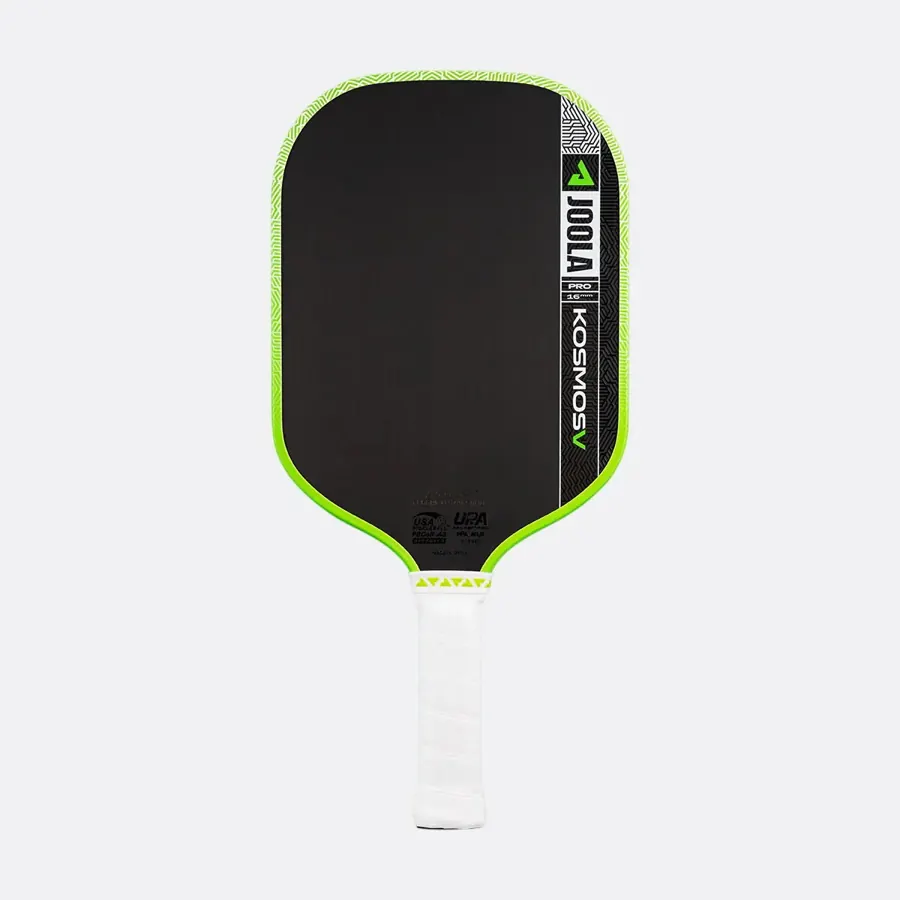
| JOOLA Kosmos Pro V | Hybrid | 16.3 in | 7.7 in | 24 in | 5.25 in |
| Selkirk OMNI Elongated | Elongated | 16.5 in | 7.45 in | 23.95 in | 5.8 in |
| JOOLA Perseus Pro V | Elongated | 16.5 in | 7.5 in | 24 in | 5.5 in |
| Avoura Revaya | Elongated | 16.5 in | 7.5 in | 24 in | 5.5 in |
| Bread & Butter Loco Elongated | Elongated | 16.5 in | 7.375 in | 23.875 in | 5.5 in |
| Slapp Life SHO | Not labelled | 16.75 in | 7.25 in | 24 in | 5.65 in |
Maker-published specs, checked October 9, 2026. Length includes the handle. "Length + width" is our addition of the two published figures.
Read down the “Length + width” column. Every paddle lands between 23.85 and 24 inches. That is not a coincidence.
Why every shape adds up to about 24 inches
USA Pickleball’s 2026 Official Rulebook, Rule 3.D.2, says the combined length and width of a paddle, including any edge guard and butt cap, must not exceed 24 inches, and the length alone must not exceed 17 inches (USA Pickleball rulebook, PDF). The same rule says there is no restriction on thickness, and Rule 3.D.3 says there is none on weight.
Makers want as much paddle as the rule allows, so nearly every design spends the full 24 inches. The only question left is how to split it. Take half an inch off the width and you can add half an inch to the length. That is the whole difference between a 16 by 8 inch widebody and a 16.5 by 7.5 inch elongated paddle.
No paddle in the chart gets close to the 17 inch length cap. A 17 inch paddle would have to be 7 inches wide or less to stay legal, which is why you rarely see one.
What the shape names mean
None of these names is defined by the rulebook. They are maker vocabulary, and the makers do not all use them the same way.
Elongated
The most consistent label. Every paddle called elongated in the chart is 16.5 inches long and between 7.375 and 7.5 inches wide. The extra length is usually shared between the face and the handle: Selkirk’s elongated shapes carry a 5.8 inch handle against 5.6 inches on its widebodies, per Selkirk’s spec sheets.
Widebody
About 16 inches long and 8 inches wide. Selkirk publishes its widebodies at 15.95 by 8 inches. The Avoura Rhapsody 13 goes further, at 15.5 by 8.37 inches, which makes it the widest paddle we stock.
Hybrid
The middle split. Avoura lists the Rivelle at 16.25 by 7.75 inches and JOOLA lists the Kosmos Pro V at 16.3 by 7.7 inches. JOOLA describes the Kosmos as the reach of its elongated Perseus combined with the wider sweet spot of its Scorpeus.
Standard and Max
These two cause the most confusion. “Standard” is the older name for the classic 16 by 8 inch outline, which is the same thing most brands now call widebody. JOOLA lists the Scorpeus Pro V as Standard, while the previous-generation Scorpeus Pro IV, with the same published 16 by 8 inch dimensions, is listed as Widebody.
“Max” is Selkirk’s word. The SLK Halo Power in Max shape is published at 16 by 7.85 inches with a 4.85 inch handle, the shortest handle in the chart. A short handle on a 16 inch paddle leaves more of the length for the face.
The practical advice: ignore the label and read the inches. Two paddles with different names can be the same outline, and the handle length changes how much of the published length is actually hitting surface.
What length and width do on court
Shape changes two measurable things besides reach: swing weight and twist weight. Swing weight is how heavy the paddle feels in motion. Twist weight is how much it resists rotating in your hand when the ball lands off-centre.
Selkirk publishes both numbers for both shapes of the same model, which is the cleanest comparison available because the core, face and thickness stay the same.
| Model | Shape | Swing weight | Twist weight |
|---|---|---|---|
| Selkirk OMNI | Widebody | 112 | 7.9 |
| Selkirk OMNI | Elongated | 118 | 6.9 |
| Selkirk LABS Project Boomstik 16mm | Widebody | 112 | 8.2 |
| Selkirk LABS Project Boomstik 16mm | Elongated | 118 | 7.2 |
| SLK ERA Power | Widebody | 109 | 7.3 |
| SLK ERA Power | Elongated | 118 | 6.6 |
Source: Selkirk's published specs for each model, checked October 9, 2026.
In all three pairs the elongated shape swings 6 to 9 points heavier and gives up 0.7 to 1.0 of twist weight. Mass further from your hand is harder to move, and a narrower face has less material out at the edges to resist twisting. You can load any two of these into the paddle comparison tool to see the full spec sheets side by side.
Which shape suits which player
| Shape | What you gain | What you give up | Suits |
|---|---|---|---|
| Elongated | Reach, leverage on serves and drives, room for two hands on the longer handles | Hand speed and stability on off-centre hits | Singles players, baseline drivers, former tennis players, two-handed backhands |
| Hybrid | Some of the reach with less of the swing weight penalty | Not the longest, not the most stable | All-court players who do not want to commit either way |
| Widebody or standard | The widest face, the highest twist weight, quicker hands | Half an inch or more of reach | Doubles players at the kitchen line, newer players, anyone who mishits toward the edges |
A few honest caveats. Shape is one input among several. Core thickness, covered in our 13mm vs 16mm guide, and total weight, covered in the paddle weight guide, change the feel as much as outline does. And the published numbers describe the paddle, not your swing. If you can, hit with both shapes before you buy. You can do that at the club with a demo paddle.
One paddle of each shape
These are the clearest examples of each outline on our wall. For ranked lists by shape, see the best elongated pickleball paddles and the best widebody pickleball paddles.
FAQ
What are the three pickleball paddle shapes?
Elongated (about 16.5 by 7.5 inches), widebody or standard (about 16 by 8 inches) and hybrid (about 16.25 by 7.75 inches). The names are maker conventions, so check the published length and width instead of relying on the label.
What is the maximum size of a pickleball paddle?
Under Rule 3.D.2 of the 2026 USA Pickleball rulebook, length plus width cannot exceed 24 inches including the edge guard and butt cap, and length cannot exceed 17 inches. There is no limit on thickness or weight. A legal shape still needs to be on the approved list for sanctioned play; see is my pickleball paddle legal.
Is an elongated or widebody paddle better for beginners?
A widebody is the easier starting point. The wider face has a higher twist weight, so mishits toward the edge stay on line more often, and the lower swing weight is easier to move in fast exchanges. Elongated paddles reward players who already make clean contact.
Is a standard paddle the same as a widebody?
Usually, yes. Both words describe the roughly 16 by 8 inch outline. JOOLA lists the Scorpeus Pro V as Standard and the Scorpeus Pro IV, at the same published dimensions, as Widebody.
Does paddle shape affect spin?
Shape itself is not a spin spec. Spin comes mostly from the face surface and how you swing, which we cover in pickleball paddle spin explained. A longer paddle does move its tip faster for the same swing, which is one reason drivers like elongated shapes.