

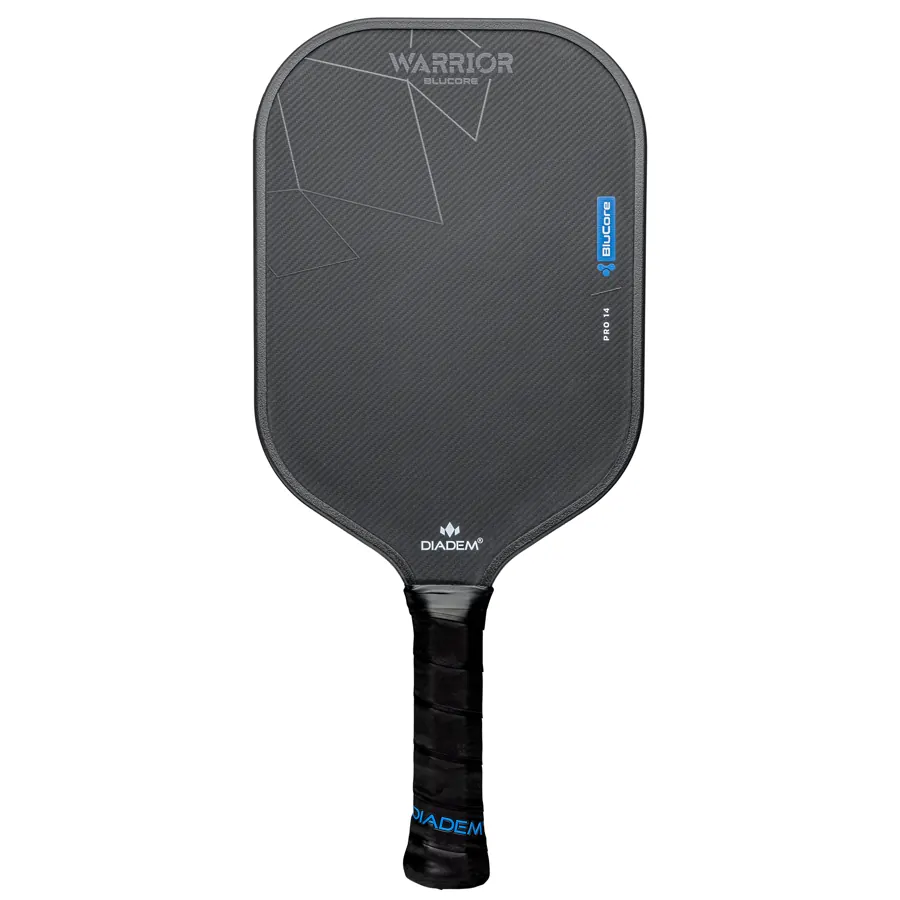
A foam core pickleball paddle replaces the usual polypropylene honeycomb with a solid piece of foam, often with a ring of a second, springier foam around it. Players and reviewers call these “Gen 4” paddles. That label is community shorthand for the fourth wave of paddle construction. It is not an official standard, and the makers below mostly do not use it.
What the makers do publish is what is inside. Here are the seven foam cores in paddles we stock, in each brand’s own wording.
Seven foam cores, in the makers’ words
| Paddle | Maker's name for the core | What the maker says is in it | Core thickness | Published weight |
|---|---|---|---|---|
| Selkirk OMNI | ReactCore | "a PureFoam floating center with a new PureFoam Ring surrounded by an EVA Power Ring" | 16 mm | 7.9–8.2 oz |
| Selkirk LABS Project Boomstik | BoomCore | "PureFoam surrounded by an EVA Power Ring and fused together" | 16 mm | 8.0–8.4 oz widebody, 8.0–8.3 oz elongated |
| Selkirk SLK Dauntless Elongated | SoloCore | "a one-piece PureFoam structure" with IsoFlex, "a perimeter cutout that loosens the core structure" | 16 mm | 7.7–8.1 oz |
| Bread & Butter Loco Elongated | Dual-Density Foam Core | "EPP and EVA foam" | 16 mm | 8.0–8.2 oz |
| Diadem Edge BluCore Pro 16mm | BluCore | "a full-foam EPP construction", with "a tapered EVA foam ring" around it | 16 mm | 8 oz |
| Diadem Warrior BluCore (Pro 19) | BluCore | "a solid EPP foam core" | 19 mm | 8.5 oz |
| Luzz Pro 4 Inferno | MPP | "MPP (Microporous Polymer) material" | 16 mm | 7.93 oz |
Quoted from each maker's own product page, checked October 9, 2026. Weights and thicknesses are maker-published. Pickleland does not lab-test paddles.
What the foam replaces
A conventional paddle core is a sheet of polypropylene honeycomb: thousands of small hexagonal cells, mostly air, sandwiched between the two faces. Our core materials guide covers polymer, Nomex and aluminum honeycomb and why polymer took over.
A foam core removes the cells. In their place is a slab of closed foam that fills the whole space under the face. The table shows the two materials that come up again and again:
- EPP is expanded polypropylene. It is the same base plastic as a polymer honeycomb, made as a foam instead of as cell walls. Diadem and Bread & Butter both name it.
- EVA is ethylene-vinyl acetate, a softer and springier foam. It usually appears as a ring around the main foam, which is how Selkirk and Diadem describe using it.
Selkirk calls its main foam PureFoam and does not say on the product pages we read what it is made of. Luzz calls its material MPP, for microporous polymer, and describes the core as “thousands of microporous foam cores.”
So several of these paddles have two parts under the face: a main foam centre and a second foam ring at the perimeter. The differences between brands are in how those parts are cut and joined. Selkirk’s three cores are a good illustration. The Boomstik has one PureFoam piece inside an EVA ring. The OMNI adds a second PureFoam ring between them. The Dauntless uses a single PureFoam piece with a cutout near the perimeter.
What Gen 4 means, and why it is only shorthand
The “Gen” numbers came from players and reviewers trying to keep up with construction changes. They are used roughly like this:
- Gen 1: faces glued to a polymer honeycomb core, with a separate edge guard.
- Gen 2: thermoformed paddles, where the face is molded around the core into one shell and foam is injected around the perimeter. See thermoformed paddles explained.
- Gen 3: thermoformed paddles that add more foam in or around the honeycomb to increase power.
- Gen 4: the honeycomb is gone and foam is the core.
Treat that list as a rough map. Nobody owns the terms, people disagree about where one generation ends and the next starts, and a higher number does not mean a better paddle. Approval for sanctioned play is per model, whatever generation people call it.
Makers use the labels loosely too. Luzz describes two of its polymer-core paddles, the Cannon and the Glider, as “Gen3+” and “Gen 3+” on their own pages. The product pages we read for the Selkirk OMNI, the Bread & Butter Loco and the Luzz Pro 4 Inferno do not use “Gen 4” at all. They describe the core.
When you shop, skip the generation number and read the core material line.
Foam in the paddle is not the same as a foam core
Plenty of honeycomb paddles contain foam. That does not make them foam-core paddles. Three examples from paddles we stock, in the makers’ wording:
- JOOLA lists the Perseus Pro V core as “PP Core + CF + EVA Foam,” with foam injected around the edges. PP is polypropylene.
- Selkirk lists the SLK ERA Power core as polypropylene surrounded by EVA foam.
- Luzz lists the Cannon as an “8mm PP Honeycomb Core with Enlarged Foam Core.”
All three keep a polypropylene core and add foam around or beside it. If the core line names a PP or polypropylene honeycomb core alongside the foam, it is a hybrid. You can check the core line for every paddle we carry in our paddle specs table.
What makers claim foam does
These are the makers’ claims, quoted. We have not tested them.
No core crush. Core crush is the name players give to honeycomb cells buckling after many hard hits, which changes how a paddle plays. A solid foam has no cells to buckle. Selkirk says of the Boomstik’s core: “No core crush, no break-in period.” Diadem says BluCore is “engineered to eliminate Core Crush and Delamination” and backs it with a lifetime core warranty. Luzz says its foam “resists crushing for lasting performance.”
Consistency over time. Selkirk says the Dauntless’s SoloCore has “lasting consistency.”
A bigger usable hitting area. Selkirk describes the Boomstik’s core as having “a massive sweet spot.” Luzz says filling the full area expands the effective hitting area.
Two cautions. These paddles are new, and our Boomstik review roundup found no reviewer had published long-term wear results. And read what a warranty covers before you count on it. Our guide on when to replace a paddle lists the signs of a worn core.
Does foam feel soft?
Not necessarily. The independent reviews we rounded up describe the Boomstik and the Loco as firm, not mushy, and they disagree with each other about the OMNI. See the OMNI roundup and the Loco roundup for what each tester said.
Feel also depends on the face and the thickness. Bread & Butter adds a layer of fiberglass to the Loco’s carbon face, and Diadem builds the Warrior BluCore at 19 mm.
Worked example: does a foam core change swing weight?
Does a solid core make a paddle heavier to swing? Selkirk publishes swing weight for foam and honeycomb paddles built in the same two shapes, so we can check.
| Selkirk paddle | Core | Elongated (16.5 × 7.45 in) | Widebody (15.95 × 8 in) |
|---|---|---|---|
| OMNI | Foam | 118 | 112 |
| LABS Project Boomstik | Foam | 118 | 112 |
| SLK Dauntless | Foam | 118 | not stocked |
| SLK ERA Power | Polypropylene with EVA foam | 118 | 109 |
| SLK Geo 14mm | Polypropylene honeycomb | 113 | not stocked |
| SLK Valkyrie | Polypropylene honeycomb | not stocked | 110 |
Selkirk's published average swing weights, checked October 9, 2026.
Average the columns:
- Elongated, foam: (118 + 118 + 118) ÷ 3 = 118
- Elongated, honeycomb or hybrid: (118 + 113) ÷ 2 = 115.5
- Widebody, foam: (112 + 112) ÷ 2 = 112
- Widebody, honeycomb or hybrid: (109 + 110) ÷ 2 = 109.5
Foam paddles come out about 2.5 points higher in each shape. The gap between shapes is 6 points for the foam paddles. So in this line-up, choosing elongated over widebody moves swing weight more than twice as much as choosing foam over honeycomb. It is a small sample from one brand, so read it as a tendency.
Selkirk’s published static weights overlap almost completely as well: 7.7 to 8.4 oz for the foam paddles and 7.8 to 8.4 oz for the others. Foam does not make a paddle heavy. For what swing weight means and how to change it, see swing weight vs static weight, or run your own numbers in the swing weight calculator.
Who should buy a foam core paddle
Worth a look if you play often and hit hard, since those are the players most likely to wear out a honeycomb core. Also if you want no break-in period, which Selkirk claims for the Boomstik.
Less urgent if your current paddle still plays the way it did when it was new. A good honeycomb paddle is not obsolete.
Check before you buy that the exact model and shape is approved for the events you play. Bread & Butter, Diadem and Luzz state approval on their product pages for the paddles above, and approval is per model, so confirm it on the official list. Our guide to checking whether a paddle is legal shows how.
Foam cores differ from each other more than the shared label suggests, so hit with one first. You can demo paddles at Pickleland in Pflugerville, or put up to three side by side in our paddle comparison tool.
FAQ
What is a Gen 4 pickleball paddle?
It is the community’s name for a paddle whose core is foam with no polypropylene honeycomb. It is shorthand, not an official standard, and most makers describe the core material without using the term.
What is a foam core pickleball paddle made of?
It varies by maker. Diadem and Bread & Butter name EPP, which is expanded polypropylene, paired with EVA foam. Selkirk calls its foam PureFoam and surrounds it with an EVA ring on the Boomstik and OMNI. Luzz calls its material MPP, a microporous polymer foam.
Do foam core paddles last longer?
Makers say so. Selkirk says the Boomstik’s core has no core crush, Diadem gives BluCore a lifetime core warranty, and Luzz says its foam resists crushing. Long-term independent data is still limited, and the face texture wears on any paddle whatever the core is made of.
Are foam core paddles legal for tournaments?
Approval is per model. Bread & Butter, Diadem and Luzz state approval on the product pages for the paddles in this post. Always check the exact model and shape on the approved list for the event you are playing.
Keep going
- Pickleball Paddle Core Materials: Polymer vs. Nomex vs. Aluminum
- Thermoformed Pickleball Paddles
- Selkirk Omni Review
- Selkirk Boomstik Review
- Bread & Butter Loco Review
Sources: maker product pages for the Selkirk OMNI, Selkirk LABS Project Boomstik, Selkirk SLK Dauntless, Bread & Butter Loco Elongated, Diadem Edge BluCore, Diadem Warrior BluCore and Luzz Pro 4 Inferno, all checked October 9, 2026.