

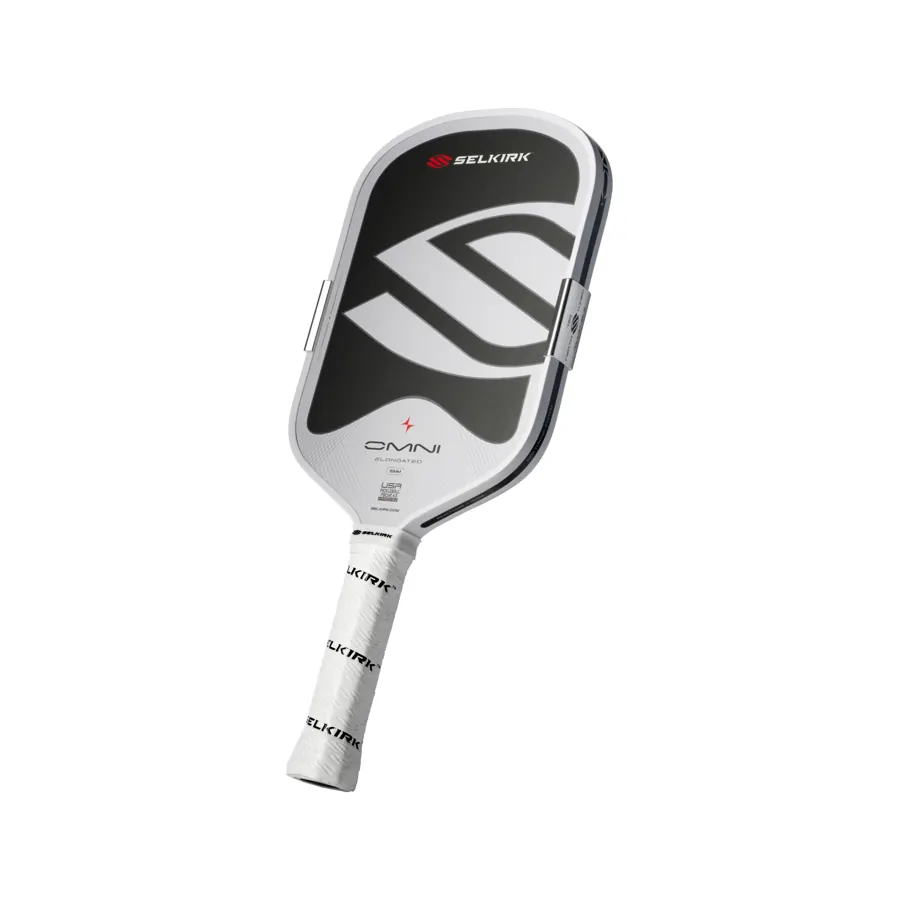
Static weight is what a paddle weighs on a scale. Swing weight is how heavy it feels when you swing it: the paddle’s moment of inertia about an axis 5 cm up from the butt cap, in kg·cm². Two paddles with the same static weight can sit 10 or more points apart in swing weight, because mass near the tip counts far more than mass near your hand.
If you want to see what a strip of tape would do to your own paddle, or measure a paddle at home, use our swing weight calculator. The rest of this post explains the number it gives you.
Published swing weights of paddles we stock
Every figure below is the maker’s own published number, checked on October 9, 2026. Selkirk, Luzz, Avoura and Bread & Butter publish swing weight. JOOLA, Diadem and Slapp Life do not, so their paddles are not in the chart.
| Paddle | Length × width (in) | Static weight (oz) | Swing weight |
|---|---|---|---|
| Luzz Cannon | 16.54 × 7.48 | 7.93 | 121 |
| Luzz Pro 4 Inferno | 16.54 × 7.48 | 7.93 | 119 |
| Bread & Butter Loco Elongated | 16.5 × 7.375 | 8.0–8.2 | 118–120 |
| Selkirk OMNI Elongated | 16.5 × 7.45 | 7.9–8.2 | 118 |
| Selkirk LABS Project Boomstik Elongated | 16.5 × 7.45 | 8.0–8.3 | 118 |
| Selkirk SLK Dauntless Elongated | 16.5 × 7.45 | 7.7–8.1 | 118 |
| Selkirk SLK ERA Power Elongated | 16.5 × 7.45 | 7.9–8.4 | 118 |
| Selkirk SLK Geo Elongated 14mm | 16.5 × 7.45 | 7.8–8.1 | 113 |
| Selkirk OMNI Widebody | 15.95 × 8 | 7.9–8.2 | 112 |
| Selkirk LABS Project Boomstik Widebody | 15.95 × 8 | 8.0–8.4 | 112 |
| Avoura Revaya | 16.5 × 7.5 | 7.8–8.2 | 112 |
| Luzz Glider 2024 Hybrid | 16.34 × 7.48 | 7.93 | 111 |
| Selkirk SLK Valkyrie Widebody | 15.95 × 8 | 7.9–8.1 | 110 |
| Avoura Rhapsody 13 | 15.5 × 8.37 | 8.1 | 110 |
| Selkirk SLK ERA Power Widebody | 15.95 × 8 | 8.0–8.3 | 109 |
| Avoura Rivelle | 16.25 × 7.75 | 7.8–8.2 | 109 |
Maker-published specs, each brand's own product page, checked October 9, 2026. Selkirk lists its figures as averages that may vary by about 2 points, and Luzz lists the Pro 4 Inferno as 119±3. Bread & Butter publishes a range. Each maker measures its own paddles, so comparisons inside one brand are the safest.
The same numbers, sortable and with averages, are in our paddle specs table.
What the chart shows
The static weights barely move: almost everything sits within a couple of tenths of 8 oz. The swing weights run from 109 to 121.
The cleanest example is inside one model. Selkirk publishes the same 7.9–8.2 oz for both shapes of the OMNI. The widebody is listed at 112 and the elongated at 118. The scale reads the same and the swing weight differs by 6 points, because the elongated paddle is about half an inch longer and carries its mass further from your hand.
Across brands, the Luzz Cannon is listed at 7.93 oz and 121. The Avoura Rhapsody 13 is listed at 8.1 oz and 110. The paddle that is heavier on the scale is 11 points lighter to swing.
You can put the two OMNI shapes side by side in our paddle comparison tool.
Why distance matters more than grams
Swing weight is a moment of inertia. Every bit of mass in the paddle contributes its mass multiplied by the square of its distance from the axis. Squaring is the whole story: a gram 30 cm from the axis counts nine times as much as a gram 10 cm from it.
For pickleball the axis sits 5 cm from the butt cap, roughly where the hand is. That is the pivot used by the Briffidi SW1 swing weight machine with its pickleball adapter, which Briffidi describes as measuring “at 5 cm from the end of the handle” and as the adapter most paddle reviewers use. Tennis swing weight is conventionally quoted about an axis roughly 10 cm (4 inches) from the butt, so a tennis racquet’s number and a paddle’s number are not comparable.
What low, medium and high feel like
There is no official standard for these bands. The cut-offs below are the ones our calculator uses, and typical paddles run from about 100 to 130.
| Swing weight | Feel | Good for | Cost |
|---|---|---|---|
| Under 105 | Light and quick | Fast exchanges at the kitchen line, tired or sore arms | Less mass behind drives and blocks |
| 105 to 117 | Middle of the road | Most doubles players | No strong advantage either way |
| 118 and up | Heavy, with plow-through | Drives, serves, counters, singles | Slower hands and more load on the forearm |
Every paddle in the chart above that is 16.5 inches or longer lands at 118 or more, except the SLK Geo and the Avoura Revaya. Every widebody lands between 109 and 112. If you like a paddle’s reach but find it slow at the net, that pattern is the reason.
Worked example: 6 grams of tape on an OMNI Elongated
Added mass changes swing weight by its mass in kilograms times the square of its distance from the 5 cm axis in centimetres:
Δ swing weight = m(kg) × (x − 5)²
Here x is the tape’s distance from the butt cap. Take the OMNI Elongated at its published 118 and add 6 grams in total (0.21 oz), split evenly between the two sides. The positions are the calculator’s presets for a 16.5 by 7.45 inch paddle.
| Where the 6 g goes | Distance from butt cap | Sum | New swing weight |
|---|---|---|---|
| Upper corners (10 and 2 o'clock) | 37.9 cm | 0.006 × 32.9² = 6.5 | 124.5 |
| Sides (3 and 9 o'clock) | 27.7 cm | 0.006 × 22.7² = 3.1 | 121.1 |
| Lower sides, near the throat | 17.6 cm | 0.006 × 12.6² = 1.0 | 119.0 |
| Handle, at the butt cap | 2 cm | 0.006 × 3² = 0.1 | 118.1 |
The same 6 grams adds 6.5 points in one spot and 0.1 in another. Per gram that is about 1.1 points at the upper corners, 0.5 at the sides and close to nothing on the handle.
The maths treats each strip as a point at its centre, so read the results as estimates to within a point or two.
How to change your paddle’s swing weight
Raising it is easy. Add weighted tape high on the edge guard. The higher it goes, the more each gram counts. Our lead tape guide covers placement, how many grams to start with and what the rules allow.
Lowering it is hard. You cannot take mass out of a finished paddle. Weight on the handle does not lower swing weight (it adds a tiny amount), but it moves the balance point toward your hand, which makes the head feel lighter. If a paddle is too heavy to swing with nothing added, the fix is a different paddle, usually a shorter or wider shape.
Some paddles have factory weights. Selkirk says the perimeter weights on the OMNI can be removed and rearranged. It describes the weights on the LABS Project Boomstik and SLK Dauntless as semi-permanent and warns that removing them could damage them.
Tape on the sides does two jobs. It adds a moderate amount of swing weight and the most twist weight per gram, which is what steadies off-centre hits.
Measuring swing weight at home
You do not need a machine. A paddle hanging from a pivot is a pendulum, and its swing time gives you its moment of inertia:
I(pivot) = m × g × d × T² ÷ 4π², then SW = I(pivot) − m × d² + m × (b − 5)²
m is the mass, d the distance from the pivot to the balance point, T the time for one full swing and b the balance point measured from the butt cap.
A worked run: an 8.0 oz paddle (0.2268 kg) balances 24 cm from the butt cap. You tape a skewer across the butt cap, hang the paddle head-down and time 20 small swings at 22.0 seconds, so T is 1.10 seconds.
- I(pivot) = 0.2268 × 9.807 × 0.24 × 1.10² ÷ 39.48 = 0.01636 kg·m², which is 163.6 kg·cm²
- Subtract m × d² = 0.2268 × 24² = 130.6, leaving 33.0 about the balance point
- Add m × (b − 5)² = 0.2268 × 19² = 81.9
- Swing weight = 114.8
Timing is the weak link. If the stopwatch had read 22.2 seconds instead of 22.0, the answer would be 117.8. A 1 percent timing error moves the result by about 3 points, so time it three times and average. The “Measure at home” tab of the calculator does the sums for you.
Where static weight still matters
Static weight tells you the total load on your arm over a long session, and nearly every product page lists it. Use it to narrow the field with our paddle weight guide, and use swing weight to explain why two paddles in the same band feel different.
You can demo paddles at Pickleland in Pflugerville and feel a 112 against a 118 on a real court before you buy.
FAQ
What is a good swing weight for a pickleball paddle?
Most published figures for paddles we stock fall between 109 and 121. Under 105 feels light and quick, 105 to 117 is the middle, and 118 or more feels heavy with more plow-through. Doubles players who live at the kitchen line usually prefer the lower half.
Is swing weight the same as paddle weight?
No. Paddle weight, or static weight, is what a scale reads. Swing weight is the moment of inertia about an axis 5 cm from the butt cap, so it depends on where the mass sits. Selkirk lists the OMNI Widebody and OMNI Elongated at the same 7.9–8.2 oz, with swing weights of 112 and 118.
How much does lead tape add to swing weight?
Each gram adds (distance from the 5 cm axis in cm)² ÷ 1000. On a 16.5 inch paddle that is about 1.1 points per gram at the upper corners, about 0.5 at the sides and almost nothing on the handle.
Why do elongated paddles have higher swing weight?
They are longer, so more of their mass sits far from the hand, and distance is squared in the calculation. In the published figures above, the elongated version of each Selkirk model is 6 to 9 points higher than the widebody.
Keep going
- Swing weight and lead tape calculator
- Pickleball Paddle Twist Weight
- Pickleball Paddle Balance Point
- Pickleball Lead Tape
- Pickleball Paddle Weight Guide
Sources: swing weights and static weights are from each maker’s own product page, recorded October 9, 2026, including Selkirk OMNI, Selkirk LABS Project Boomstik, Selkirk SLK Dauntless and Bread & Butter Loco. Measurement axis: Briffidi Pickleball Adapter Five for SW1.