
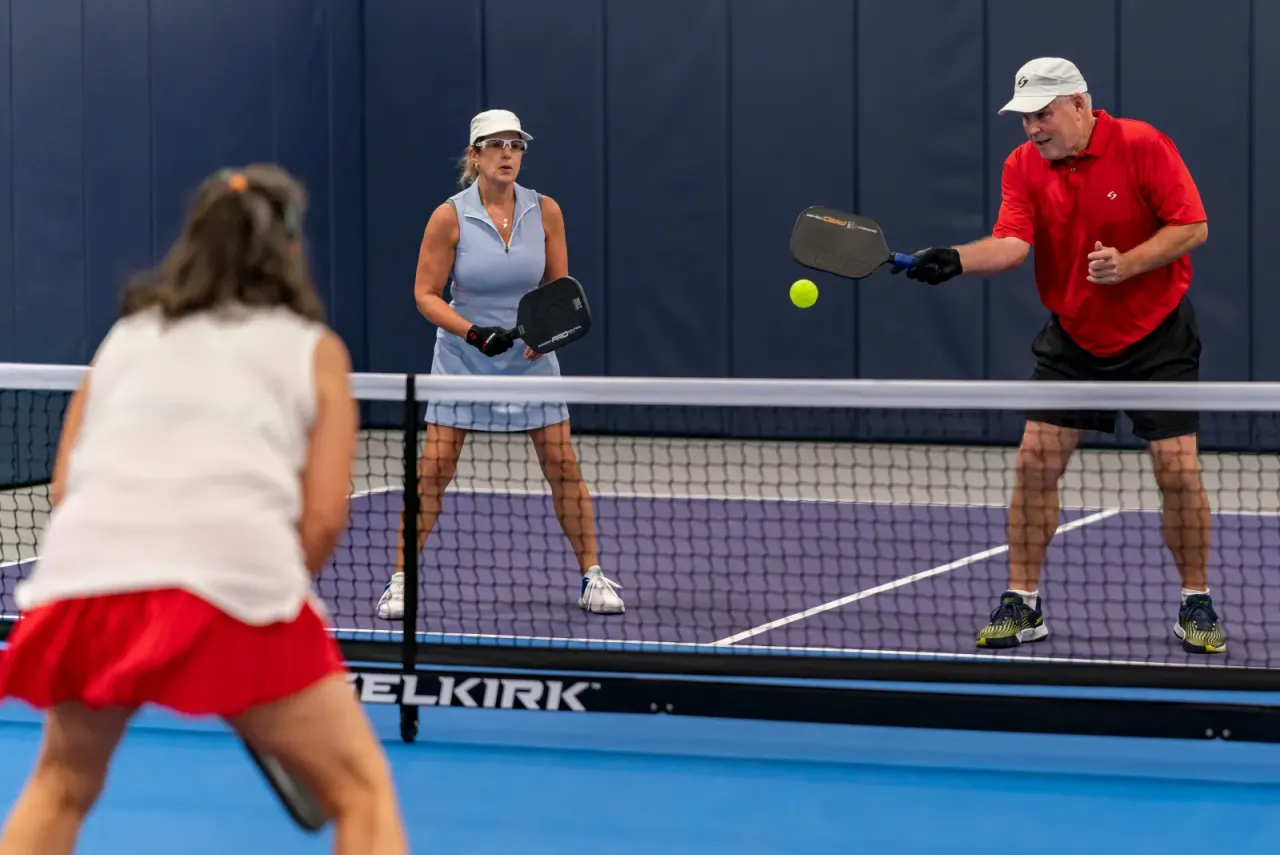
Mixed doubles gets treated as “regular doubles with a different lineup,” and that’s mostly true — the rules don’t change, the court doesn’t change, the third shot drop still wins the same way it always does. What changes is the matchup math: two mixed teams rarely bring the same skill gap to both sides of the court, and good opponents find that gap in the first few points. Here’s how to think about positioning, targeting, and the conversations that keep a mixed team from losing points to confusion instead of skill.
Why mixed doubles plays differently
At most rec and 3.0–4.0 club levels, mixed teams are built around who’s available, not who’s evenly matched — so it’s common for one partner to be clearly ahead of the other in power, reach, or reset consistency. That’s not a gender rule, it’s just how pairs form. The practical effect is the same either way: opponents probe both sides early, find the shakier one, and hit there relentlessly until you adjust.
The fix isn’t to hide your weaker side — it’s to know honestly, before the first serve, which of you is stronger where, and build your positioning around that instead of around habit.
Positioning: put the stronger forehand in the middle
The single highest-value adjustment in mixed doubles is the same one that matters in any doubles pairing: keep your best forehand covering the middle of the court, where the net sits lowest and most balls get hit. If one partner is right-handed and the other left-handed, stacking lets you keep both forehands in the middle at once — a real structural advantage over a team that doesn’t stack. The full mechanics of full vs. half stacking are in stacking in pickleball; the mixed-specific version of the same idea is just applying it honestly, not automatically putting the stronger player on the “power” side out of habit.
Where opponents will target you
Good opposing teams don’t guess — they test. Expect the first several points to include shots aimed at both of you, not just the assumed weaker side, because a smart opponent wants to confirm the gap rather than assume it. Once they’ve found it, three targets show up over and over:
- Straight down the middle, since the net is lowest at the center and a middle ball creates hesitation between two players regardless of who’s stronger. See pickleball net height for why that specific shot is so hard to defend.
- At the feet of whoever is slower to close to the kitchen line, forcing a low, defensive reset instead of an attacking dink.
- Deep and hard at whoever has the shorter or less consistent backhand, especially on the third and fifth shots of a rally, before either team has settled at the net.
Knowing this in advance changes what you practice before you ever set foot in a match — footwork into the kitchen line and backhand resets matter more in mixed doubles than raw power does.
Third-shot decisions
The third shot drop rule doesn’t change in mixed doubles, but the target usually should. If your partner is still working on kitchen-line resets, a hard, low third-shot drive at the net player who’s least comfortable blocking is often more effective than a picture-perfect drop, because it takes away their time to think rather than giving them a soft ball to attack. If both of you are comfortable at the net, default back to the standard drop-and-advance pattern covered in how to win at pickleball doubles.
Talk about the plan before the first serve
Thirty seconds of honest conversation prevents more lost mixed-doubles points than any drill:
- “Who’s stronger up top, and who’s stronger from the baseline?” Answer honestly — this decides your stacking side, not seniority or habit.
- “Middle balls — whoever’s forehand is there takes it.” Same default as any doubles team; see who takes the middle in pickleball doubles for the exceptions.
- “If they’re hunting one of us, are we switching or holding?” Some teams rotate sides mid-game to break the pattern once an opponent has locked onto a target; others hold position and just tighten technique. Decide before it happens, not while you’re down 2-6.
Common mixed doubles mistakes
- Assuming the stacking side by gender instead of by forehand and reach. Stack for the matchup you actually have, not the one you expect.
- Poaching too aggressively for a partner who hasn’t asked for help. A poach that leaves your partner’s side wide open costs more than it saves unless you’ve talked about when to do it.
- Playing passively to protect a weaker side instead of hiding it with positioning. Standing back to avoid mistakes usually just gives opponents more time and a bigger target — better to close to the kitchen line and rely on the team’s positioning plan.
Frequently Asked Questions
Is mixed doubles strategy different from regular doubles strategy?
The core mechanics — kitchen control, the third shot drop, forehand-in-the-middle positioning — are identical. What’s different is that mixed teams more often carry an uneven skill gap between partners, so stacking, target awareness, and pre-match communication matter more than they do for a closely matched same-level pairing.
Where do opponents usually target the ball in mixed doubles?
Down the middle first, since the net is lowest there and it creates hesitation between partners. After that, wherever a team identifies the shakier reset or backhand — which side that is depends on the actual players, not gender.
Should the stronger player always take the middle in mixed doubles?
Not automatically — the middle should go to whoever has the stronger forehand positioned there, which depends on handedness and stacking, not just who’s the better overall player. See who takes the middle in pickleball doubles for the full default and its exceptions.
How can a mixed team practice this before a real match?
Play matched games regularly so the stacking and communication habits become automatic under pressure, not something you’re deciding for the first time mid-rally. A bracket format helps more than open play does, because it forces the same decisions a competitive match will — Pickleland’s Unlimited members get free member-only Mini Tournaments, which is the cheapest way to get that practice.