
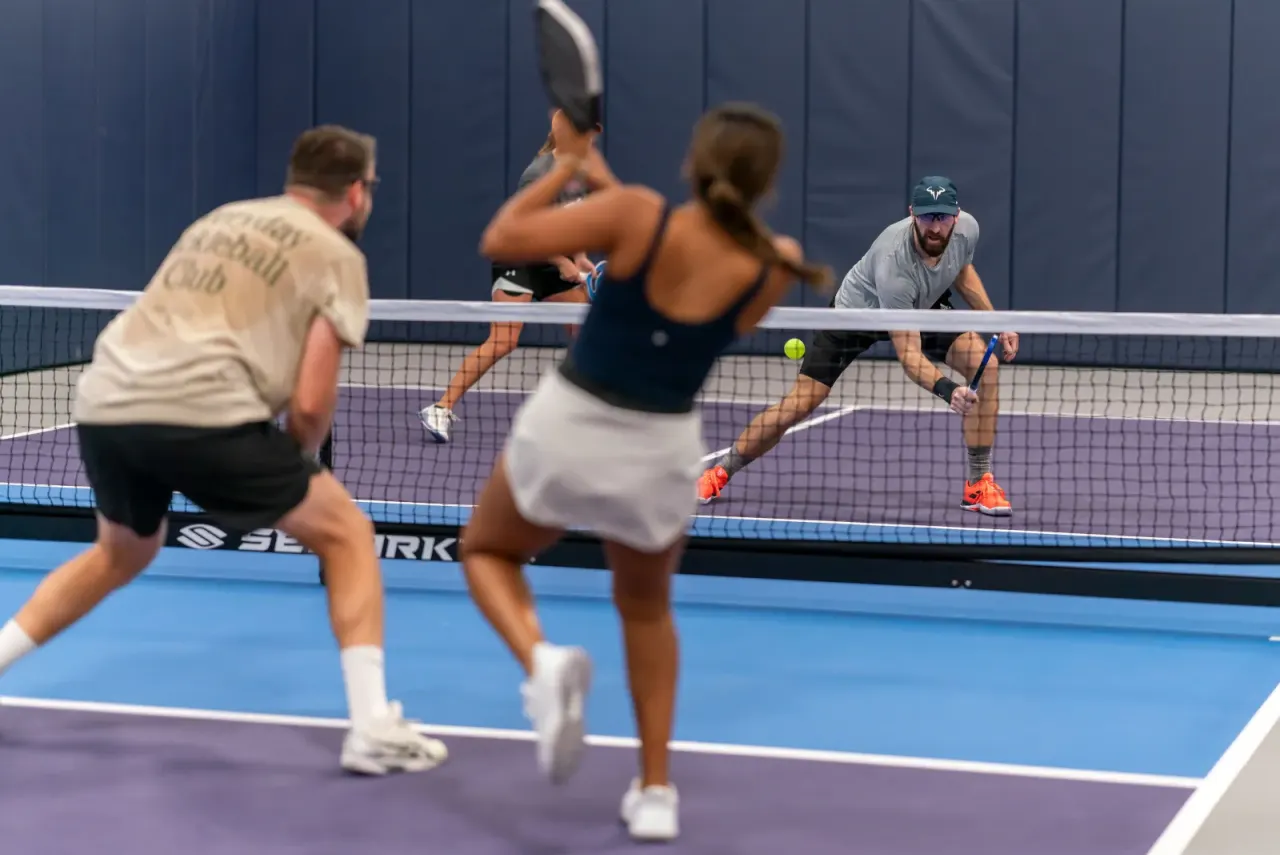
More points are lost to a ball landing untouched between two players than to any single technical error. Both players watch it, both assume the other has it, and nobody moves.
The fix isn’t athletic. It’s a decision made before the point starts.
The default rule: forehand takes the middle
If you remember one thing, remember this. The player whose forehand is in the middle takes the middle ball.
A forehand is a stronger, more reachable shot than a backhand for nearly every player. Two right-handers with one on each side means the player on the left side has their forehand in the middle, so middle balls are theirs.
This is a default, not a law — but as a default it resolves the large majority of middle balls without anyone having to think.
The exceptions
Left-handed pairings change everything. A right-hander on the left and a left-hander on the right puts two forehands in the middle — strong middle coverage, and the sidelines become the weak spot. Reverse it (lefty on the left, righty on the right) and you have two backhands in the middle, which is the weakest possible configuration. If you play with a lefty regularly, decide which side each of you takes and stick to it.
The player who’s moving forward takes it. Momentum wins. A player already stepping toward the middle should take the ball even if it’s technically the other’s forehand, because they’ll get there earlier and more balanced.
The player who can take it higher takes it. If one of you can hit it above net height and the other would take it at ankle height, the higher contact wins regardless of forehand or backhand.
The stronger player takes more. Uncomfortable but true, and standard in competitive doubles. If there’s a clear skill gap, the stronger player covers more of the middle.
Down-the-middle lobs go to whoever can turn fastest. Usually the player on the side the ball is drifting toward. Call it immediately — see the overhead smash.
Talk about it before the game
Thirty seconds before the first serve, with a new partner:
- “Are you a righty?” Establishes which forehands are where.
- “Middle balls — forehand takes it?” Agree the default out loud.
- “Call ‘mine’ early.” Agree that whoever calls it first gets it, no argument mid-point.
That’s it. This conversation prevents more lost points than any warm-up drill.
Communicating during the point
Call early, call short. “Mine” as the ball leaves their paddle. Not “I’ve got it” as it passes you.
Whoever calls first owns it. No negotiating mid-rally. If you both call, the forehand default breaks the tie.
Silence means the default applies. Which is why having a default matters.
Talk between points, not just during them. “That one was mine, I’ll take those” costs three seconds and fixes the pattern.
Partner communication is explicitly not a distraction fault, so don’t be shy about volume.
Why opponents target the middle
Understanding why you’re being attacked there helps you defend it.
- The net is lowest at the center — 34 inches versus 36 at the sidelines — so a middle ball is the safest shot on the court.
- It creates hesitation between two players, and hesitation produces weak shots.
- It has the most margin for error. No sideline to miss.
Good opponents hit the middle constantly. If you’re leaking points there, they will keep going until you stop it.
Drills
Middle ball feeds. Coach or partner feeds only middle balls while you and your partner hold the kitchen line. Call every one out loud. The drill is the calling, not the hitting.
Silent middle. Same feed, but no talking allowed. Forces the default rule to do the work and exposes whether you actually have one.
Lefty simulation. If one of you can play a few points with your non-dominant hand, it reveals fast how much the forehand-side assumption is doing.
Frequently Asked Questions
Who should take the middle ball in pickleball doubles?
By default, the player whose forehand is in the middle. For two right-handers, that’s the player on the left side of the court.
What if both partners are left-handed or mixed?
A right-hander on the left with a left-hander on the right gives you two forehands in the middle, which is the strongest setup. The reverse gives two backhands in the middle, so agree explicitly on coverage.
Why do opponents keep hitting down the middle?
Because the net is lowest at the center, there’s no sideline to miss, and a middle ball creates hesitation between two players. It’s the highest-percentage target in doubles.
How do you stop losing middle balls?
Agree a default before the game (forehand takes it), call “mine” early rather than late, and accept that whoever calls first owns the ball with no mid-point negotiation.
Does the stronger player take more of the middle?
In competitive doubles, usually yes. If there’s a clear skill difference, the stronger player covering more of the middle is standard and generally wins more points.