
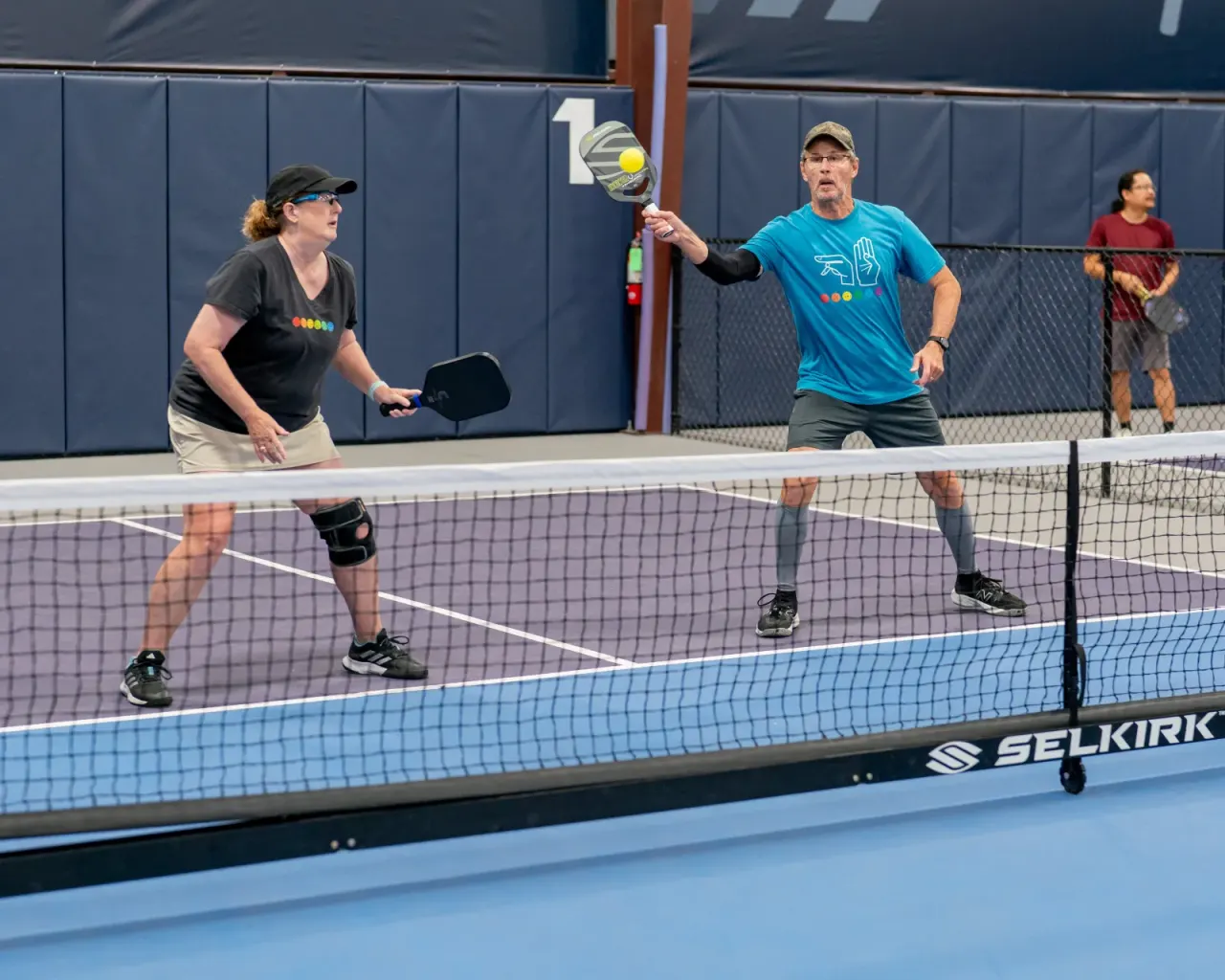
If your knee starts aching a few games into open play — or the next morning when you’re taking the stairs — you’re not alone. Knees are one of the most common complaints we hear at the front desk, right up there with pickleball elbow. The quick stops, lateral shuffles, and lunges that make pickleball so much fun are exactly the movements that load the knee joint hardest.
Below is what we tell our members: why pickleball is tougher on knees than it looks, the stance and strength fixes that prevent most of it, and what to do if you’re already feeling it.
Why Pickleball Is So Hard on Knees
Pickleball looks gentler than tennis or basketball, but a few things about the sport put real, repeated stress on the knee joint:
- Constant lateral movement. Side-to-side shuffles and quick direction changes load the knee in ways straight-ahead running doesn’t, especially the ligaments that stabilize sideways motion.
- Short, hard stops. The court is small, so points end in sudden decelerations — lunging for a dink, sprinting back for a lob — that put a spike of force through the knee with every one.
- A smaller court means less recovery time. You don’t get long rallies to move at an easy pace; it’s short bursts of hard effort, over and over, with little rest between them.
- Most players are 40+. Cartilage thins and stabilizing muscles weaken with age, so the same movement that was harmless at 25 asks more of an older knee.
- Rapid ramp-up. Like pickleball elbow, players go from once a week to four or five times a week within a month, and the knee’s supporting muscles don’t have time to catch up.
None of that means you should stop playing — it means the knee needs the same deliberate care players give their shoulder or elbow.
Common Pickleball Knee Injuries
Patellofemoral pain (runner’s knee)
A dull ache around or behind the kneecap, usually worse going down stairs or after sitting for a while. It’s an overuse pattern from the kneecap tracking slightly off-line during repeated bending, not a single injury — the most common knee complaint in racket sports.
Meniscus tears
The meniscus is the cartilage cushion between your thigh and shin bones. A sudden twist while your foot is planted — lunging for a wide dink, then pivoting — can tear it. Look for pain on the inside or outside of the knee joint line, occasional catching or locking, and swelling that builds over several hours.
MCL/LCL sprains
The ligaments on the inner (MCL) and outer (LCL) sides of the knee can sprain from a hard lateral cut or an awkward step on an opponent’s foot. Pain sits right on the side of the knee and often comes with mild instability.
IT band syndrome
The iliotibial band runs down the outside of the thigh to the knee. Repetitive bending under load can irritate it, causing sharp pain on the outer knee that flares up after 15-20 minutes of play and eases with rest.
Tendinitis
Overuse inflammation of the patellar tendon (just below the kneecap) or quad tendon (just above it), usually from a sudden jump in playing volume without matching strength work.
How to Prevent Knee Pain in Pickleball
1. Warm up before every session
Cold, stiff muscles transfer more shock straight to the joint. A dynamic warm-up — leg swings, walking lunges, a few minutes of light footwork — gets blood into the muscles around the knee before you ask them to decelerate hard.
2. Strengthen the muscles that protect the knee
Strong quads, hamstrings, and glutes absorb force so the knee joint itself doesn’t have to. Two to three times a week, twenty minutes is enough:
- Bodyweight squats and wall sits for the quads
- Glute bridges and clamshells for hip stability, which controls how the knee tracks during lateral movement
- Step-ups to build single-leg strength, since pickleball is played almost entirely on one leg at a time
- Calf raises, since a stiff ankle pushes more load up into the knee
This overlaps with a good chunk of our pickleball-specific workout routine — it’s not knee-only work, it’s the same conditioning that helps your whole game.
3. Get your footwear right
Running shoes are built for straight-line motion and let your foot roll on lateral cuts, twisting the knee above it. Court shoes with a stable, flatter sole and real lateral support keep your foot planted so the twisting force stops at the shoe instead of traveling up the leg. Our pickleball shoes guide covers what to look for.
4. Fix your stance, not just your shots
A lot of knee strain comes from bad footwork habits: reaching for a wide ball instead of moving your feet to it, or stopping dead instead of decelerating over two or three steps. Bend at the knees and hips rather than the waist, and keep your weight centered over your feet rather than lunging from a standstill.
5. Build volume gradually
Add no more than one extra session per week when you’re ramping up. The muscles around the knee need time to adapt to a new training load — jumping from twice a week to daily is the single most common cause of overuse knee pain we see.
6. Play on a forgiving surface
Concrete transmits far more shock into the knee than a sprung or cushioned indoor floor. If knee pain flares up specifically after outdoor sessions, that’s a real signal, not a coincidence.
7. Consider a brace for extra support
A simple compression sleeve or a hinged brace (for players with a history of ligament issues) can add proprioceptive feedback and mild support. It’s not a substitute for strength work, but plenty of our regulars wear one and it clearly helps them stay comfortable through a full session.
Treatment: What to Do If Your Knee Already Hurts
Rest, but don’t fully stop
As with most overuse injuries, total rest isn’t usually the answer — scale back to a level that doesn’t aggravate the pain (shorter sessions, dinks only, a day off between) while it settles.
Ice and anti-inflammatories
Ice for 15-20 minutes after play reduces swelling. Over-the-counter NSAIDs like ibuprofen can help manage pain during the acute phase, but they’re a short-term tool, not a long-term plan.
Compression and elevation
A knee sleeve helps with swelling and gives the joint some support during daily activity. Elevating the leg above heart level for stretches of time after a flare-up also helps fluid drain.
Gentle strengthening once the acute pain settles
Once you can move without sharp pain, gradually reintroduce the strengthening exercises above, starting light. Weak muscles are usually part of what let the injury happen in the first place, so skipping this step invites a repeat.
Physical therapy
If pain hasn’t meaningfully improved after two to three weeks of rest and self-care, a sports-focused physical therapist can identify what’s actually driving it — often something as specific as hip weakness or a footwork habit — and build a targeted plan.
When to See a Doctor
Most mild knee pain from pickleball responds to rest, ice, and strength work. See an orthopedist or sports medicine doctor if you notice:
- A popping sensation at the moment of injury, followed by swelling within a few hours
- The knee catching, locking, or giving way
- Pain or swelling that hasn’t improved after two weeks of rest
- Visible swelling, warmth, or redness around the joint
- Inability to fully straighten or bend the knee
- Pain severe enough that you can’t put weight on the leg
A locking or giving-way knee in particular is worth getting imaged — that pattern is consistent with a meniscus tear or ligament injury that self-care alone won’t fix.
Pickleland’s Two-Cent Take
Knee pain in pickleball is almost always a strength and footwork issue wearing a gear disguise. Players show up looking for a brace or a softer paddle, but the real fix is usually two things: build the hip and quad strength that controls how the knee tracks, and fix the habit of lunging from a dead stop instead of moving your feet. Our broader injury prevention guide covers the rest of the body, and our pickleball elbow guide is the companion piece for the other joint we hear about most.
If you’re playing at Pickleland and your knee has been nagging you, ask one of us at the desk — we can take a quick look at your footwork and stance and usually spot the pattern fast.
This article is for general education and isn’t a substitute for medical advice. If your symptoms are severe or persistent, please see a qualified healthcare provider.