

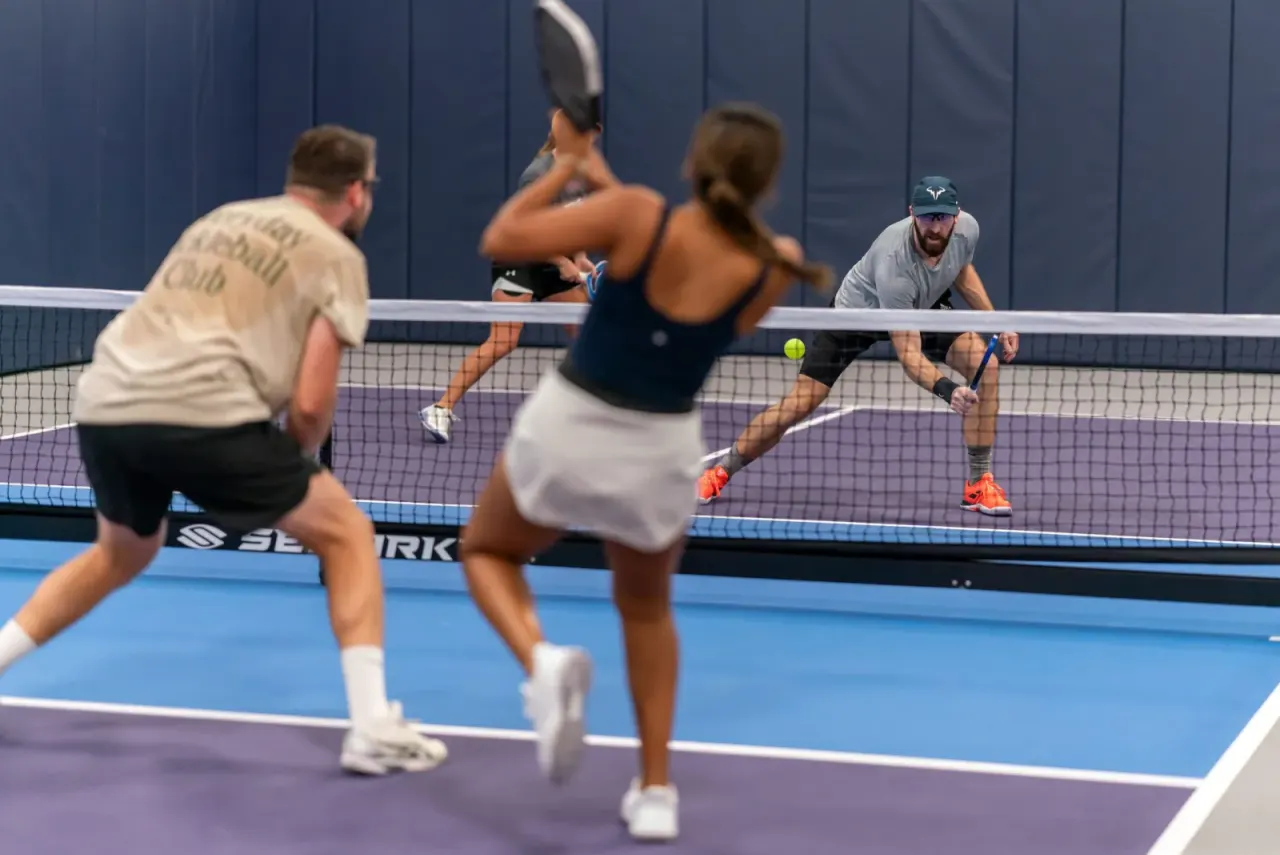
If you play outdoor pickleball, you’ve probably had a neighbor mention the noise — half-joking, half-not. It’s not just an Austin thing. Cities across the country are dealing with real disputes over the sport’s signature “pop,” and a couple of recent cases hit close to home.
Here’s what’s actually going on, why pickleball is so loud in the first place, and why more Austin-area players are quietly (pun intended) moving their weekly games indoors.
Why Pickleball Sounds So Loud in the First Place
The pop you hear on every shot comes from a hard, textured paddle face striking a hard plastic ball — a much sharper impact than a felt tennis ball meeting a strung racquet. Standard paddles can produce noise up to roughly 90 decibels at the point of contact, and that sound sits mostly in the 1,000–2,000 Hz range, which happens to be the frequency band human hearing is most sensitive to. That combination — sharp, repetitive, and pitched right where our ears pick up best — is why pickleball courts carry so much farther than a tennis rally, even at a similar volume on paper.
Multiply that by four players hitting hundreds of shots an hour, on courts often built close together and close to houses, and you get the noise disputes that have been showing up in city council meetings nationwide.
USA Pickleball’s Answer: The “Quiet Category”
The sport’s governing body has actually built an official response to this. In September 2023, USA Pickleball launched a Quiet Category certification for paddles: to qualify, a paddle has to test at roughly 50% lower acoustic output than a typical paddle, with an underlying decibel ceiling built into the testing protocol. Certified “quiet” paddles are engineered to shift the impact sound to a lower, duller frequency — more of a thump than a pop — which travels less and bothers neighbors less. USA Pickleball keeps the current list of certified products on its official equipment site.
If you play outdoors near houses — or your HOA or local park has started asking about it — a quiet-certified paddle is a legitimate, low-effort fix. It won’t make your game silent, but manufacturers and independent testing both put the reduction in the 7–13 decibel range, which is a meaningfully smaller footprint.
Austin Has Already Had Its Own Noise Fight
This isn’t hypothetical for Austin. Austin Pickle Ranch’s rooftop location — an eight-court setup built on top of a four-story office building and parking garage at Hartland Plaza on West Sixth Street, just east of MoPac — ran into exactly this problem. The Old West Austin Neighborhood Association told local reporters it was “a noise and light issue mostly,” describing the repetitive impulse sound of paddle-on-ball carrying into nearby homes from early morning into the evening. The facility was shut down in June 2024 over the underlying zoning issue — “ultimately due to city zoning issues,” as Pickle Ranch put it in its own closure notice — and the property owner then pursued a rezoning to reopen, with the neighborhood association asking the Planning Commission to require 10-foot sound barriers on the west and north sides of the building.
That was two years ago, and the rooftop courts have not come back: as of October 2026 Austin Pickle Ranch lists a single location, its indoor Braker facility at 11000 Middle Fiskville Rd, with no West Sixth location advertised at all. The lesson Austin players took from it is the durable one — eight courts, a signed lease and a built-out rooftop lost to a dispute about sound. (Austin Monitor; Urbanize Austin; Austin Pickle Ranch’s own closure notice)
Austin isn’t unique, either. In December 2025, Carmel-by-the-Sea, California — an oceanfront town that had already tried a temporary ban — made its prohibition on pickleball at its only public court, Forest Hill Park, permanent after residents described the constant popping as disruptive to the neighborhood.
Why This Doesn’t Touch Indoor Courts
Every one of these disputes shares the same root cause: an open-air court next to homes, with sound radiating outward with nothing to absorb or contain it. That’s a non-issue inside a purpose-built facility. At Pickleland, our 9 courts sit inside a fully enclosed, climate-controlled building in Pflugerville — the pop stays inside with the AC, there’s no property line for a neighbor to complain across, and nobody’s rezoning case depends on how loud your dinks are. It’s one of the quieter side benefits of playing indoors, alongside not melting in a Texas summer (see our guide on playing pickleball in Texas heat) or dealing with wind pushing your dinks off target.
If you’re weighing indoor vs. outdoor options around Austin, our rundown of the best indoor pickleball courts in Austin covers the full list, and Pickleland’s hours and location are Mon–Fri 8am–10pm and Sat–Sun 8am–8pm at 21427 Martin Lane, Pflugerville.
If You Do Play Outdoors: A Few Practical Fixes
Not everyone has an indoor court nearby, so if you’re playing outside in a neighborhood setting, a few things genuinely help:
- Switch to a quiet-certified paddle for residential-adjacent courts — check the USA Pickleball Quiet Category list before you buy.
- Respect posted hours. Most noise complaints escalate around early-morning or late-evening play, not midday sessions.
- Ask about sound barriers or landscaping if you’re part of a group petitioning a city or HOA for court access — it’s the single biggest mitigation lever short of relocating.
- Advocate with data, not just opinions. Cities that have adopted clear decibel thresholds (rather than case-by-case complaints) tend to produce outcomes both players and neighbors can live with.
Pickleland’s Two-Cent Take
We love outdoor pickleball, but we also watched a well-known Austin facility get shut down over exactly this issue, so we don’t think it’s a fringe concern. If you’re building a backyard or community court, plan for sound from day one — quiet paddles, distance from bedroom windows, and reasonable hours will save you a rezoning fight later. And if you’d rather skip the whole equation, that’s what indoor courts are for — come hit with us any day of the week, no neighbors required.