
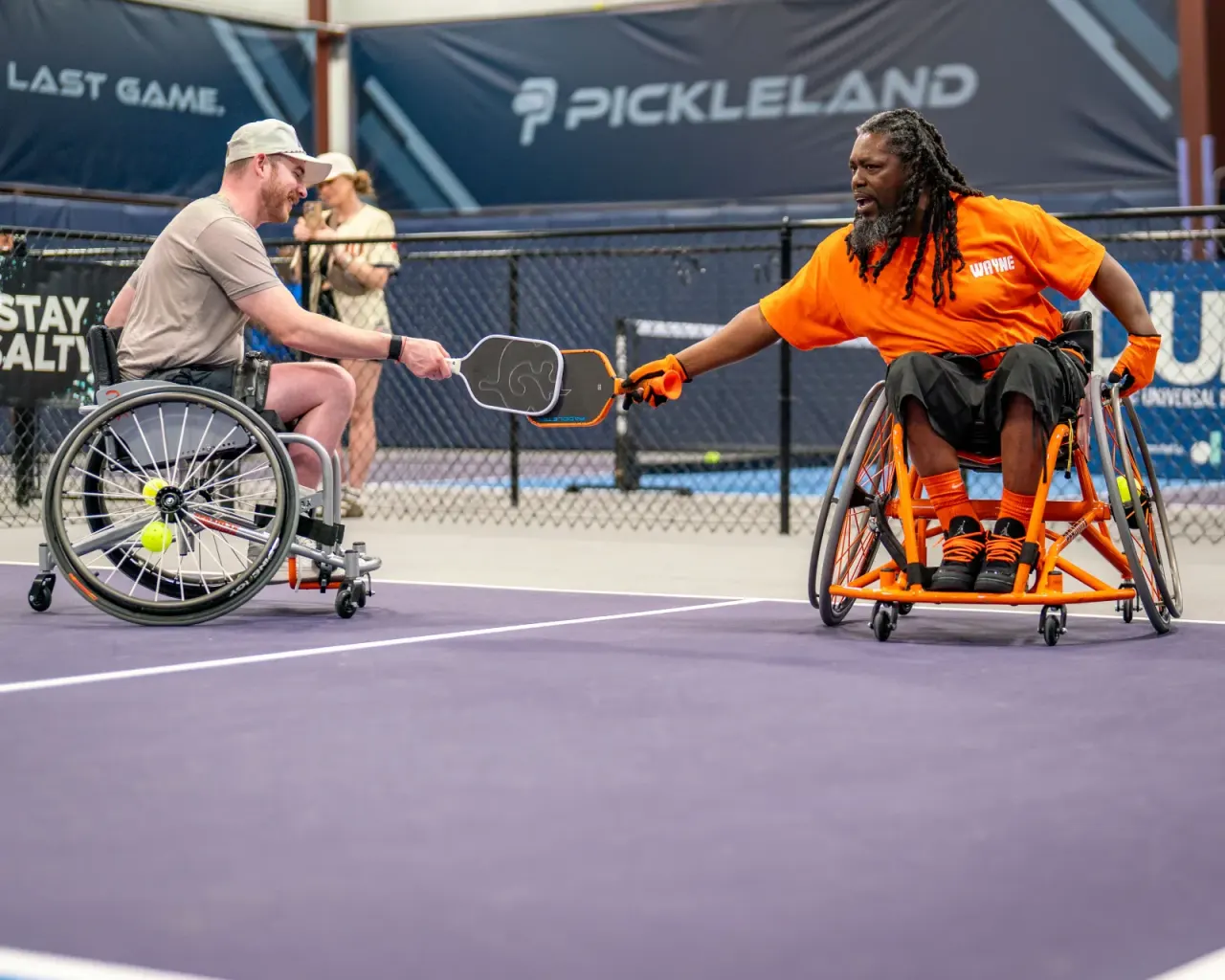
Pickleball’s low-impact reputation made it a natural fit for adaptive play from early on, and USA Pickleball has built out a full set of wheelchair-specific rules to go with it — not a simplified version of the game, but a real ruleset with its own mechanics. Here’s how it actually works, straight from USA Pickleball’s rulebook.
Who plays wheelchair pickleball
USA Pickleball’s definition is broader than people expect: “an eligible wheelchair player is any person, with or without a disability, who plays the game in a wheelchair.” You don’t need a documented disability to play in a wheelchair — the rules exist for anyone competing that way.
The wheelchair counts as part of the player
The chair itself is treated as an extension of the player’s body for rules purposes, the same way a standing player’s legs are. Specifically, the large rear wheels are treated like a standing player’s legs for positioning — where they are matters for faults the same way foot position matters for a standing player.
The two-bounce accommodation
This is the rule most people have heard of, and it’s the core adaptation: a wheelchair player may allow the ball to bounce twice before returning it, and the second bounce can land anywhere on the playing surface — not just within a limited zone. This applies on top of pickleball’s standard two-bounce (one for each side) rule at the start of a rally, giving wheelchair players extra time to reach a ball and reposition. If a ball bounces in the kitchen, a wheelchair player is allowed that second bounce anywhere on the court before playing their return.
Non-volley zone (kitchen) faults
The kitchen rule gets an important adjustment for wheelchair play:
- The chair’s front and stabilizing wheels can contact the non-volley zone at any time without penalty.
- Contact by the large rear wheels while volleying is a fault — this is the wheelchair equivalent of a standing player stepping into the kitchen on a volley.
- If a volley’s momentum carries a large rear wheel into the non-volley zone — even after the ball is already dead — it’s still called as a fault.
Serving
During the serve, both large rear wheels must stay on the playing surface, behind the baseline, and within the correct service area — mirroring the foot-fault rule for standing servers. The smaller front wheels are allowed to extend into the court while hitting the serve.
Tournament eligibility and hybrid doubles
Wheelchair players aren’t limited to wheelchair-only brackets. Per USA Pickleball’s rules, a wheelchair player may compete in any tournament event other than an adaptive standing-only event, and can partner with or play against standing players, adaptive standing players, or other wheelchair players. Wheelchair-only events, by contrast, are restricted to wheelchair players.
That opens the door to hybrid doubles — one wheelchair player paired with a standing player. In that format, the two-bounce accommodation applies only to the wheelchair player on their side of the court; their standing partner still plays under the standard rules.
Equipment
There’s no separate paddle or ball requirement for wheelchair pickleball — the same USA Pickleball-approved paddles and balls used in standing play apply. The main equipment consideration is the chair itself: a sport wheelchair with camber (angled wheels) gives faster lateral movement and tighter turns than a standard chair, which matters more in pickleball’s quick side-to-side kitchen exchanges than it does in most other adaptive sports.
How to get started
- Find a program near you. USA Pickleball and regional wheelchair sports organizations maintain listings of adaptive pickleball clinics and leagues — check with your local parks and recreation department or ADA sports program first, since many indoor facilities can accommodate wheelchair play without any special setup.
- Learn the two-bounce and kitchen adjustments before your first session so you’re not relearning positioning mid-game — they’re the two rules that trip up standing players trying to referee or play against a wheelchair opponent for the first time, too.
- Play mixed games early. Because hybrid doubles is explicitly allowed, you don’t need a full wheelchair group to start playing — a standing partner or opponents works from day one.
Frequently Asked Questions
Can anyone play wheelchair pickleball, or only players with disabilities?
Anyone. USA Pickleball defines an eligible wheelchair player as any person who plays the game in a wheelchair, with or without a disability.
What is the two-bounce rule in wheelchair pickleball?
A wheelchair player may let the ball bounce twice before returning it, and the second bounce can land anywhere on the court. This is on top of the standard rule that each side lets the return of serve bounce once before hitting a volley.
Can a wheelchair player and a standing player be doubles partners?
Yes — this is called hybrid doubles, and it’s explicitly allowed in tournament play. The two-bounce accommodation applies only to the wheelchair player’s side of the return.
Do wheelchair players need special paddles or balls?
No. The same USA Pickleball-approved paddles and balls used in standing play are used in wheelchair pickleball; the main equipment difference is the chair itself, where a cambered sport wheelchair helps with lateral movement.
What counts as a kitchen fault for a wheelchair player?
Contact with the non-volley zone by the chair’s large rear wheels while volleying is a fault, including if momentum carries a rear wheel into the zone after the ball is dead. The smaller front and stabilizing wheels may enter the non-volley zone at any time.