

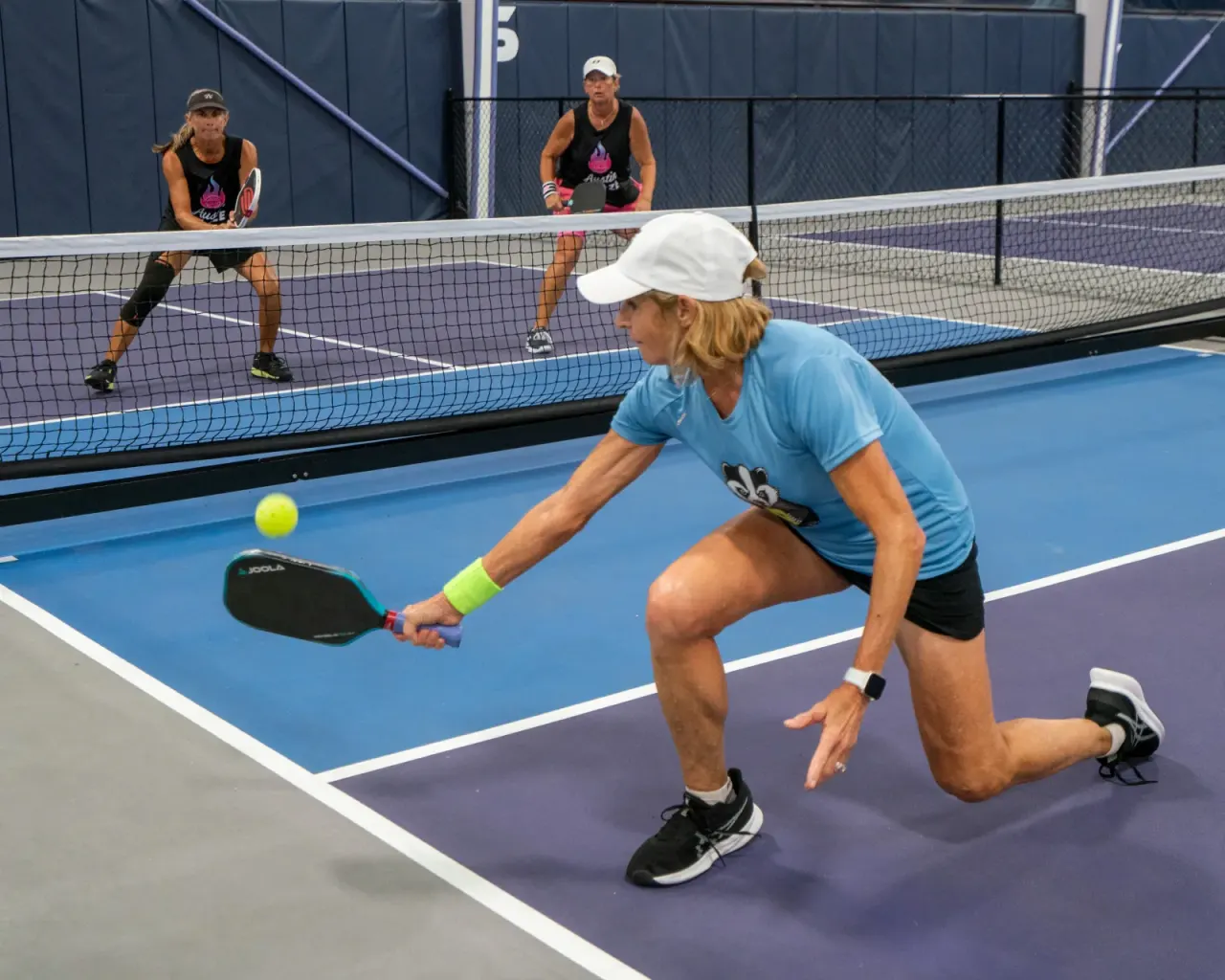
The reset is the shot that separates 3.0 players from 3.5 players. When a fast exchange erupts at the kitchen, most beginners either panic and try to counter at full pace or pop the ball up into an easy put-away. A player who can reset takes that same high-speed ball, absorbs the pace, and returns it softly into the kitchen — ending the exchange and rebuilding the rally on their terms.
It’s not flashy. It’s not satisfying the way a winning drive is. But the reset is arguably the most important skill in pickleball for anyone trying to move up a rating level.
What Is a Pickleball Reset?
A reset is a soft, controlled shot — usually a volley or half-volley — that returns a hard-driven or speed-up ball into the non-volley zone. Its goal is not to win the point, but to neutralize your opponents’ attack and get both teams back to a neutral dinking exchange.
When executed correctly, a reset:
- Lands low in the kitchen, forcing opponents to hit up
- Removes the pace they were counting on
- Buys time to recover your feet and court position
- Sets up a dink rally where you’re no longer under pressure
When executed with too much grip or too much forward swing, the ball floats back up and your opponent gets another attack.
Why the Reset Is So Hard
The counterintuitive part of the reset is that it requires you to go soft when your brain is screaming to go hard. A ball driven at pace looks like it needs a forceful response. But pickleball’s court geometry means that a soft ball placed low in the kitchen is nearly impossible to attack — while a counter-drive returned at the same pace is easy to handle for someone already loaded in an attack position.
Your nervous system defaults to matching incoming pace. Overriding that instinct — consistently, under pressure — is what makes the reset a trained skill rather than a natural one.
The Three Keys to a Good Reset
1. Loosen Your Grip
Grip pressure is the single most common reset mistake. A tight grip creates a stiff paddle face that bounces the ball back at pace. You want the opposite: a soft, absorbing surface.
Think of it like catching a ball with your glove hand. You don’t tense up when catching — you let the hand give back slightly to absorb momentum. Your paddle works the same way with a loose grip.
On a 1–10 scale, most players hold around 7–8 during a fast exchange. For a reset, aim for 4–5. It will feel wrong at first. That discomfort is the skill being built.
2. Open Your Paddle Face
A slightly open paddle face — tilted back a few degrees rather than flat — naturally deflects the ball downward into the kitchen rather than sending it straight back at pace. Combined with a loose grip, it acts like a ramp: incoming pace arrives, absorbs, and exits low.
The exact angle depends on ball height and speed. Practice calibrates your feel, but the default for most resets is a face slightly more open than what you’d use for a standard dink.
3. Move the Paddle Back, Not Forward
A drive coming at your body is moving toward you fast. If you swing your paddle forward at it — even gently — you’re adding to its momentum. Instead, yield the paddle back slightly as you make contact, using the incoming pace to do the work.
This is called “soft hands.” The ball arrives, the paddle gives backward a few inches, and the ball loses most of its energy before it exits your face. Done right, it feels like you did almost nothing at all.
Body Position and Footwork
Good resets begin before the ball reaches you.
- Get low. Bend your knees and keep your center of gravity down. A low contact point gives you far more control over trajectory. Standing tall makes it nearly impossible to keep the ball from floating above the net.
- Meet the ball in front. Contact the ball in front of your body, not off to the side or behind you. A ball hit at your hip or past your frame is nearly impossible to reset — you lose all directional control.
- Face the threat. If the attack comes from your right, rotate your shoulders to face it squarely. A reset hit across your body has a much higher error rate than one hit head-on.
- Stay wide. A balanced, athletic stance — feet shoulder-width apart or wider — gives you a stable base. A narrow or closed stance makes the absorbing motion choppy.
When to Reset vs. When to Counter-Attack
Not every fast ball needs a reset. The key question: is this ball attackable from where you’re currently standing?
Reset if:
- The ball is below net height or at your feet
- You’re off-balance or out of position
- You didn’t pick up the ball early enough for a clean swing
- You need time to recover your position
Counter-attack if:
- The ball is above net height and in your strike zone
- You’re already set, balanced, and have a clean look
- There’s an open shoulder or hip to target
Most intermediate players under-reset and over-attack. A practical rule: if you’re less than 70% confident the attack wins the point, default to the reset. Patience compounds over a full match.
Three Drills to Build Reset Muscle Memory
Drill 1: Feed-and-Reset (with a partner)
Your partner stands at the baseline and drives balls at medium pace to your forehand and backhand at the kitchen line. Your only job is to reset each ball into the kitchen — no counter-attacking, just absorbing and returning low.
- Reps: 50 per side
- Track: how many land in the kitchen vs. float above net height
- Goal: 80%+ in the kitchen before progressing to faster feeds
Drill 2: Speed-Up-Reset Cycle (with a partner)
Play a dink rally. Either player can randomly speed up any dink at any time. The receiver must reset. After a successful reset, the rally returns to dinking. Whoever fails the reset or the speed-up loses the point.
This drill mirrors the real game situation: you don’t know when the speed-up is coming. Your reset has to become a reflex, not a conscious decision.
Drill 3: Solo Wall Resets
Stand about 7 feet from a wall and drive the ball at head height, then reset the return back to the same spot. Continuous repetitions. The wall gives instant feedback — a good reset produces a low, controllable return; a stiff reset bounces high and wide.
Great for calibrating grip pressure before you take it on court.
The Reset in Doubles
In doubles, the reset has an extra dimension: communication.
When you absorb a speed-up and reset, your partner needs to know not to attack the next ball. The reset typically produces a neutral or below-net return — attacking it risks an error. A quick “reset” or “no” call gives your partner time to hold.
Also decide in advance who takes the body shot. Most teams default to forehand-takes-middle, but discuss it before the match. An uncontested ball through the middle is one of the most common reasons resets fail — both players hesitate, and nobody gets there in time.
Resets at Every Skill Level
2.5 / 3.0: Focus on the fundamentals — loose grip and open paddle face. Don’t worry about placement yet. Just keep the ball below net height on the way back over. Getting it in the kitchen at all is the win.
3.5: Start directing your resets cross-court instead of straight-ahead. Cross-court resets pass over the lowest part of the net and land further from the player who just attacked — both advantages in one adjustment.
4.0+: The reset becomes a transition shot. Absorb the pace, your partner covers if the reset floats, and you move back to the kitchen line immediately, ready to speed up the next opportunity. The reset is no longer purely defensive — it’s a setup shot.
The Reset as a Mindset Shift
The best reset players don’t just have good technique — they’ve accepted that neutralizing the rally is a win, not a concession. When you absorb your opponent’s hardest shot and return it softly into the kitchen, you’ve done something genuinely difficult. The fact that it doesn’t look impressive is the point.
Train it until it’s boring. Then use it to out-survive every player who is trying to blast their way to a 4.0.
Also read:
- How to Beat Bangers in Pickleball (Without Becoming One)
- How to Dink in Pickleball: Technique, Patterns, and Drills
- How to Get Better at Pickleball: The Ultimate Improvement Guide
Frequently Asked Questions
What is a reset in pickleball?
A reset is a soft, absorbing shot — typically a volley or half-volley at the kitchen line — that returns a hard-driven or sped-up ball low into the non-volley zone. Its purpose is not to win the point but to neutralize your opponents’ attack and return the rally to a neutral dinking exchange.
How do you reset a hard-driven ball in pickleball?
Three keys: loosen your grip (around 4–5 on a 1–10 scale), open your paddle face slightly so the ball deflects downward, and let the paddle yield back slightly on contact rather than swinging forward. Your goal is to absorb the pace, not match it.
When should you reset instead of counter-attacking?
Reset when the ball is below net height, you’re off-balance, or you don’t have a clean attacking angle. Counter-attack when the ball is above net height, you’re set, and you’re confident in the shot. Most intermediate players under-reset — when in doubt, default to the soft ball in the kitchen.
Why is the reset so difficult to master?
It requires going soft under pressure, which is the opposite of most athletes’ instincts. A tight grip — what almost everyone defaults to in a fast exchange — sends the ball floating back up for another attack. Building “soft hands” takes deliberate repetition in drills before it becomes automatic in live play.
Is a reset the same as a dink?
They’re related but different. A dink is a controlled, intentional soft shot in a dink rally. A reset is specifically a defensive response to a hard-driven or sped-up ball. Both land in the non-volley zone; the reset just has to absorb significantly more incoming pace first.
Does the reset count as a let or fault if it catches the net?
No special rule — a reset that hits the net and stays on your side is just like any other ball into the net: it’s your point lost. If it clips the net and falls over onto your opponent’s side of the kitchen, it’s in play, same as any shot.