

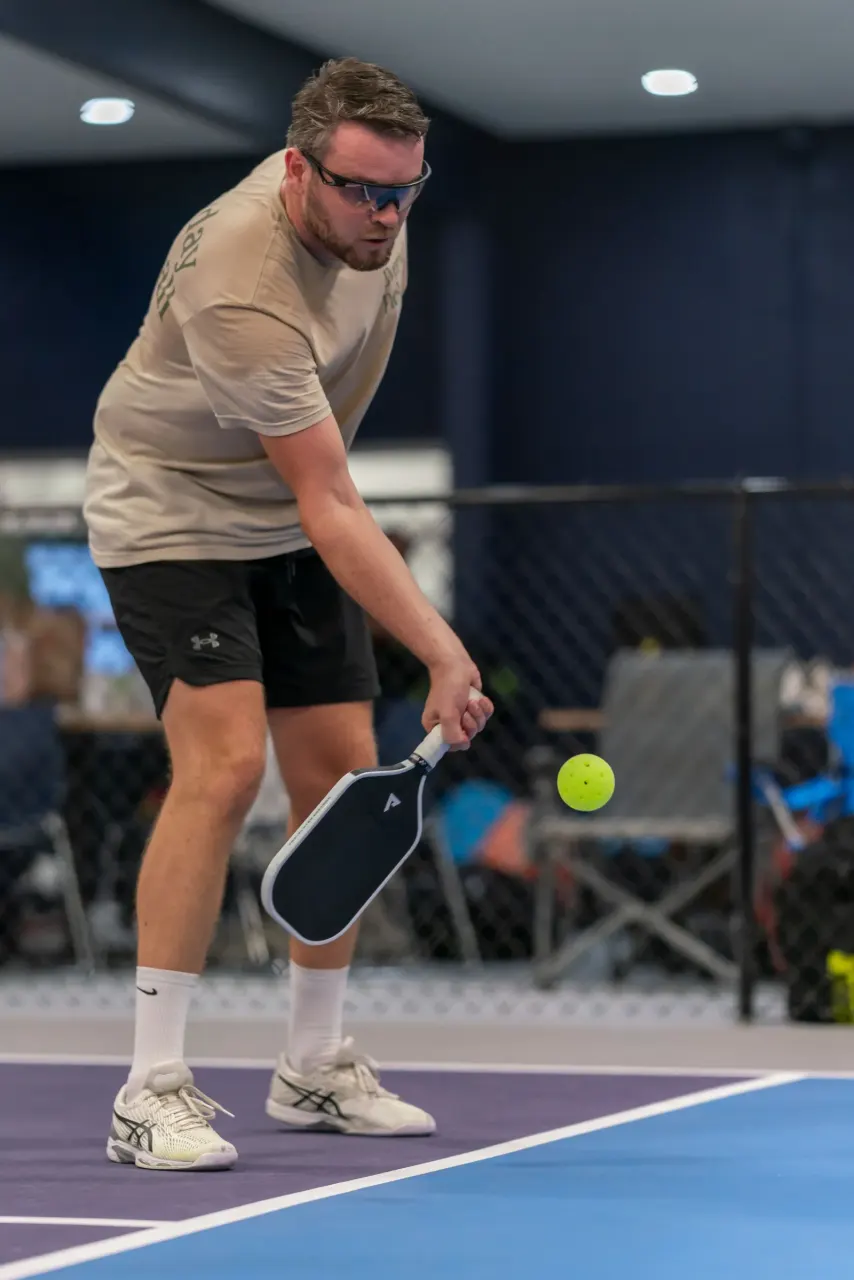
The drop serve is the serve that lets you stop worrying about the serve. Drop the ball, let it bounce, hit it. No waist-height contact to judge, no paddle-below-wrist check, and no arc to prove to a referee.
Here is how the drop serve works, what makes one legal, and the mistakes that turn it into a fault.
How the Drop Serve Works
Instead of striking the ball out of the air, you let it bounce first. The sequence is simple:
- Stand behind the baseline, inside the imaginary extension of the sideline and centerline, like any other serve.
- Release the ball from your hand (or off your paddle face) so it falls.
- Let it bounce on the ground.
- Hit it after the bounce, sending it diagonally into the opposite service court.
Because the ball bounces before you hit it, the drop serve is not subject to the volley serve’s restrictions on contact height, paddle position and swing path. The rest of the serve rules still apply.
What Counts as a Legal Drop
The release is where most drop serve faults happen. The ball has to fall by gravity alone.
- Let go, don’t throw. Open your hand or lower the paddle face and let the ball fall. Tossing it down, or pushing it up, adds force.
- No spin from the fingers. Spinning the ball as it leaves your hand counts as adding force too.
- Hand or paddle release. Both are fine, as long as the ball simply falls.
- Any surface works. The ball is allowed to bounce on any surface you are serving from, so a rough court or an indoor floor both work.
Drop Serve vs. Volley Serve
| Drop serve | Volley serve | |
|---|---|---|
| Ball is hit | After one bounce | Out of the air |
| Contact height | No restriction | Clearly below the waist |
| Paddle position | No restriction | Paddle head clearly below the wrist |
| Swing path | No restriction | Clearly upward arc |
| Landing target | Diagonal service court, past the kitchen | Same |
Drop Serve Faults to Avoid
The usual rules for any serve still apply, so these still cost you the serve:
- Stepping on or over the baseline before the ball is struck.
- Adding force to the release, by throwing, pushing or spinning the ball.
- Landing it in the kitchen, or on the kitchen line, instead of the diagonal service court.
- Missing the diagonal court, or hitting it into the net.
- Letting it bounce twice before you hit it.
You also get just one serve attempt, with no second chance as in tennis.
Is the Drop Serve Still Legal in 2026?
Yes. The 2026 USA Pickleball rulebook made the volley serve stricter by requiring that contact be clearly below the waist, the paddle clearly below the wrist and the swing clearly upward. The drop serve is not subject to those three requirements, which makes it the clean option if a borderline volley serve is getting called. We cover the broader changes in our 2026 pickleball rule changes and the full list of serve types in our pickleball serve rules guide.
Should You Use the Drop Serve?
For most newer players, yes. It is consistent, easy to repeat under pressure and hard to fault. You also get a bit more time to line up your target.
The tradeoff is power and disguise: a bounced ball is slower to set up than a volley serve, so many experienced players use the drop serve as their reliable second option and save the volley serve for when they want pace. Drop serves tend to land softer, which makes depth, not speed, your goal. Aim deep toward the baseline of the service court so your opponent can’t step in and attack.
Practice It at Pickleland
The fastest way to make the drop serve automatic is repetition against real returns. Check open play and programs at Pickleland to find a session at your level, and see how to serve in pickleball for the basics of the motion.