
Most players treat the serve as a formality — get it in, start the point. That’s a waste. The serve is the only shot in pickleball you hit with no time pressure and no opponent influence, and a good one meaningfully tilts the rally.
This is about technique and placement. For the legality requirements, see pickleball serve rules and can you serve overhand.
Build a repeatable motion
Stance. Side-on to the net, feet behind the baseline, weight on your back foot. Roughly shoulder-width — you’re not lunging.
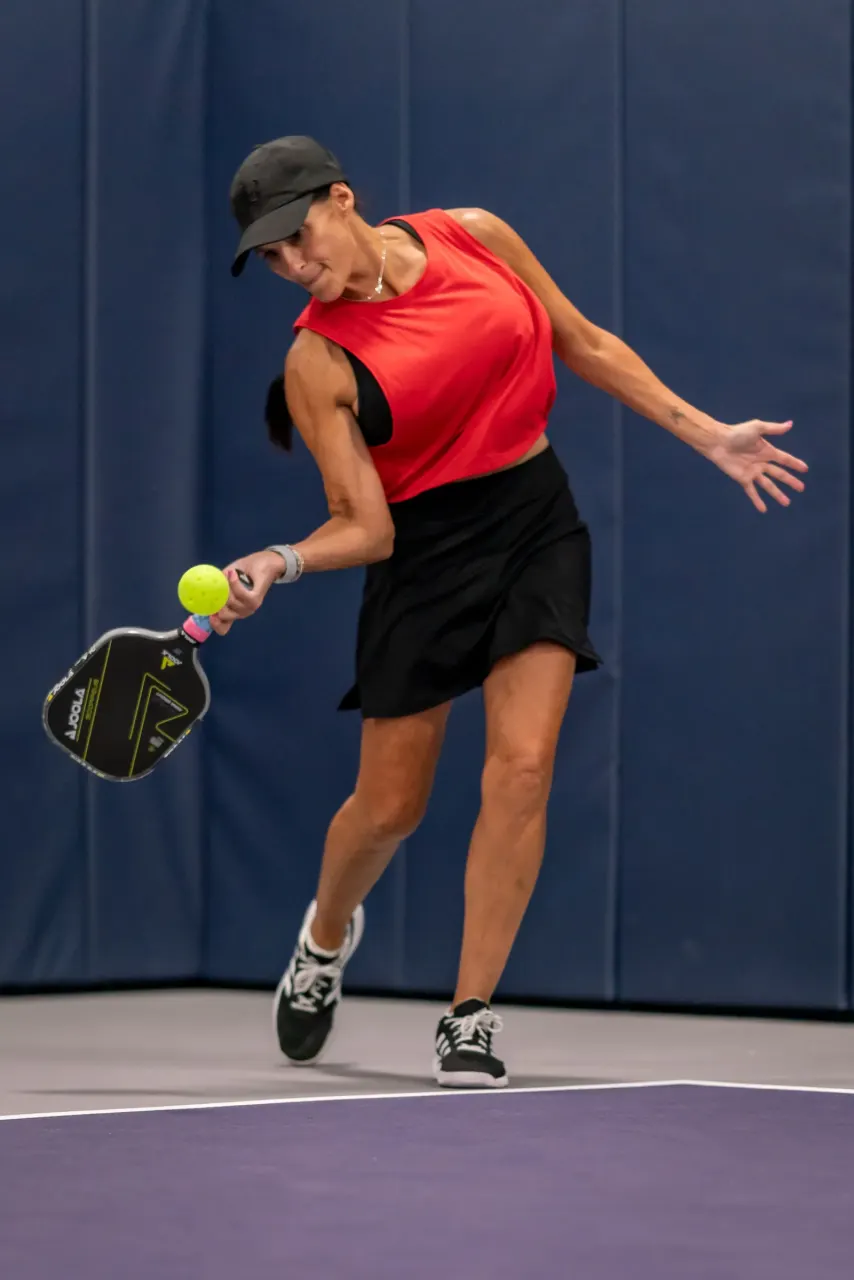
Ball position. Drop or hold the ball out in front of your body and slightly to your paddle side. If it’s too close, you’ll jam yourself and the paddle path goes sideways rather than up.
Contact point. Below your waist, out in front of your body, around thigh height. Consistent contact height is what makes a serve repeatable.
Swing path. Low to high, brushing up through the ball, finishing high across your body. That upward path isn’t just a rule — it generates depth and net clearance.
Weight transfer. Back foot to front foot as you swing. Nearly all serve pace comes from this and from shoulder rotation, not from arm speed.
The test of a motion is repeatability. If you can hit ten serves in a row without adjusting, you have one. If every serve feels different, simplify before you add anything.
Depth is the first priority
Before placement, before spin, before pace: get the ball deep.
A serve landing within a couple of feet of the baseline pushes the returner back and makes their return travel further, which buys you time on the third shot. A short serve lets them step in and drive it.
Aim for the back third of the service box. Most players’ serves land mid-box out of caution, and the cost is a much easier return.
Then placement
Three targets worth learning, in order of usefulness:
1. Deep at the backhand. The default. Most players are weaker on the backhand return, and deep-plus-backhand compounds two problems at once.
2. Deep at the outside corner. Pulls the returner wide, opening the middle for your third shot and lengthening their crosscourt return.
3. At the body or inside hip. Situationally excellent. Jams the returner, who has to move away from the ball to make room. Especially good against players who stand well behind the baseline.
Vary them. A returner who knows where the ball is going will step around their backhand every time.
Adding pace legally
You can hit a hard serve within a legal underhand motion. What you cannot do is raise your contact point to get it.
Sources of legal pace:
- Leg drive and hip rotation. The main engine. Drive off the back foot and rotate.
- Paddle head speed through contact, rather than a bigger backswing.
- Topspin. Brushing up the back of the ball lets you hit harder while the spin brings it down inside the baseline. This is the highest-value addition to most serves.
- A relaxed grip. Tension slows the paddle. Think four or five out of ten on grip pressure.
If you fault when you try to hit harder, the cause is almost always the contact point creeping above the waist as the swing gets bigger. Keep contact height fixed and let the legs supply the extra.
The drop serve alternative
The drop serve — release the ball, let it bounce, hit it — is not subject to the below-waist, paddle-below-wrist, or upward-arc requirements. That makes it genuinely useful, not a beginner crutch:
- It removes any doubt about legality under the stricter 2026 enforcement.
- It allows a more natural groundstroke motion, which players from tennis often prefer.
- The tradeoff is a lower contact point off the bounce, which can cost some depth.
Worth having as a second option even if the volley serve is your primary.
Drills
Ten deep. Ten consecutive serves landing in the back third of the box. Restart the count on any miss. This single drill fixes most serves.
Corner targets. Two cones deep in the service box, one at each corner. Alternate backhand corner and outside corner, ten each.
Pace ladder. Serve five at roughly two-thirds effort, five at three-quarters, five near maximum. Note where depth and legality break down — that’s your current ceiling. Train just under it.
Frequently Asked Questions
How do you hit a good pickleball serve?
Build a repeatable underhand motion with consistent contact below the waist and out in front, then prioritize depth. A deep serve to the backhand pressures the returner more than a hard, shallow one.
How do you serve harder in pickleball without faulting?
Generate pace from leg drive and hip rotation rather than a higher contact point, and add topspin so the ball drops inside the baseline. Faults when hitting harder almost always come from the contact point rising above the waist.
Where should you aim your pickleball serve?
Deep in the back third of the service box, favoring the returner’s backhand. Deep to the outside corner and a jamming serve at the body are useful variations.
Is the drop serve easier than a volley serve?
For many players, yes — it is not subject to the below-waist, paddle-below-wrist, or upward-arc requirements, so legality is never in question. The tradeoff is a lower contact point, which can reduce depth.
Does serve placement matter in recreational pickleball?
Yes, and more than pace. A deep serve to the backhand produces weaker returns, which makes your third shot easier. That advantage compounds across a game.