


A pickleball ladder is a league or session that ranks players by their results, so you keep playing people near your level. Win and you climb, lose and you drop. There’s no official ladder rule in the USA Pickleball rulebook. Ladders are a club format, so the details vary. Ladders usually take one of three forms: up-and-down courts, a rotating-partner round robin that ranks individuals by points, or a challenge ladder where you challenge someone above you.
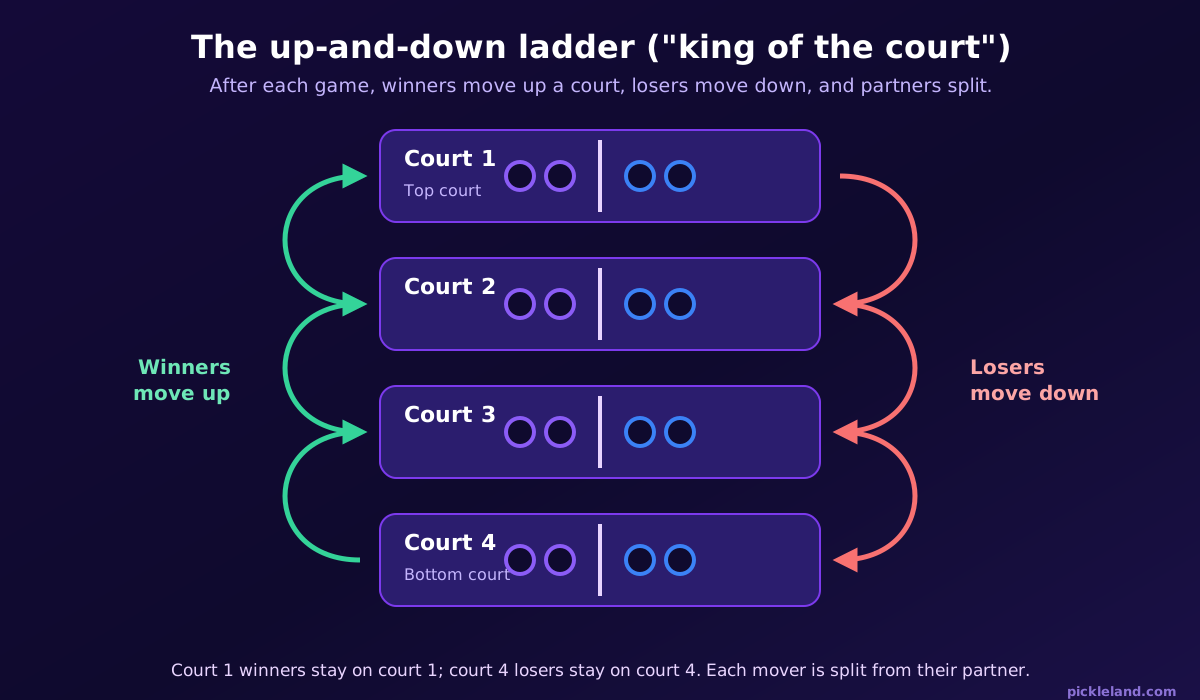
The three ladder formats
| Format | How it works | Ranks | Best for |
|---|---|---|---|
| Up-and-down courts (“king of the court”) | Play one game per round. Winners move up a court, losers move down. Partners usually split after each game | Court position at the end | Drop-in sessions, mixed abilities, fast sorting |
| Rotating round robin | Groups of four play three games, each with a different partner. Individuals score points | Total points or wins across games | Leagues that run several weeks |
| Challenge ladder | A ranked list. You challenge a player (or team) up to a set number of places above you. Win and you swap places | Position on the list | Singles and fixed doubles teams, flexible scheduling |
1. Up-and-down courts
- Seed the first round by rating, sign-up order or at random.
- Play one game per court, often to 11 or to a time limit.
- Winners move up one court and split up. Losers move down one court and split up. Court 1 winners stay on court 1. Bottom-court losers stay on the bottom court.
- New partners pair up on each court and play again.
- After the last round, your final court is your ranking for the night.
Splitting partners means you’re ranked on your own results, not your partner’s. Some clubs keep partners together for a “team” version.
2. Rotating round robin
Four players on a court play three games, so every player partners each of the others exactly once:
| Game | Team 1 | Team 2 |
|---|---|---|
| 1 | A + B | C + D |
| 2 | A + C | B + D |
| 3 | A + D | B + C |
Each player records the points their team scored in each game (or the games they won). The top scorer in each group moves up a group next week, and the lowest moves down. With more than four players, our free round robin generator builds the rotations for any group size and number of courts.
3. Challenge ladder
- Players or teams are listed from 1 down.
- You may challenge anyone up to a set number of places above you, for example two or three.
- The challenged player must accept within an agreed window, such as a week.
- If the challenger wins, they take the higher place and everyone in between drops one spot. If they lose, nothing changes.
- Common extras: a cooling-off period before re-challenging the same person, and dropping players who don’t play for a set time.
Breaking ties fairly
Ladders are informal, but the 2026 USA Pickleball rulebook has a tested tiebreak order for round robins (Rule 15.B.4) that works well for ladders too:
- Head-to-head record among the tied players or teams.
- Point differential across all games played.
- Point differential in head-to-head games.
- Point differential against the next-highest finisher.
- Most total points scored.
Worked example of point differential: a team wins its first match 11–8, 11–4 (+3 and +7, so +10). It then wins 11–9, loses 2–11 and wins 11–6 (+2, −9, +5, so −2). Its total point differential is +8 (Rule 15.B.4.c).
Write your tiebreak order down before the first game. Ladder disputes are usually about a rule nobody agreed on in advance.
Ladder rules to agree before you start
| Decide | Common choices |
|---|---|
| Game length | To 11 win by 2, to 11 win by 1 (faster), or a time cap |
| Scoring system | Standard side-out, or rally scoring for faster, timed rounds |
| Who calls the score | The server, out loud, every point |
| Line calls | Each team calls its own side; give the opponent the benefit of the doubt (2026 Rule 8.D) |
| Late arrivals | Start on the bottom court, or sit out one round |
| Byes | With an odd number of players, rotate who sits out |
| Is it rated? | If you want results on DUPR, someone must submit them. Club-submitted matches count more than self-posted ones (DUPR Help Center) |
How to do well on a ladder
- Win your own court first. In up-and-down, you only need to beat the people next to you. Steady, low-error play moves you up more reliably than highlight shots.
- Learn to play with anyone. Rotating partners rewards communication. A quick “I’ve got middle” before the first point helps. See who takes the middle.
- Count points, not just wins. In point-based ladders, a close loss still counts. Keep fighting at 4–10.
- Know the tiebreaks. If point differential decides ties, an 11–2 win is worth more than 11–9.
Frequently Asked Questions
What is a ladder league in pickleball?
A league or session that ranks players by results, so everyone keeps playing people at their level. Formats include up-and-down courts, rotating round robins and challenge ladders.
How does a pickleball ladder work?
In the most common drop-in format, winners on each court move up a court and losers move down, with partners changing each round. After several rounds, your court shows your level for the session.
How is a pickleball ladder scored?
It depends on the format: final court position (up-and-down), total points or wins across games (round robin), or place on a ranked list (challenge ladder).
What happens if there’s a tie in a pickleball ladder?
A fair order, borrowed from USA Pickleball’s round-robin rules, is head-to-head first, then point differential, then head-to-head point differential, then points scored.
Is a ladder league good for beginners?
Yes, if it’s split by level. Up-and-down ladders sort players quickly, so beginners end up playing other beginners within a round or two.