

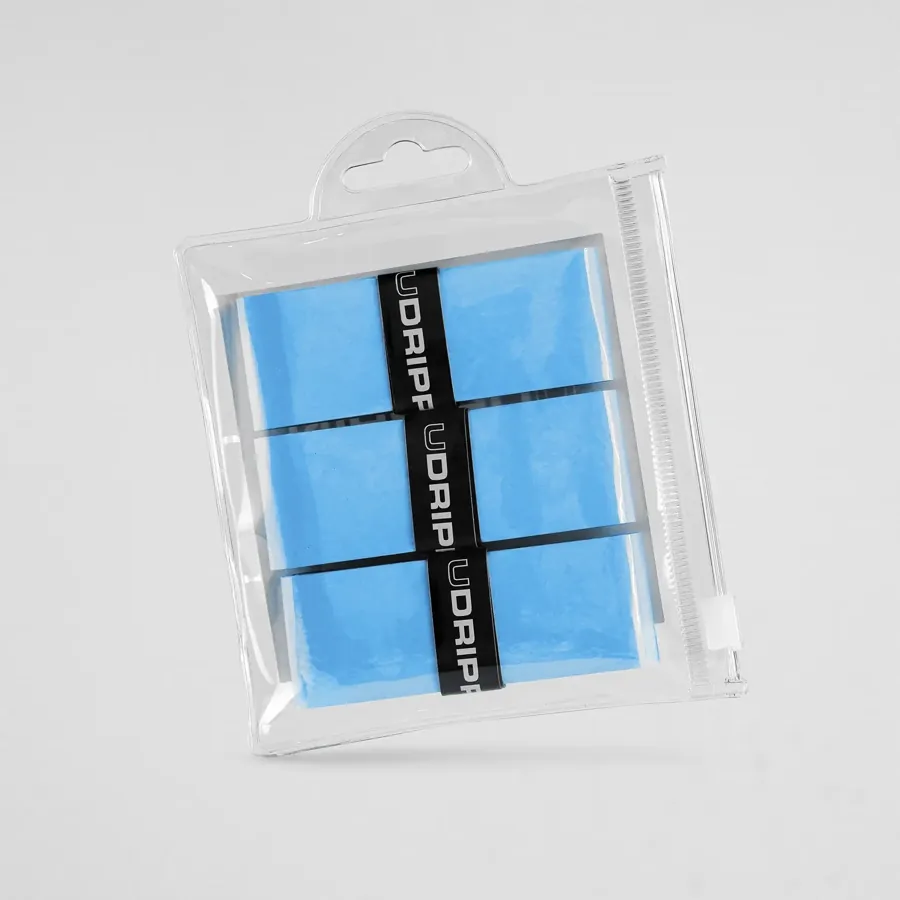
An overgrip costs a few dollars and takes a couple of minutes to put on. It’s also the piece of gear most likely to be worn out on a paddle that’s otherwise fine. A slick handle makes you squeeze harder, and a hard squeeze costs you touch on dinks and resets and puts extra strain on your forearm.
This guide covers what an overgrip is, how it differs from the grip under it, how to choose one, and how to wrap it. If you’re comparing grip types and brands, see our best pickleball grips guide. If you’re not sure your handle is the right size to begin with, read pickleball paddle grip size first.
Grip vs overgrip: what’s the difference?
Every paddle handle has two possible layers.
The replacement grip (also called the base grip or grip tape) is the cushioned wrap that comes on the paddle and sits directly on the handle. It sets the handle’s thickness and cushioning. Retailer guides put it at about 1.5 to 2 mm thick (Forwrd).
The overgrip is a thin wrap that goes over the base grip. Its job is tack and sweat absorption, plus a little cushioning (Pickleball.com). Overgrips run about 0.5 to 0.7 mm. Udrippin lists its Pro DRIP at 0.56 mm and its Comfort Tour at 0.60 mm.
| Overgrip | Replacement grip | |
|---|---|---|
| Goes on | Over the existing grip | Directly on the bare handle |
| Typical thickness | About 0.5–0.7 mm | About 1.5–2 mm |
| Main job | Tack and sweat absorption | Cushioning and handle size |
| Adhesive | Usually only a small strip at the start | Adhesive backing along its length |
| Replace when | It feels slick, frays or looks dirty | It's cracked, hardened or packed flat |
| Rough lifespan | Weeks | Months to years |
Thickness from Forwrd and Udrippin. Lifespans from Pickleball.com and Forwrd; they vary a lot with how much you play and sweat.
A simple rule from the same guides: if the handle feels too thin, the fix is a new or thicker base grip. If it just feels slick, an overgrip is enough.
Should you use an overgrip?
For most players, yes. Here’s why:
- It protects the base grip. You replace a cheap overgrip often instead of the base grip. Pickleball.com notes that many players do exactly this so the base grip lasts longer.
- It restores tack. A fresh overgrip lets you hold the paddle with a relaxed grip, which is what you want for the soft game. Our grip size guide suggests about 4–5 out of 10 pressure for dinks.
- It fine-tunes handle size. One overgrip makes the handle a little thicker. Two make it thicker again.
- It’s cheap and reversible. If you don’t like it, cut it off.
The main reason to skip it: your handle is already at the top of your size range, and even a thin wrap pushes it over.
Tacky vs dry overgrips
Tacky overgrips feel slightly sticky. They hold the paddle in your hand with less squeeze, and many players like them in humid conditions. Pickleball.com suggests a mid-tack, moderate-thickness grip as a sensible default. Udrippin’s Pro DRIP is its high-tack option. The Comfort Tour is a little less tacky by the brand’s own description, with a slightly thicker 0.60 mm build for comfort.
Dry-feel overgrips aren’t sticky. They soak up sweat and grip through friction. Heavy sweaters often prefer them, because a tacky grip that’s soaked turns slick. Udrippin makes dry options as well as tacky ones, per a January 2026 profile of the brand in The Kitchen.
On an air-conditioned indoor court like ours, you’ll usually sweat less than on a Texas outdoor court in August, so a tacky grip is a good place to start. If you play outside in summer, keep a dry-feel grip in your bag too.
How much thicker does an overgrip make the handle?
A single overgrip adds roughly 1/16 of an inch to the handle’s circumference, according to Tennis Warehouse’s grip-size guide. Grip sizes go up in 1/8-inch steps, so one overgrip is about half a size. Tension matters too: Tennis Warehouse’s wrapping guide points out that the tighter you pull, the thinner the grip feels.
Source: Forwrd; Tennis Warehouse
That’s why our grip size guide says when in doubt, size down. A paddle with a 4 1/8-inch handle plus one overgrip lands close to 4 3/16. Two overgrips bring it to about 4 1/4. A handle that’s too big can’t be fixed the same way.
How often should you change your overgrip?
There’s no fixed schedule, and published guidance varies a lot. Pickleball.com says most active players replace theirs “every few weeks.” Other guides range from about 8 hours of play for a heavy sweater to 100 hours. Your sweat, your climate and how often you play make the difference.
Change it when you notice any of these:
- It feels slick even after you wipe your hand.
- It’s shiny or darkened where your palm sits.
- The edges are fraying or peeling up.
- You notice you’re squeezing harder than usual.
For the base grip, Forwrd suggests about 6 to 12 months for someone who plays 10 or more hours a week, and longer for occasional players. Replace it sooner if it cracks, hardens or loses its cushion.
Udrippin also notes a one-year shelf life for best tack, so don’t buy a three-year supply.
How to put on an overgrip, step by step
You don’t need tools beyond scissors. Plan on about five minutes the first time.
- Unwrap it. Peel off the plastic film. If there’s a small adhesive strip at the tapered end, peel its backing.
- Start at the butt cap. Put the tapered end against the bottom of the handle at an angle, so it starts flush with the butt cap.
- Wrap upward with even tension. Pull it snug as you go. Tighter makes a thinner, firmer grip; looser makes a softer, slightly thicker one.
- Overlap a little, evenly. Tennis Warehouse suggests about 1/16 of an inch per turn. Uneven overlap leaves ridges you’ll feel in your palm.
- Trim at the top. When you reach the top of the handle, cut off the extra at an angle so the end lies flat.
- Secure it with the finishing tape that comes in the pack, wrapped around the top edge.
Then do a squeeze test. Hold the paddle in your normal grip and feel for lumps or thin spots. If you find one, unwind and rewrap. Overgrips stretch, so a second try usually fixes it.
Dyed overgrips can bleed. Udrippin warns that its colored grips can leave a little dye on the base grip when they get sweaty. If you care about the base grip color, a black or white overgrip avoids the issue.
How to replace a replacement grip
Replacing the base grip takes longer, mostly because of the cleanup. These steps follow Forwrd’s regripping guide:
- Remove the old grip. Peel off the finishing tape at the top, then unwind slowly toward the butt cap. Going fast tears the grip and leaves more adhesive behind.
- Clean the handle. Wipe it with a slightly damp cloth and let it dry for a few minutes. Leftover adhesive is the main reason new grips peel.
- Start at the butt cap at about 45 degrees. Peel back a few inches of the backing film and press the tapered end down firmly.
- Wrap upward with a consistent 3–5 mm overlap, keeping it slightly taut but not stretched.
- Trim and finish with the finishing tape, pressed flat around the top.
- Squeeze-test it, then add an overgrip on top if you use one.
USA Pickleball’s 2026 rulebook allows players to add or replace grip wrap and to change grip size with inserts (Rules 3.D.6.g and 3.D.6.h in the official rulebook), so regripping is fine for sanctioned play.
Frequently Asked Questions
Should I use an overgrip on my pickleball paddle?
Most players should. An overgrip adds tack and soaks up sweat, protects the base grip underneath, and costs far less to replace. Skip it only if your handle is already as thick as your hand can comfortably take.
What’s the difference between a grip and an overgrip?
The grip (replacement or base grip) is the cushioned layer stuck directly to the handle, about 1.5–2 mm thick. It sets the handle’s size and cushioning. An overgrip is a thinner wrap, about 0.5–0.7 mm, that goes over it to add tack and absorb sweat, and you change it far more often.
What overgrips do pickleball pros use?
There’s no official tally. Pros mostly use whatever their grip sponsor makes. Udrippin, the brand we stock at Pickleland, has sponsored pros including Thomas Wilson, Catherine Parenteau, Allyce Jones, DJ Young, Meghan Dizon and Blaine Hovenier over the years. It has also made team grips with several Major League Pickleball teams, according to The Kitchen.
Does tennis overgrip work for pickleball?
Yes. An overgrip is the same kind of thin wrap in any racket sport, and Tennis Warehouse’s tennis wrapping steps are the same ones you’d use on a paddle. A pickleball handle is shorter than a tennis handle, so expect to trim more off the end. Pickleball-specific overgrips like Udrippin’s are made for paddle handles.
How many overgrips can you put on a pickleball paddle?
As many as your hand likes. Each one adds roughly 1/16 inch of circumference. Most players use one, and some use two to build up a small handle.
How often should you change a pickleball overgrip?
When it feels slick, looks shiny or starts to fray. For an active player that’s often every few weeks. Heavy sweaters and outdoor players in summer will change it sooner.
Get a fresh grip at the club
Order Udrippin overgrips from our grips and accessories shop and pick them up free at the front desk at Pickleland in Pflugerville. We also deliver within 10 miles of the club, but we don’t ship. Building up a handle and want to feel the difference first? Demo a paddle on an indoor court.