

Weighted tape is the cheapest performance upgrade in pickleball. A few grams in the right spot can make a paddle steadier on off-center blocks, heavier through a drive, or quicker at the net. The same few grams in the wrong spot make it sluggish and hard on your elbow.
This guide goes deep on the tape itself. If you’re still deciding how heavy a paddle should be in the first place, start with our pickleball paddle weight guide and come back.
What weighted tape actually changes
The number on a scale is static weight. Tape barely moves it. A 3-gram strip on an 8.0 oz (227 g) paddle is about a 1.3% increase, according to paddle maker RPM Pickleball’s customization guide. What tape changes is where the mass sits, and that drives three things you can feel.
Swingweight is how heavy the paddle feels in motion. Mass far from your hand, at the top of the face, raises it the most. More swingweight gives you more plow-through on drives and serves and less hand speed in fast exchanges. RPM estimates that 3 g at 12 o’clock raises swingweight roughly 2–4% on a typical paddle and moves the balance point forward by about a third to half an inch.
Twistweight is how much the paddle resists rotating in your hand when you hit the ball off-center. Mass far from the centerline, out on the left and right edges, raises it the most. Higher twistweight means fewer mishits that squirt sideways. That’s what “a bigger sweet spot” really means.
Balance point is where the paddle balances. Head-heavy paddles feel powerful and slow. Handle-heavy paddles feel quick even when they weigh more on the scale.
Every placement trades these three off. The chart below shows how.
The placement chart
| Position | Main effect | Trade-off | Try it if |
|---|---|---|---|
| 12 o'clock (top) | Biggest swingweight gain per gram; balance moves toward the head | Slower hands at the net, more load on the arm | Your drives and serves feel light or land short |
| 10 and 2 o'clock | Moderate gains in both swingweight and twistweight | A little slower than stock | You want an all-court upgrade without a big change in feel |
| 3 and 9 o'clock (sides) | Biggest twistweight gain per gram, so off-center hits stay straighter | Moderate swingweight gain | Blocks and counters fly sideways when you miss the middle |
| Throat (just above the handle) | Adds static weight with little extra swingweight; sweet spot shifts slightly lower | Less power gain than higher placements | You want more solidity but don't want the head to feel heavier |
| Handle / butt cap | Moves balance toward your hand, so the head feels lighter | Adds total weight without adding power | Your net game feels slow, or your elbow or wrist is complaining |
Effects summarized from RPM Pickleball's lead tape guide and The Dink's customization guide (April 2026). They describe direction and size of the change, not lab measurements of your paddle.
Two shape-specific notes from The Dink’s guide, which credits pro James Ignatowich for its recommendations. Widebody paddles start with lower swingweight, so they handle tape on all four corners. Elongated paddles already carry their mass high, so keep tape below the midline unless you really want more swingweight.
You can put numbers on any of these placements before you peel the backing. Our swing weight and lead tape calculator takes your paddle’s weight, length and width, the grams you plan to add and the position, and returns the change in swing weight, twist weight and balance point. For what those numbers mean, see swing weight vs static weight and twist weight.
3 and 9 o’clock: the placement most people should try first
If you only try one setup, make it a strip on each side at 3 and 9 o’clock. It’s the most forgiving change. You get a steadier paddle on the hands battles and blocks where most rec points are won and lost, without turning the head into a hammer. The Dink’s guide suggests about 1 gram per inch of tape on each side as a starting point.
Keep both sides equal. A paddle that’s heavier on one edge twists in one direction, which is the opposite of what you want.
How much weight to add
Most players add somewhere between 2 and 10 grams in total, per RPM’s guide. Work up to it slowly:
- Start with 2–3 grams. Play a full session before you add more. If you add 5 g at once you can’t tell which change caused what.
- Change one thing at a time. Don’t add tape and swap your overgrip in the same week.
- Expect a small effect. A few grams moves the sweet spot by roughly half an inch to an inch, according to RPM. If you need more than that, you need a different paddle, not more tape.
- Stop if your arm complains. Extra swingweight is extra load on the forearm. If you’ve had pickleball elbow, lean toward the throat or handle, or skip tape entirely.
It’s easy to work out grams from tape length. Weighted tape is sold by grams per inch, so a 1 g/inch tape gives you 3 grams from a 3-inch strip.
Is lead tape legal in pickleball?
Yes, within limits. The 2026 USA Pickleball Official Rulebook lists “addition of weighted tape” among the alterations a player may make to a certified paddle (Rule 3.D.6.b). It doesn’t matter whether the tape is lead, tungsten or another material. There’s also no limit on paddle weight (Rule 3.D.3).
The catch is where the tape goes. Rule 3.D.7 limits tape on the paddle face:
Source: 2026 USA Pickleball Official Rulebook, Rules 3.D.3 and 3.D.7
In practice, perimeter tape has to sit on or right next to the edge guard. A strip laid across the middle of the hitting surface is not allowed. Throat tape can’t climb more than an inch above the grip. Rule 3.D.6 also says an altered paddle must still meet every paddle specification.
For rec play none of this is policed. If you play sanctioned tournaments, keep tape on the edge guard and the handle and you’ll pass inspection.
Lead vs tungsten (and other weighted tapes)
| Lead tape | Tungsten tape | |
|---|---|---|
| Density | About 11.3 g/cm³ | About 19.3 g/cm³ |
| Strip width for the same grams | Wider | Narrower, so it hides more easily on thin edge guards |
| Cost | Cheaper | More expensive |
| Handling | Lead is toxic. Wash your hands after applying it and keep it away from kids | No lead |
Densities from RPM Pickleball.
Why lead is worth thinking about. The CDC says no safe blood lead level has been identified in children. Adhesive lead tape on an edge guard isn’t a big exposure risk. Still, cutting it, peeling it and handling the scraps all put lead on your fingers. If you have kids around your gear bag, a lead-free tape is the easy choice.
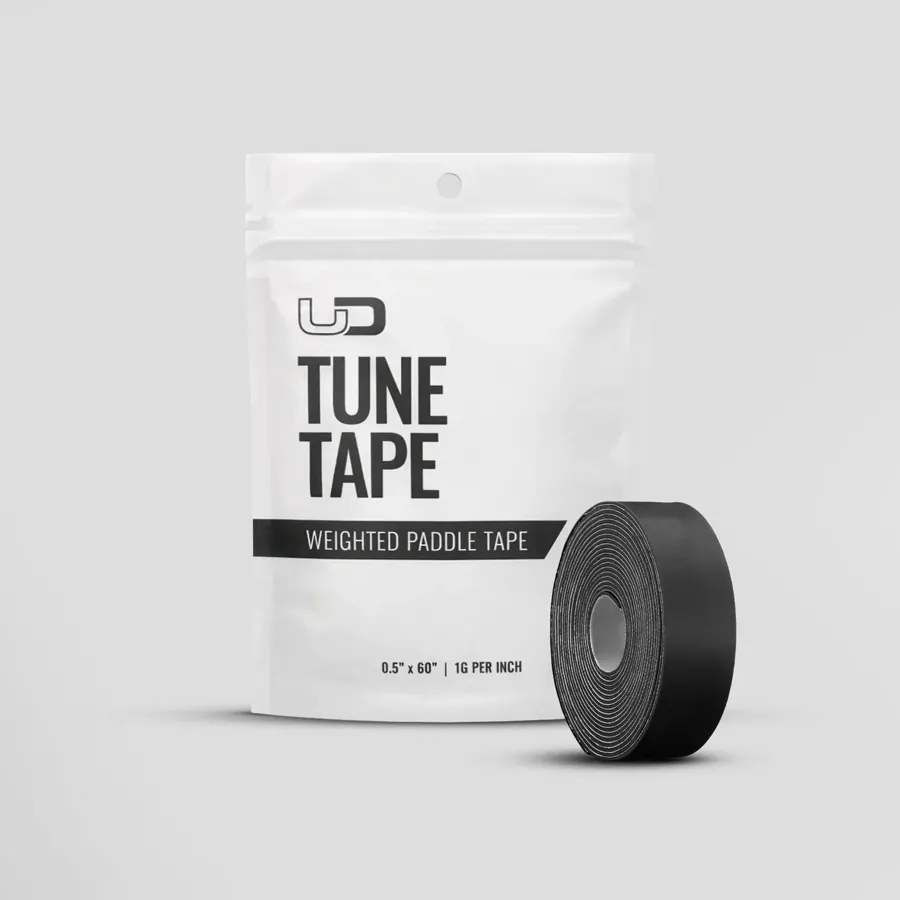
Other weighted tapes. Not every “weighted paddle tape” is lead or tungsten. The Udrippin Tune Tape we stock at the club is made from a rubber-based weighted material, which the maker describes as non-toxic. It comes in 1/2-gram and 1-gram-per-inch versions. The package for the 1 g/inch version lists a roll of 0.5 by 60 inches. That’s about 60 grams of tape, plenty for many rounds of experimenting.
How to apply weighted tape, step by step
- Weigh the paddle first if you have a kitchen scale, so you know your baseline.
- Clean the edge guard with a little rubbing alcohol and let it dry. Tape won’t stick to dust and sweat.
- Measure and cut. Work out the grams you want and cut that length. Round the corners of the strip with scissors so they don’t catch and peel.
- Mark the position with a pencil or a small piece of painter’s tape, so both sides match.
- Apply under light tension, pressing it flat along the edge guard. Keep it within half an inch of the edge if you play sanctioned events.
- Cover it if it starts to lift. A layer of edge guard tape over the strip holds it down, and adding edge guard tape is also an allowed alteration (Rule 3.D.6.a).
- Play a full session before you judge it, then adjust.
Nothing here is permanent. Udrippin pitches its tape as easy to cut, apply and adjust, so if you overshoot, peel off an inch and try again.
Common mistakes
- Adding too much at once. A quarter of an ounce is about 7 grams, and that’s already a lot of tape. Small steps.
- Uneven sides. Unequal weight at 3 and 9 o’clock makes the paddle twist in one direction.
- Tape on the hitting surface. Beyond the rules, it can change how the ball comes off the face.
- Using tape to fix the wrong problem. If your hands are slow, adding weight to the head makes it worse. Weight the handle or try a lighter paddle.
- Ignoring the grip. A fresh, tacky overgrip adds a little weight at the handle too, and a slick grip makes you squeeze harder than any tape setup ever will.
Try before you tape
Tape fine-tunes a paddle that already suits you. It won’t rescue one that doesn’t. At Pickleland you can rent a demo paddle and play real points on an indoor court before you buy. Pick up tape and overgrips in our grips and accessories shop with free pickup at the club in Pflugerville. We also deliver within 10 miles of the club, but we don’t ship.
Frequently Asked Questions
Where should I put lead tape on my pickleball paddle?
For most players, at 3 and 9 o’clock on the edge guard. It makes off-center hits more stable without making the paddle much slower to swing. Put it at 12 o’clock for more power, or at the throat or handle to add weight while keeping the head quick.
How much lead tape should I put on a pickleball paddle?
Start with 2–3 grams in total, play a full session, and add more only if you want it. Most players end up between 2 and 10 grams.
Is lead tape legal in pickleball tournaments?
Yes. USA Pickleball’s 2026 rulebook allows weighted tape (Rule 3.D.6.b). On the paddle face, tape can’t go more than 0.5 inch inside the edge or edge guard, or more than 1 inch above the top of the grip (Rule 3.D.7).
Is tungsten tape better than lead tape?
Tungsten is denser, so you need a narrower strip for the same weight, and it doesn’t contain lead. Lead is cheaper. On the court, a gram is a gram: placement matters far more than material.
Does lead tape increase the sweet spot?
It increases twistweight, which is what people mean by a bigger sweet spot. Tape on the sides at 3 and 9 o’clock makes off-center hits twist the paddle less, so they fly straighter.