

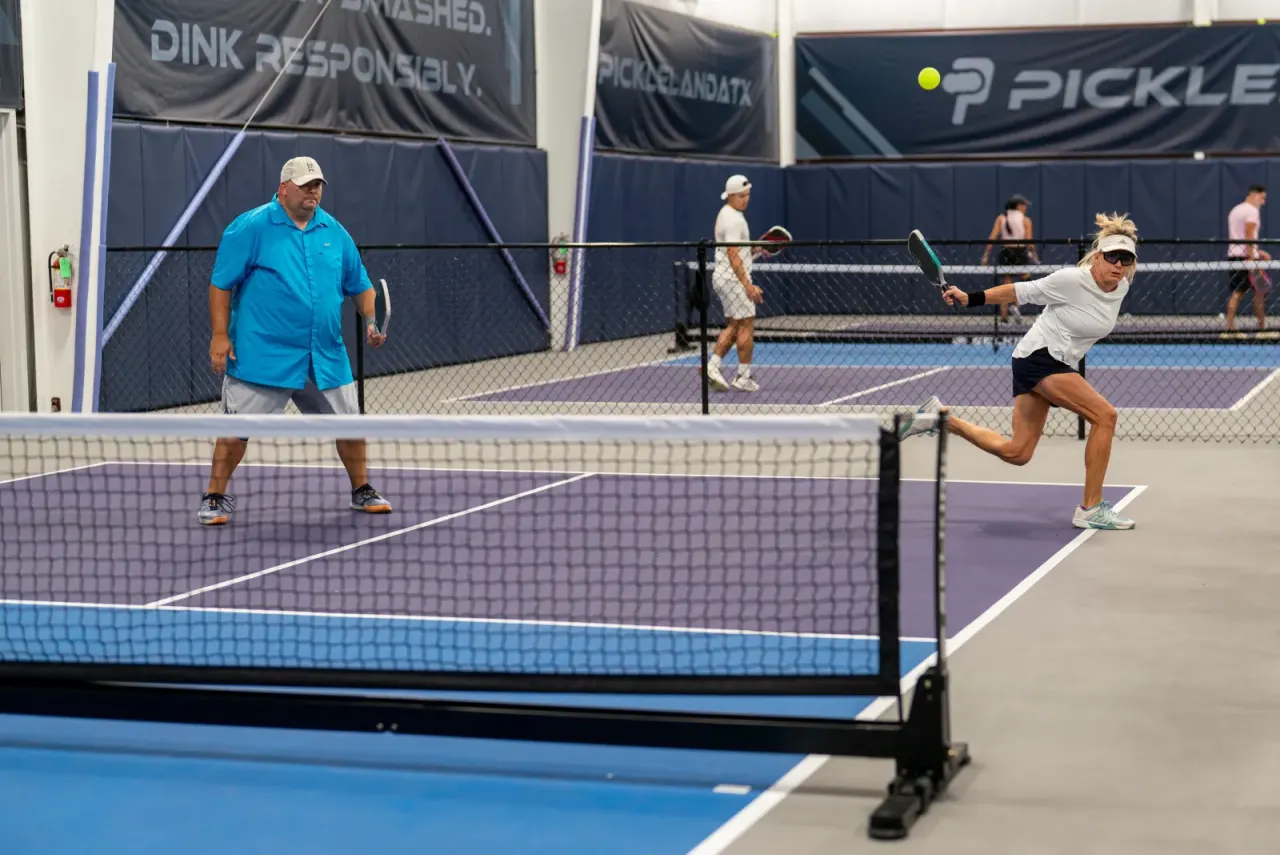
Pickleball is the fastest-growing sport in the country — and one of the most complained-about. In neighborhoods and parks near outdoor courts, the same sharp, repetitive “pop” that makes the game fun to play has turned into a real source of friction between players and the people who live nearby. Courts have been restricted, hours have been capped, and in some communities the fight has ended up in front of a city council or a judge.
None of that is really about pickleball itself — it’s about the sound the ball and paddle make together, and where that sound is allowed to travel. Here’s why pickleball is so loud, what’s actually being done about it, and how to play in a way that doesn’t turn your neighbors against the sport.
Why Pickleball Sounds So Loud
The noise isn’t about pickleball being louder than other sports in a simple decibel sense — it’s about the character of the sound. A hard, textured plastic ball striking a stiff composite paddle face produces a sharp, high-frequency pop rather than the duller thud of a tennis ball on strings. That pop cuts through ambient background noise in a way most outdoor sports don’t, and it repeats every couple of seconds for the length of a rally.
Measured sound levels back this up. Paddle-on-ball contact commonly measures somewhere in the 70–80 dBA range at 15 feet, and courts can still register around 70 dB at 100 feet — while typical ambient noise in a quiet residential neighborhood sits closer to 40–55 dBA. That gap, combined with the rhythmic, repetitive nature of rally play, is what makes a set of outdoor courts so noticeable to nearby homes even when the raw volume isn’t dramatically higher than, say, a barking dog or passing traffic.
Multiple courts running side by side compounds the effect. A single court is one source of pops; a six- or eight-court facility can layer dozens of impacts per minute into a near-constant background hum that’s much harder for neighbors to tune out.
How Cities and HOAs Are Responding
As outdoor court counts have exploded, so has the volume of noise complaints — and local governments and homeowners associations have started treating it as a land-use problem, not just an etiquette issue. The tools showing up most often:
- Distance setbacks — requiring new courts to sit a minimum distance from residential property lines, since distance is the simplest and most enforceable way to cut perceived noise.
- Quiet hours — restricting play to certain windows (for example, no play before 8 a.m. or after 8 p.m.) to protect early mornings and evenings.
- Equipment requirements — some HOAs and private facilities now require certified “quiet” paddles and balls on their courts.
- Sound barriers — acoustic fencing or landscaping berms around courts built near homes.
In the more contentious cases, none of that has been enough, and disputes have escalated to permanent court closures, capped court counts, or litigation between residents and municipalities. It’s a real enough problem that USA Pickleball and equipment makers have gotten directly involved — which is where quiet paddle certification comes in.
USA Pickleball’s Quiet Category
USA Pickleball, the sport’s governing body, now maintains a Quiet Category approved-equipment list alongside its standard approved list — paddles, balls, and even paddle covers that meet stricter acoustic requirements. To qualify, equipment has to test below specific frequency and decibel thresholds designed to meaningfully cut the sharpness of the pop, not just make it slightly quieter.
The OWL paddle was the first product to earn USA Pickleball Quiet Category certification, reportedly cutting perceived noise by roughly half compared to a standard paddle. Since then, more manufacturers have released their own certified-quiet models as HOAs, private clubs, and noise-sensitive municipalities increasingly ask for — or require — equipment from the list.
If you play at a court near homes, checking whether your paddle (and your opponents’) is on the Quiet Category list is a genuinely useful, low-effort way to be a better neighbor.
Other Ways to Cut Court Noise
Quiet-certified equipment helps, but it’s one piece of a bigger toolkit. Facilities and rec centers dealing with noise pushback commonly combine a few approaches:
- Acoustic barriers — solid fencing, sound-dampening panels, or vegetation buffers between courts and property lines.
- Court orientation and layout — positioning courts so the loudest sightlines face away from homes, not toward them.
- Scheduling — keeping the busiest, loudest hours (weekend mornings tend to draw the biggest crowds) away from the times neighbors are most sensitive.
- Ball choice — some ball designs are noticeably quieter than others even outside the formal Quiet Category program.
None of these fully solve the problem the way an enclosed building does — they just move the needle.
Why Playing Indoors Sidesteps the Whole Fight
The most complete fix for outdoor court noise isn’t a paddle or a fence — it’s a roof and four walls. An indoor facility doesn’t send that pop into anyone’s backyard, so there’s no HOA meeting to sit through, no noise ordinance to track, and no risk of your court getting shut down because of a complaint that had nothing to do with how you play.
That’s part of why we built Pickleland as a fully indoor club rather than a set of outdoor courts. Our 9 courts in Pflugerville run on a normal daily schedule — Monday through Friday 8 a.m. to 10 p.m., weekends 8 a.m. to 8 p.m. — without a single quiet-hours restriction, because the noise question simply doesn’t apply the same way indoors. If you’ve been priced out of your own backyard court by a noise complaint, or you’re just tired of scheduling around what the neighbors will tolerate, that’s one less thing to think about.
Curious how indoor and outdoor courts differ beyond noise — surface, ball type, and strategy all change too. See our full breakdown of indoor vs. outdoor pickleball, or check out Austin’s best indoor pickleball courts if you’re hunting for a quieter place to play.
Frequently Asked Questions
Why is pickleball louder than tennis?
It comes down to the equipment, not raw volume. A hard plastic ball hitting a stiff composite paddle produces a sharp, high-frequency “pop,” while a tennis ball compressing against strung strings produces a duller, lower-frequency thud. The pickleball pop cuts through background noise more easily and repeats more often during a rally, which is why it reads as more disruptive even when the measured decibel levels aren’t wildly different.
What decibel level is pickleball noise?
Paddle-on-ball contact commonly measures around 70–80 dBA at 15 feet, and a court can still register roughly 70 dB at 100 feet away — well above typical quiet-neighborhood ambient noise of 40–55 dBA. Multiple courts running at once compound the effect.
Do quiet pickleball paddles actually work?
Yes, to a meaningful degree. Paddles certified under USA Pickleball’s Quiet Category have to meet specific frequency and decibel limits, and early certified models like OWL have reported cutting perceived noise by roughly half compared to standard paddles. They won’t make an outdoor court silent, but they measurably soften the sharp pop that triggers most complaints.
Can an HOA legally require quiet paddles or ban pickleball?
HOAs generally have broad authority to set rules for shared amenities they own, including requiring approved “quiet” equipment or restricting play hours — often more strictly than what the local city ordinance requires. Full bans are less common than restrictions, but both are legally possible depending on the HOA’s governing documents and local law, so check your specific community’s rules rather than assuming.
Is indoor pickleball quieter for players too?
The sound is different, not necessarily lower — enclosed spaces can reflect and slightly amplify the pop inside the room even though none of it reaches the outside world. What indoor play eliminates is the outward noise that causes neighbor complaints in the first place, which is the part that actually gets courts restricted or shut down.