

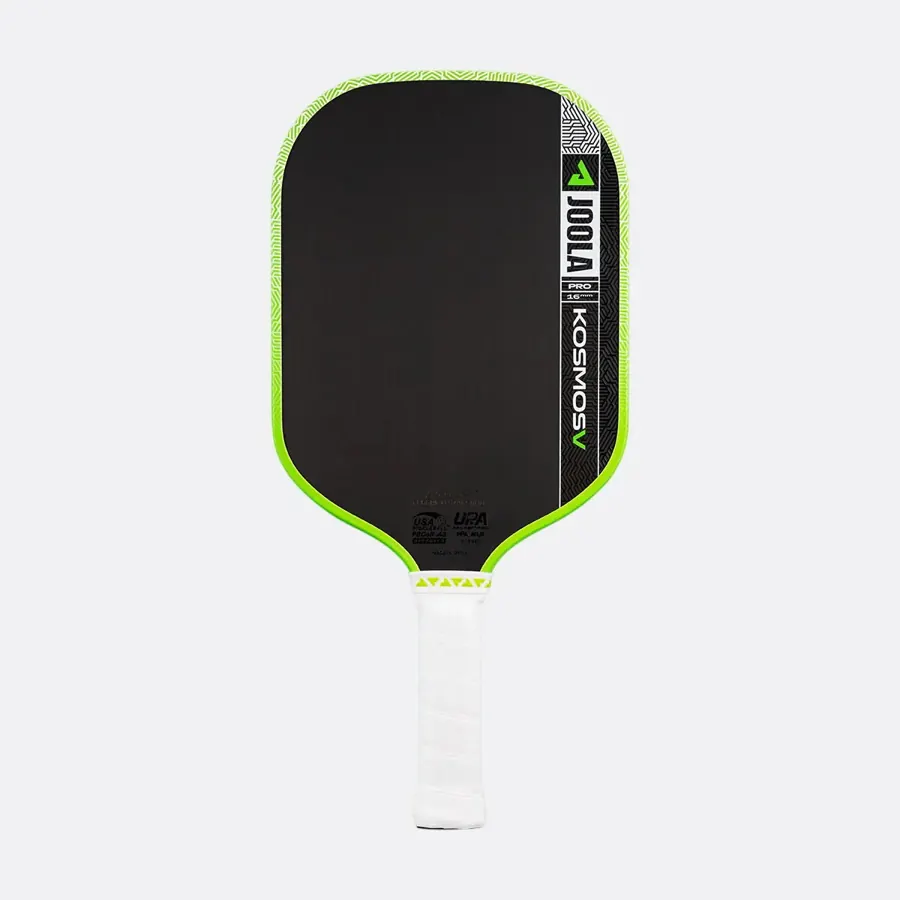
Choose a pickleball paddle in this order: shape, core thickness, weight and swing weight, handle length, grip size, face material, then budget. The first two decide how the paddle plays, the next three decide whether it fits your body and your strokes, and the last two narrow what is left. If you get shape and core thickness right, the rest is fine-tuning.
This page is the hub for our paddle guides and tools. Each step links to a longer explainer, and the examples use manufacturer-published specs for paddles in the Pickleland pro shop, checked October 9, 2026. We do not lab-test paddles.
If you are X, look for Y
| If you are | Shape | Core | Also look for |
|---|---|---|---|
| A true beginner | Widebody | 16mm | Midweight, about 7.7 to 8.2 oz |
| A doubles player who wins at the kitchen | Widebody or hybrid | 16mm | Lower swing weight for hand speed |
| A singles player or baseline driver | Elongated | 14mm or 16mm | Higher swing weight |
| A tennis player with a two-handed backhand | Elongated | 16mm | Handle of 5.5 in or more |
| A player with small hands | Any | Any | Grip of 4.1 to 4.125 in |
| Managing a sore elbow or shoulder | Widebody or hybrid | 16mm or thicker | Lower swing weight, correctly sized grip |
| Not sure how you play yet | Hybrid | 16mm | Midweight |
| Short on finishing power | Elongated or hybrid | 14mm | Fiberglass or layered face |
Starting points, not rules. A demo session on court beats any chart.
Prefer to be asked the questions? The paddle finder is a short quiz that does this sorting for you.
Step 1: shape
Shape sets the trade between forgiveness and reach, and you can read it straight off the dimensions.
- Widebody or standard: about 16 inches long and 8 inches wide. The biggest sweet spot and the most stable face on blocks.
- Elongated: about 16.5 inches long and 7.5 inches wide. More reach and leverage, a narrower face.
- Hybrid: in between. JOOLA’s Kosmos Pro V, for example, is 16.3 by 7.7 inches.
Makers that publish twist weight give you a way to check the forgiveness claim. Selkirk lists its OMNI at 7.9 in widebody and 6.9 in elongated. Higher twist weight means the face turns less when you miss the center.
Start wide if you are new. Go long if you play singles, hit hard from the back, or want a long handle.
Step 2: core thickness
Thickness is measured in millimeters between the two faces. Most paddles are 14mm or 16mm, with a few at 13mm and some foam-core models thicker still.
- 16mm: softer, more controlled, easier on dinks, drops and resets.
- 14mm or 13mm: faster off the face, better for counters and put-aways, less margin for error.
Thinner versions of the same paddle are usually a little lighter. JOOLA lists its Perseus Pro V at 7.9 ounces in 14mm and 8.1 ounces in 16mm.
If you are unsure, pick 16mm. The longer version is in 13mm vs. 16mm paddles. What the core is made of (polymer honeycomb or solid foam) is a separate question, covered in paddle core materials and thermoformed paddles.
Step 3: weight and swing weight
There are two numbers here and the second one matters more.
Static weight is what a scale reads. Most paddles fall between about 7.3 and 8.3 ounces, and that midweight band suits most players. Published weights for the paddles we stock run from 7.7 to 8.5 ounces.
Swing weight is how heavy the paddle feels when you swing it, which depends on where the mass sits. A lower figure is quicker at the net. A higher one puts more behind drives and serves. Among the paddles in our shop with a published swing weight, the range is 109 to 121. Elongated paddles tend to sit higher: Selkirk lists the OMNI at 112 in widebody and 118 in elongated.
Not every brand publishes swing weight. Selkirk and Avoura do for most of the models we carry. JOOLA does not.
Buy slightly lighter than you think you need. You can add weight with lead tape and you cannot remove it. Our swing weight calculator shows what a given amount of tape does at each position, and it walks through measuring swing weight at home. Background reading: the paddle weight guide and the lead tape guide.
Step 4: handle length
Handle length decides whether a second hand fits. For a two-handed backhand, look for 5.5 inches or more. For a one-handed game, a shorter handle is fine and leaves more length for the face.
Published handle lengths on our wall run from 4.85 inches (Selkirk SLK HALO Power) to 5.8 inches (Selkirk’s elongated shapes). Widebody and hybrid paddles are often around 5.25 inches. Check the number, because shape names do not tell you. Players coming from a racquet should read paddles for tennis players.
Step 5: grip size
Grip circumference is the spec people skip and then regret. Too large and your wrist locks up. Too small is easy to fix with an overgrip. So when in doubt, size down.
Most paddles come in one size. The paddles we stock publish grips between 4.1 and 4.25 inches, with Avoura at the small end. The measuring methods are in our grip size guide, and we wrote a separate piece on fit for smaller hands in paddles for women, which is really a guide to grip size and swing weight.
Step 6: face material
The face is what touches the ball, and there are two main families.
- Carbon fiber, usually raw T700: the default on performance paddles, chosen for spin and a controlled feel.
- Fiberglass: livelier, with more pop for the same swing, common on lower-priced paddles.
Some paddles layer the two. Selkirk’s SLK ERA Power, for instance, lists a three-layer face of woven fiberglass and raw carbon fiber.
Face material matters less than the first five steps, which is why it comes sixth. Read carbon fiber vs. fiberglass for the comparison and paddle spin explained for what surface texture does and does not do. If you plan to play sanctioned tournaments, also confirm the exact model is approved: see is my paddle legal.
Step 7: budget
Set the budget last, because by now you know which specs you need, and those specs exist at more than one price.
- A brand’s second line. Several of Selkirk’s SLK paddles have the same published outline and handle length as its flagship models.
- The previous generation. JOOLA’s Pro IV paddles are the generation before its current Pro V line, in the same shapes.
- Simpler construction. Lower-priced paddles more often pair a fiberglass face with a standard honeycomb core, while foam cores and tuned weighting show up higher in the range.
What makers put into their top models is mostly newer core construction, tuned swing and twist weight, and surface textures they say last longer. Those matter more the better you get. A newer player will not feel most of them.
We do not type prices into posts because they change. Live prices sit beside every spec in the paddle specs table, which you can sort by any column, and on each product in the paddle shop. For low-cost options beyond what we stock, see affordable pickleball paddles.
Narrow it to three, then hit with them
Once you have a shape, a thickness and a weight range, you should be down to a handful of paddles. From there:
- Sort the paddle specs table by the number you care about most. It lists the paddles we stock, with averages by brand, shape and core.
- Put your top three in the comparison tool to see them side by side.
- Hit with them. Dinks and resets first, then fast volleys, then drives. If you are near Austin you can demo paddles at Pickleland on a real court before buying.
Specs narrow the field. They do not pick the winner.
Guides by player type
- Best pickleball paddles for beginners
- Best pickleball paddles for intermediate players
- Best pickleball paddles for tennis players
- Best pickleball paddles for women
- The best pickleball paddles overall
FAQ
What is the most important factor when choosing a pickleball paddle?
Shape, then core thickness. Together they set how forgiving the paddle is and how fast the ball leaves the face. Weight, handle and grip then decide whether that paddle fits you.
What paddle should a beginner choose?
A widebody shape with a 16mm core in the midweight range. That combination gives the largest sweet spot and the most control while you build a consistent swing. Specific models are in our beginner paddle guide.
Is swing weight more important than paddle weight?
For how a paddle feels in play, yes. Two paddles with the same static weight can swing very differently depending on where the mass is. Use static weight to rule out extremes and swing weight, where the maker publishes it, to compare finalists.
How much should I spend on a pickleball paddle?
Enough to get the shape, thickness and handle you need, and no more until you can feel the difference. Check live prices in the specs table and compare the models that match your specs.
How long does a pickleball paddle last?
It depends on how often and how hard you play. Surface texture wears and cores can break down over time. The warning signs are in when to replace your paddle.