
Skinny singles is two-player pickleball on half the court. USA Pickleball made it official in 2024 under the name mini-singles, and in the 2026 rulebook it’s Rule 14.B. All standard singles rules apply, with one change: for each rally, only the right or left half of each player’s end is in play, chosen by that player’s own score. Even score, right half. Odd score, left half.
You’ll also see a looser “crosscourt only” version at clubs, where both players just play diagonally. Both are covered below, so you’ll know which one you’re agreeing to before the first serve.
Source: 2026 USA Pickleball Official Rulebook, Rule 14.B; Pickleheads, Pickleball rule changes guide
The official mini-singles rules (Rule 14.B)
Mini-singles uses every standard singles rule (serve, two-bounce rule, kitchen, faults, side-out scoring) with these changes:
- Standard court (14.B.1). No special court is needed.
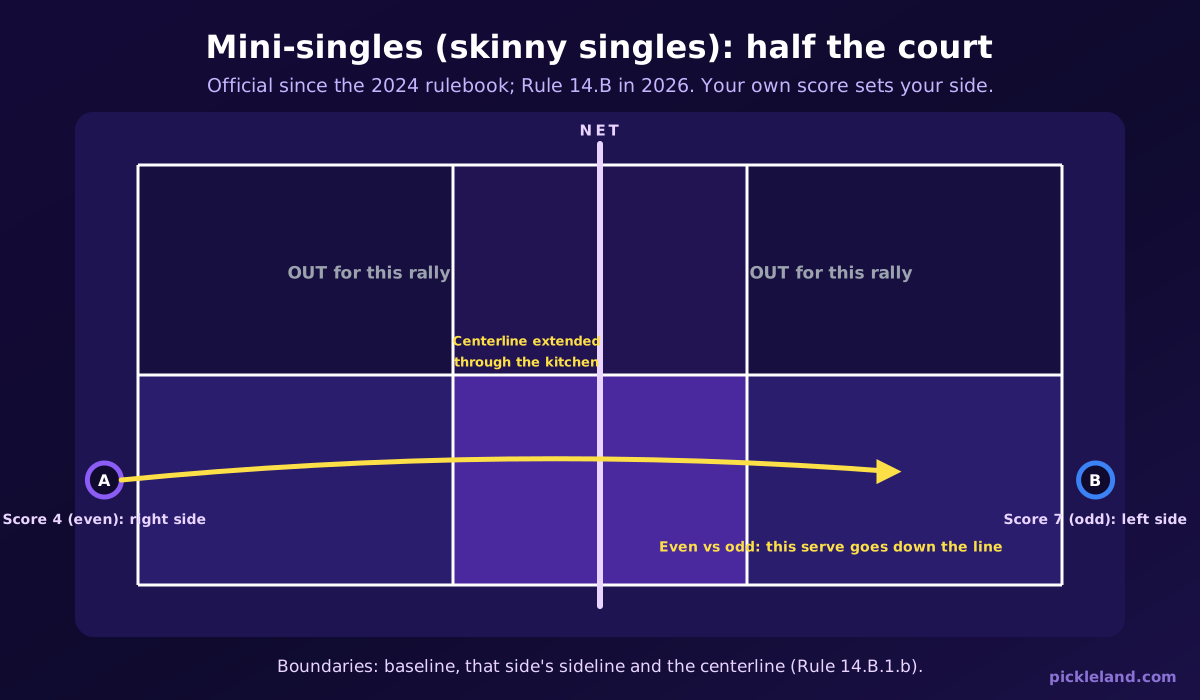
- Half the court per rally (14.B.1.a). On each player’s end, only the right or left side is in play, based on that player’s own score. Zero or even is the right side, odd is the left, as in normal singles.
- Boundaries (14.B.1.b). The in-play side is bounded by the baseline, that side’s sideline and the centerline. The other side is out, including its part of the kitchen.
- An extra line (14.B.1.c). The centerline must be extended through each kitchen so the half-court boundary is visible. It doesn’t have to be the same color as the other lines. Tape works.
- Positions follow individual scores (14.B.2). The server’s side is set by the server’s score and the receiver’s side by the receiver’s score.
- Every shot must land in the opponent’s in-play side (14.B.3), the serve included.
The part people miss: the serve isn’t always crosscourt
In regular singles the serve always goes diagonally. In mini-singles it goes to whichever half the receiver is using, and that depends on the receiver’s score, not the server’s:
| Server’s score | Receiver’s score | Server stands | Receiver stands | Serve direction |
|---|---|---|---|---|
| Even | Even | Right | Right | Crosscourt |
| Odd | Odd | Left | Left | Crosscourt |
| Even | Odd | Right | Left | Straight ahead (down the line) |
| Odd | Even | Left | Right | Straight ahead (down the line) |
Right and left are from each player’s own point of view, facing the net. So the serve is crosscourt only when both scores are even or both are odd. In the other two cases it goes straight ahead, down the line.
Scoring
Standard side-out scoring: only the server scores, games to 11, win by 2. The score call has two numbers, server then receiver (singles rules). If you lose a rally while serving, it’s a side out. You may also use the provisional rally scoring option if both players agree.
The casual version: crosscourt skinny singles
At clubs and in drills, many players use a simpler setup. Both players stay on the same diagonal for the whole game, and every shot must land in the crosscourt half. It’s simpler to track and it’s a great way to practise the crosscourt dink and drive patterns you use in doubles.
| Official mini-singles (14.B) | Crosscourt skinny singles (house rule) | |
|---|---|---|
| Who sets your half | Your own score, every rally | Fixed for the game, or switched at agreed times |
| Serve direction | Crosscourt or down the line | Always crosscourt |
| Rally shots | Into the opponent’s in-play half | Into the opponent’s diagonal half |
| Best for | Match play, tournaments that offer it | Drills, warm-ups, doubles practice |

Agree on which version you’re playing before the first serve. Most arguments in skinny singles come from one player using the official rule and the other using the house rule.
Why play skinny singles
- You only need two people. No waiting to put a foursome together.
- It feels like doubles. You cover a 10-foot-wide lane, about what each player covers in doubles, so it trains the same dinks, resets and crosscourt patterns.
- It’s less running than full singles. Half the width makes it a good option for players who find full singles too much.
- It sharpens accuracy. With half the court out, a ball that would be safely in during doubles is out here.
Tips for winning at mini-singles
- Track both scores out loud. Your half and your opponent’s half change independently. Saying the score clearly before each serve prevents most position errors.
- Use the down-the-line serve. When the serve goes straight ahead, it’s shorter and more direct than a crosscourt one. Aim deep.
- Get to the kitchen. As in doubles, the player at the kitchen line has the advantage. The two-bounce rule means the receiver usually gets there first.
- Dink to the centerline. With the outer half out, the centerline is your safest target. A ball wide of it is out.
- Practise your crosscourt dink. Our guide to the crosscourt dink applies directly.
Frequently Asked Questions
Is skinny singles an official pickleball format?
Yes. USA Pickleball added it as mini-singles in 2024. In the 2026 rulebook it’s Rule 14.B.
How do you score skinny singles?
Like regular singles: side-out scoring, games to 11, win by 2, and a two-number score call.
Which side do you play on in skinny singles?
In official mini-singles, your own score decides: zero or even means the right half, odd means the left. Your opponent’s half is set by their score.
Is the other half of the kitchen in or out in mini-singles?
Out. Only the in-play side, bounded by the baseline, its sideline and the centerline, is in. The centerline is extended through the kitchen to show the boundary.
Do you always serve crosscourt in skinny singles?
Not in official mini-singles. The serve goes to the receiver’s in-play half, so it’s crosscourt when both scores are even or both odd, and straight ahead otherwise. In the casual crosscourt version, it’s always diagonal.