
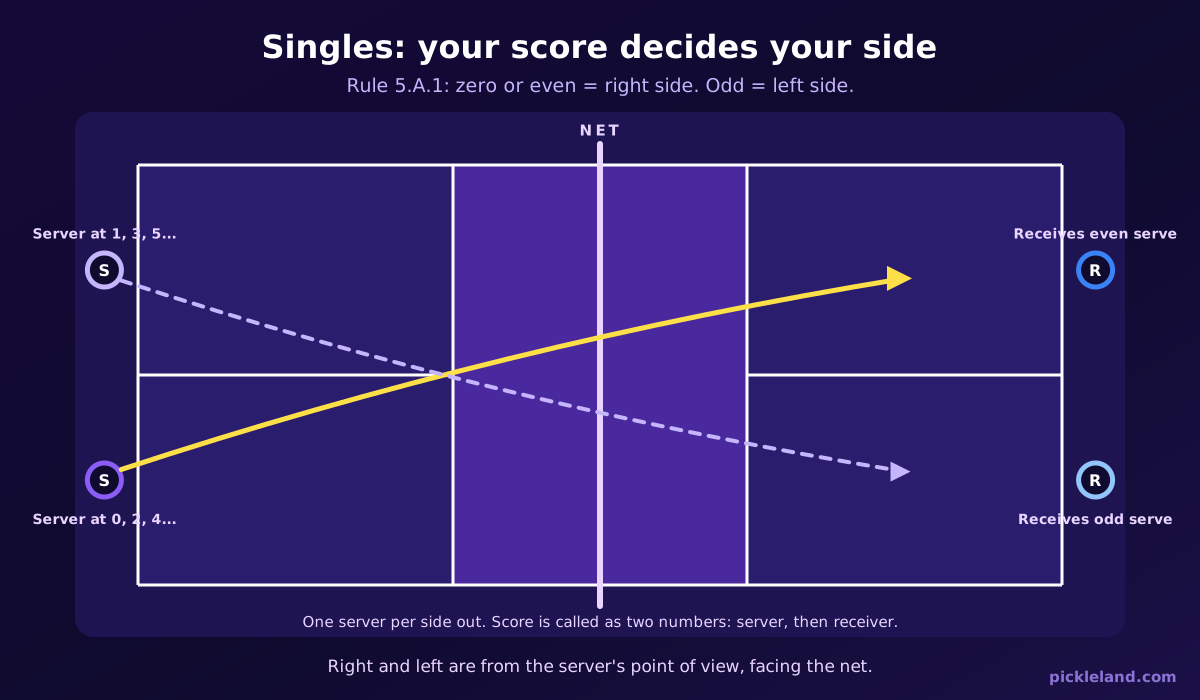
Singles in one paragraph: same court, same net, same kitchen and same two-bounce rule as doubles. What changes is the serve. There’s one server per side, so there’s no “second server,” and the score is called as two numbers, not three. You serve from the right when your score is zero or even and from the left when it’s odd (Rule 5.A.1 of the 2026 USA Pickleball rulebook). Games are to 11, win by 2, and only the server scores, unless you’re playing rally scoring.
Singles vs. doubles: what’s different
| Singles | Doubles | |
|---|---|---|
| Court | 20 × 44 ft, the full width (Rule 3.A.1) | Same |
| Servers per side out | 1 | 2 (only 1 for the first serving team of each game) |
| Score call | 2 numbers: server, receiver (6.B.1) | 3 numbers: serving team, receiving team, server number (6.B.2) |
| Opening call | “0–0” | “0–0–2” |
| Where you serve from | Your score: even = right, odd = left (5.A.1) | The starting server is on the right when the team’s score is even (5.B.3) |
| Two-bounce rule | Applies | Applies |
| Kitchen rules | Apply | Apply |
| Standard game | To 11, win by 2 | Same |
| Event types (2026) | Men’s, women’s, wheelchair, adaptive standing (15.A) | Adds mixed and hybrid doubles |
How the singles serve rotation works
- Start of the game. The first server stands behind the baseline on the right (score 0, even) and calls “0–0.”
- Win the rally, keep serving. You score a point and switch sides: right to left, left to right (5.A.2). Your new score sets your side. At 1 you’re on the left, at 2 on the right, and so on.
- Lose the rally, side out. Your opponent now serves (5.A.3). They stand on the side that matches their score.
Quick check during play: if you’re serving and your score is even, you should be on the right. If you’re not, something has gone wrong. Before the serve you may ask your opponent for the score or whether you’re in the right position, and they must answer (Rules 5.C and 6.E.1).
The singles serve and return
All the usual serve rules apply. Serve diagonally, clear the kitchen and its line, and land in the opponent’s service court. You have one serve, 10 seconds after the score call (6.D), and a choice of volley serve or drop serve.
The two-bounce rule matters even more in singles. The receiver must let the serve bounce, and then you as the server must let the return bounce. You start every point at the baseline with the whole court to cover, while the receiver can return deep and run to the net.
Scoring options in singles
- Recreational: games to 11, win by 2, with side-out scoring.
- Tournaments (Rule 15.C.1): best 2 of 3 games to 11, best 3 of 5 to 11, or one game to 15 or 21, all win by 2.
- Rally scoring (provisional, Rule 14.A): a point on every rally, whoever served. Learn the details in rally scoring.
- Mini-singles, also called skinny singles (Rule 14.B): singles on half the court. See how to play skinny singles.
Faults that come up more in singles
- Serving from the wrong side. In doubles your partner usually reminds you. In singles nobody does. If a player stops the rally to correctly point out a position error, the rally is replayed (5.C.1.a). If nobody notices until after the rally, the result stands (5.C.2).
- Volleying the return as the server. You’re the only player on your side, and you’ll be tempted to rush in. Let it bounce (10.A.2).
- Kitchen faults on passing shots. When you charge the net to cut off a pass, momentum often carries you into the kitchen. That’s a fault even after the ball is dead (11.A.2). See kitchen rules.
- Line calls. You call every line on your own end (8.A). When in doubt, it’s in (8.D).
Strategy basics for singles
Singles rewards a different game from doubles. Covering 20 feet of width alone means depth and placement matter more than soft play.
- Serve deep. A deep serve keeps the receiver from returning and charging in easily.
- Return deep, then come in. The receiver’s advantage is the two-bounce rule. Use it.
- Hit the third shot to a corner. Many singles players drive or roll the third shot rather than drop it, because there’s no partner to cover the court while you move in.
- Passing shots beat dinks. With one opponent at the net, the sidelines are open.
We go deeper in singles strategies. Singles results also count toward a separate DUPR singles rating. See singles vs doubles DUPR.
Frequently Asked Questions
What are the basic rules of singles pickleball?
The same as doubles, except for serving and scoring. Each side has one server, the score is called as two numbers, and you serve from the right when your score is even and the left when it’s odd. The two-bounce rule and kitchen rules apply as normal.
How do you call the score in singles pickleball?
Two numbers: the server’s score, then the receiver’s score. A game starts at “0–0.”
How do you know which side to serve from in singles?
Look at your own score. Zero or even means you serve from the right. Odd means the left (Rule 5.A.1).
Is singles pickleball played on the full court?
Yes. Standard singles uses the full 20-foot width. Mini-singles (skinny singles) uses half the court and is a separate variation (Rule 14.B).
Do you get two serves in singles pickleball?
No. You get one serve. If you win the rally you keep serving. If you lose it, it’s a side out.
What is the score to win in singles pickleball?
11 points, win by 2, in recreational play. Tournaments may also use games to 15 or 21 and best-of-three or best-of-five matches.