

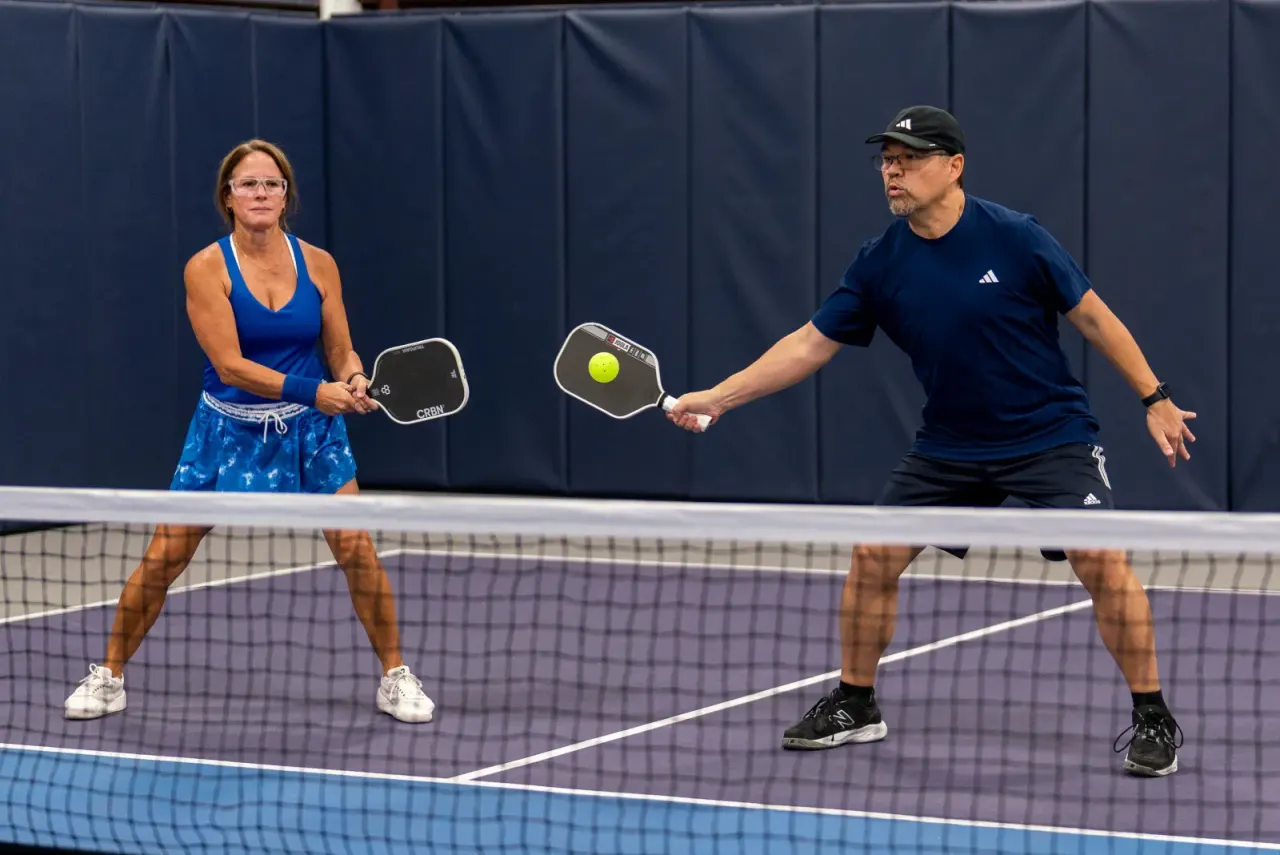
Three players, one court: you have three good options. Cutthroat puts one solo player against a pair, and only the solo server can score. Winner-stays skinny singles has two players on half the court while the third waits to challenge. Three-player drills are the third option if you’d rather practise than keep score. None of these is in the USA Pickleball rulebook, which covers singles, doubles and their official variations (rally scoring and mini-singles, Section 14). These are house formats, so agree on the details before the first serve.
Which 3-player game should you play?
| Cutthroat | Winner-stays skinny singles | 3-player drills | |
|---|---|---|---|
| On court at once | 3 (1 vs 2) | 2 (third waits) | 3 |
| Who scores | Only the solo server, for themselves | The server, as in singles | Optional |
| Running | Lots for the solo player | Moderate (half court) | You choose |
| Best for | A competitive game with friends | Even-level players who like singles | Practising the soft game |
| Pace | Fast rotations | Short games, one person rests | Continuous |
1. Cutthroat (1 vs 2)
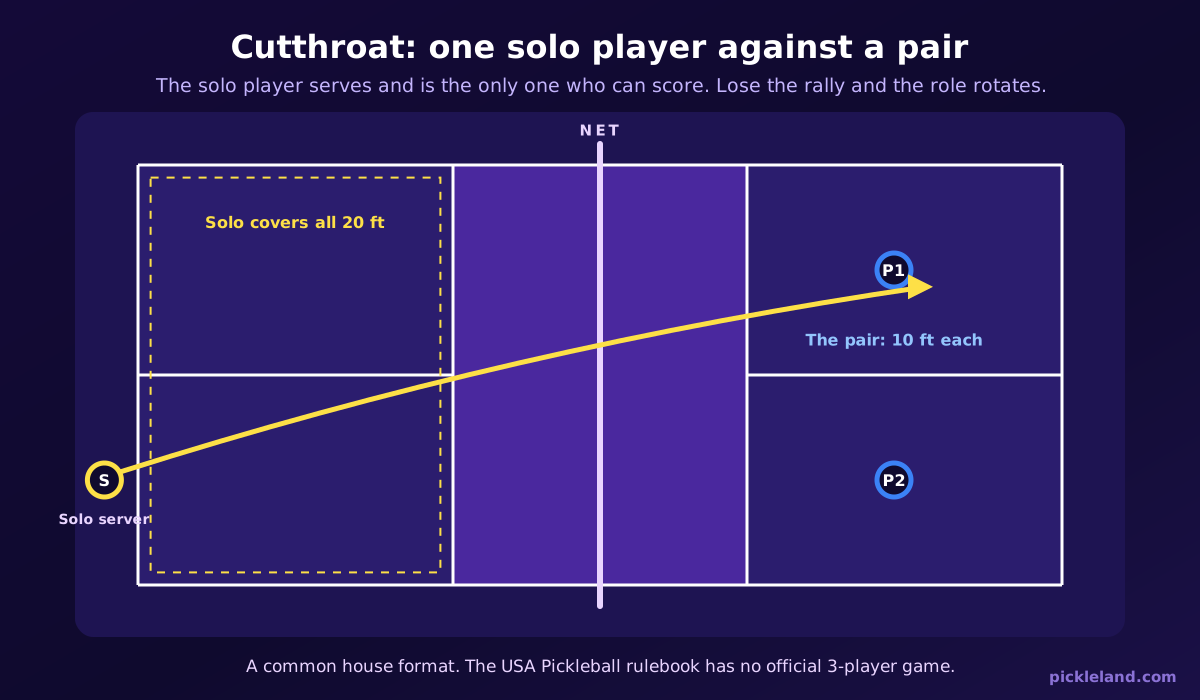
The most popular 3-player game. Setup:
- Decide the serving order: A, B, C.
- A is the solo player. A stands alone on one side and serves. B and C share the other side as a pair.
- A serves from the side that matches A’s score, as in singles: right when A’s score is even, left when it’s odd.
- If A wins the rally, A scores a point and serves again from the other side.
- If A loses the rally, there’s no point. The next player in order (B) becomes the solo server, and A joins C as a pair.
- Everyone keeps their own score. First to 11, win by 2, wins.
The pair can’t score, so their job is to break the solo player’s serve. It’s a strange incentive at first: you’re teammates for one rally and opponents the next.
How the serve rotates (example):
| Rally | Solo server | Pair | Result | Scores (A–B–C) |
|---|---|---|---|---|
| 1 | A | B + C | A wins | 1–0–0 |
| 2 | A | B + C | Pair wins | 1–0–0 |
| 3 | B | A + C | B wins | 1–1–0 |
| 4 | B | A + C | Pair wins | 1–1–0 |
| 5 | C | A + B | C wins | 1–1–1 |
Common variations:
- Two-bounce rule on or off for the solo player. The standard two-bounce rule applies by default. Some groups let the solo player volley the return to make up for being outnumbered.
- Half court for the pair. To even things out, the pair must hit into the solo player’s half and the solo player can hit anywhere. Or the reverse, if the solo player is the strongest.
- Rally scoring. Points on every rally, credited to whoever was serving or receiving alone. Faster, but more arguments about who scored.
More tactics in our full cutthroat guide.
2. Winner-stays skinny singles
Two players play a short game on half the court, crosscourt or with the official mini-singles rules. The third waits at the side.
- Play to 5 or 7 points, win by 1, to keep games short.
- The winner stays on. The loser steps off and the waiting player steps in.
- Track total games won. After 30 minutes, most games won wins the session.
Short games and constant rotation mean nobody waits more than a few minutes.
A 9-game schedule if you’d rather everyone plays the same amount (each pair plays three times):
| Game | On court | Sitting out |
|---|---|---|
| 1, 4, 7 | A vs B | C |
| 2, 5, 8 | B vs C | A |
| 3, 6, 9 | A vs C | B |
Each player plays 6 of the 9 games and sits out 3.
3. Drills for three
When the score doesn’t matter, three players can practise more than four:
- Two-on-one dinking. Two players dink from one side and the third covers alone. Rotate every 2 minutes. The solo player gets twice the touches.
- Third-shot drop practice. One player feeds deep from the baseline, one hits third-shot drops, and one stands at the kitchen line and calls whether each drop would have been attackable.
- Reset under pressure. Two players at the net speed up at a third in the transition zone, who tries to reset into the kitchen.
Etiquette with three
- Agree on the rules before the first point. Two-bounce rule, scoring, game length, line calls.
- Call your own score clearly in cutthroat. It’s easy to lose track with three running totals.
- Rotate the solo role fairly. If one player is much stronger, give them the solo role longer or have them play the pair’s half-court variation.
- If a fourth player arrives, switch to doubles. See open play formats.
Frequently Asked Questions
Can you play pickleball with 3 people?
Yes. The most common game is cutthroat, where one solo player serves against a pair and only the solo server can score. Winner-stays skinny singles and three-player drills are other options.
How does scoring work in 3-person pickleball?
In cutthroat, each player keeps their own score. You can only score while you’re the solo server. Lose the rally and the next player becomes the solo server. First to 11, win by 2.
Is there an official 3-person pickleball rule?
No. The USA Pickleball rulebook covers singles and doubles, plus rally scoring and mini-singles. Three-player games are house rules, so agree on them before you start.
Does the two-bounce rule apply in cutthroat?
By default, yes: the serve and the return must each bounce. Some groups relax it for the solo player.
What is cutthroat pickleball?
A 3-player game where one player plays alone against two. The solo player serves and is the only one who can score. When they lose a rally, the role rotates to the next player.