
Most players plateau because they play games and call it practice. Games are useful — they give you match experience — but they don’t isolate the weaknesses holding your rating back. You spend 85% of a game doing things you’re already okay at, and 15% doing the things you actually need to fix.
A ball machine flips that ratio. You pick the shot, you pick the pressure, and you get 200 reps in the time it takes to play a single open play session. Done right, a 45-minute ball machine session is one of the highest-leverage training investments in pickleball.
Here’s how to actually use one.
What a Ball Machine Can (and Can’t) Do
A ball machine is exceptional at building:
- Motor patterns — getting a stroke from “conscious effort” to automatic
- Consistency under repetition — can you hit the same dink 50 times in a row?
- Pressure thresholds — gradually increasing speed to find your edge and push past it
What it can’t simulate: reading an opponent’s body language, reacting to non-ball cues, or the chaos of real doubles positioning. Use machines for isolation. Use games for integration. You need both.
Before You Start: Session Setup
Get these right before the first ball drops.
Machine placement: Unless the drill specifies otherwise, start the machine at the baseline on the other side of the net. For kitchen drills, move it to the NVZ line.
Speed setting: Start one notch below what you think you need. Your goal is perfect reps, not survived reps. Once you string together 20 clean contacts, bump up a notch.
Ball count: Feed the hopper full (most machines hold 50–150 balls). Stopping to pick up mid-drill kills the training effect.
Shadow drill first: Before the machine starts, shadow the movement 5–10 times with no ball. Your brain learns positioning separately from ball-tracking — don’t skip this.
The 6 Drills
1. Serve Consistency: The Deep Corner Loop
What it fixes: Serves that land short, pop up, or miss cross-court.
Setup: Machine at mid-court on the far side, angled to feed a consistent waist-high ball to your serving position. This simulates the self-toss rhythm.
The drill: Serve to the same corner (backhand corner of the service box) for 25 consecutive balls. Count consecutive successes — 15 or more in a row is the goal. Then switch to the forehand corner for 25 more.
Progression: Once you’re hitting 15 consecutive to each side, add a depth target: lay down a cone 3 feet from the baseline. Serves landing short of the cone don’t count.
Why it works: Most players practice serving without a target. A corner + depth constraint reveals exactly where your toss, contact point, or follow-through breaks down.
2. Return of Serve: Neutralize the Pace
What it fixes: Returns that float (giving the serving team time to rush the net) or go into the net under pace.
Setup: Machine at the baseline, alternating randomly between deep and mid-depth feeds. Simulate a hard, flat serve.
The drill: Your goal is to land every return in the back third of the court — between the kitchen line and the baseline — while moving immediately into transition. After each return, take three quick steps forward and reset your ready position. Repeat for 30 balls.
Key cue: Think “absorb and redirect,” not “swing.” Compact backswing, meet the ball in front of your body, and let pace work for you.
Progression: Ask a hitting partner to watch and call out every return that lands in the first half of the court. Identify the pattern — usually it’s the backhand side under pressure.
3. Dink Consistency: Cross-Court 50
What it fixes: Dinks that pop up (attackable) or go wide.
Setup: Machine at the far NVZ line, cross-court from your forehand. Feed set to low speed, high arc, landing just past the net.
The drill: Rally cross-court dinks from your NVZ. Goal: 50 consecutive dinks landing inside the kitchen (non-volley zone). Any ball above knee height that you volley — that’s a reset opportunity, not a dink. Start your count over if you pop one up.
What you’re training: Paddle angle consistency and net clearance. The moment you start rushing the reset, your grip tightens, your elbow locks, and the ball pops up. Slow down on purpose.
Progression: Once you hit 50, switch to backhand dinks for another 50. Then alternate every 5 reps.
4. Third-Shot Drop: The 30-Foot Window
What it fixes: Third shots that land in the transition zone instead of the kitchen.
Setup: Machine at the far baseline simulating a deep return. You stand at your own baseline.
The drill: Hit 40 third-shot drops. Track where each ball lands — inside the kitchen, kitchen line (good), transition zone (too long), or net (too short). Your goal: 70% kitchen in a single set.
The common miss: Most players hit into the net on this drill because they’re trying to “drop” the ball. The fix: you’re not dropping it down, you’re hitting a soft, upward arc that peaks over the net and lands softly. Think “up and over” not “down.”
Progression: Once at 70%, close your non-hitting hand behind your back. This forces your core to rotate and stops the common fault of arm-only swings.
5. Reset Under Pressure: Transition Zone Hands
What it fixes: Losing the point in the transition zone — the “dead zone” between baseline and kitchen.
Setup: Machine at the far NVZ, aimed directly at your body (hip to chest height). Start at medium-high speed.
The drill: Stand at the centerline, one step behind the NVZ line. Your only goal is to block every ball back into the kitchen with a compact punch motion. No backswing. 30 balls per set.
The mental shift: This drill teaches you that “reset” doesn’t mean a perfect dink — it means any ball that lands in the kitchen and stays low. A clean, short punch that falls into the kitchen beats a “pretty” dink that floats.
Progression: Increase speed one notch after each set of 30. Note the speed where your form starts to break down. That’s your training ceiling — spend your next session there.
6. Speed-Up Counter: Hands Reaction
What it fixes: Losing points when opponents speed up from the kitchen. This is the drill that most directly shows up in real match results.
Setup: Machine at the NVZ, max or near-max speed, aimed at your dominant shoulder (the most common attack direction). You stand at the NVZ line.
The drill: Counter every ball back over the net using a compact forehand block — paddle face closed slightly, minimal backswing, punch through the ball. 20 reps. Then switch to backhand counters for 20 more.
The key: Your paddle starts in front of your body, not at your side. If you have to bring it across your body to respond, you’re already late. This drill will expose if your ready position is wrong before the ball even comes.
Progression: Ask a friend to stand at the machine and feed manually, varying the height and angle unpredictably. Random inputs train reaction, repetitive inputs train motor pattern — you need both.
How to Structure a Full Session
A 45-minute machine session could look like this:
| Block | Duration | Drill |
|---|---|---|
| Warm-up | 5 min | Slow cross-court dinks, no counting |
| Block 1 | 10 min | Serve consistency (both sides) |
| Block 2 | 10 min | Third-shot drop (two sets) |
| Block 3 | 10 min | Dink cross-court 50 |
| Block 4 | 10 min | Reset / speed-up counter |
| Cool-down | 5 min | Slow volleys, stretch |
Don’t mix all six drills in one session. Pick two to three and go deep. Breadth feels like practice. Depth is what actually moves ratings.
When to Add a Coach
A ball machine session can hide bad habits. If you’re practicing a faulty technique 200 times, you’re cementing it faster. If your rating has been stuck for a few months even with consistent play, a lesson before your next machine session will give you something specific to drill rather than just volume.
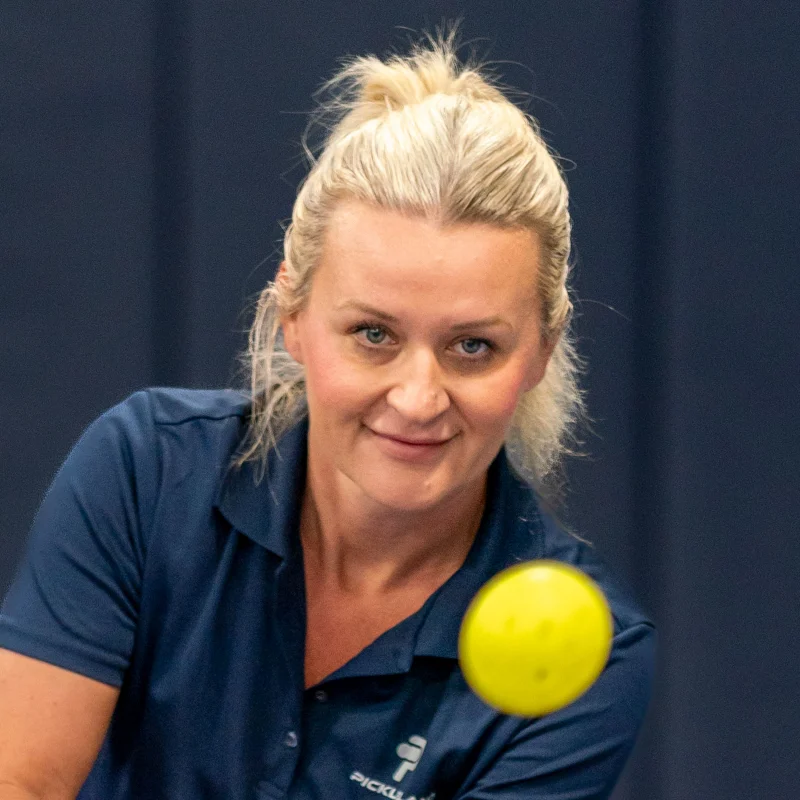
At Pickleland, Coach Kasia (DUPR 4.9, Selkirk-sponsored pro) specializes in exactly this: identifying the one or two mechanics that are limiting a player and giving targeted feedback. A single 60-minute lesson can reframe your next 10 machine sessions.
Start Tonight
Pickleland’s ball machine is available at $15/hr, bookable alongside court time. If you haven’t used one before, start with drills 3 and 4 — dinks and third-shot drops — since those two show up in nearly every point and are the easiest to isolate on a machine.
Book your court and ball machine session →
Also read: