
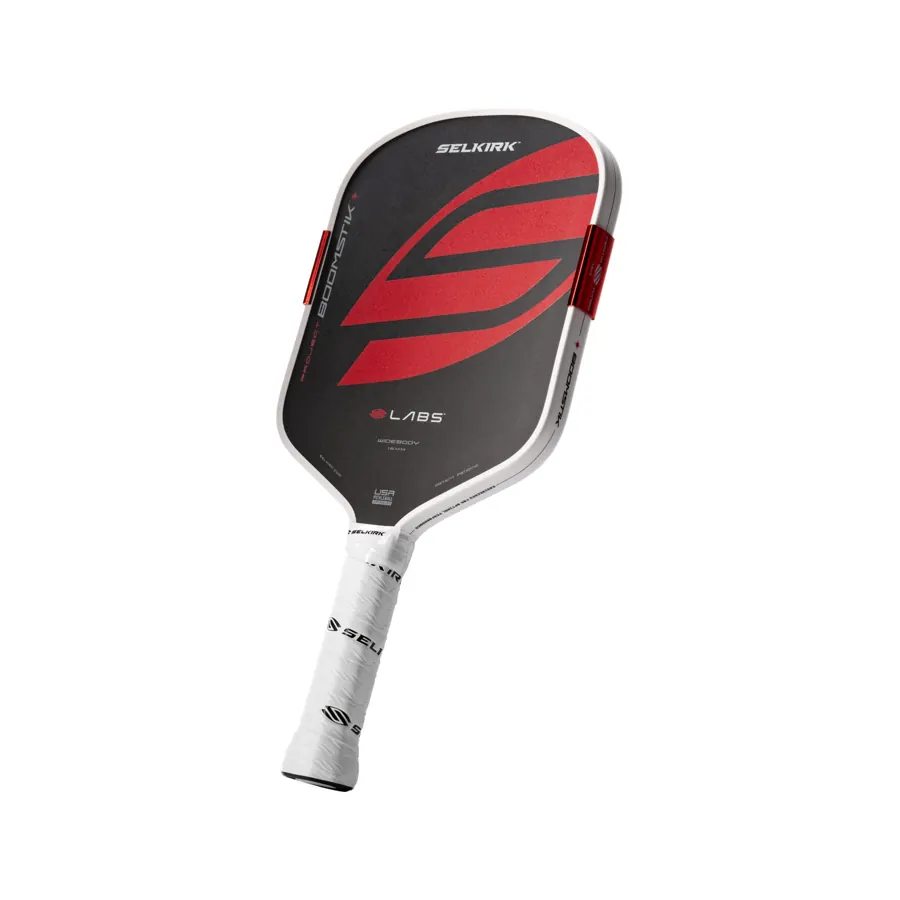
Twist weight is a paddle’s resistance to rotating around its long axis when the ball lands off-centre. Higher twist weight means the face stays squarer on a mishit, which is what people mean by a bigger sweet spot. Wider paddles have more of it, and tape on the side edges raises it more per gram than tape anywhere else.
Like swing weight, it is a moment of inertia in kg·cm². The difference is the axis. Swing weight is measured about an axis across the handle. Twist weight is measured about the centreline that runs from the butt cap to the tip.
Published twist weights: widebody vs elongated
Selkirk sells several models in two shapes and publishes twist weight for both. The numbers below are the maker’s own, checked on October 9, 2026.
| Model | Widebody (15.95 × 8 in) | Elongated (16.5 × 7.45 in) | Gap |
|---|---|---|---|
| Selkirk LABS Project Boomstik 16mm | 8.2 | 7.2 | 1.0 |
| Selkirk OMNI | 7.9 | 6.9 | 1.0 |
| Selkirk SLK ERA Power | 7.3 | 6.6 | 0.7 |
Selkirk's published averages. Selkirk says twist weight may vary by about 0.2 points on the OMNI and 0.3 on the Boomstik. JOOLA, Diadem and Slapp Life do not publish twist weight, so their paddles are not shown.
In every pair the wider shape is higher, by 0.7 to 1.0 points. Avoura’s three paddles show the same pattern across three widths.
| Paddle | Width (in) | Length (in) | Twist weight | Swing weight |
|---|---|---|---|---|
| Avoura Rhapsody 13 | 8.37 | 15.5 | 7.76 | 110 |
| Avoura Rivelle | 7.75 | 16.25 | 6.09 | 109 |
| Avoura Revaya | 7.5 | 16.5 | 5.83 | 112 |
Avoura's published specs, checked October 9, 2026.
The other paddles we stock with a published figure: Selkirk SLK Valkyrie Widebody 7.0, Selkirk SLK Dauntless Elongated 6.9, Selkirk SLK Geo Elongated 6.7, Luzz Glider 2024 Hybrid 6.4, Bread & Butter Loco Elongated 6.28, and the Luzz Cannon and Luzz Pro 4 Inferno at 6.2 each. Across everything we stock, published twist weights run from 5.83 to 8.2. All of them are sortable in our paddle specs table.
What twist weight does on court
Hit the ball dead centre and the paddle has no reason to rotate. Hit it two inches toward the edge and the ball pushes on one side of the face. The paddle tries to spin around its centreline, like a door being pushed near the handle.
How far it turns before the ball leaves depends on how much it resists that rotation. A paddle with more twist weight turns less. The face stays closer to where you aimed it, so the ball goes closer to where you aimed it and less of the impact is wasted on rotating the paddle in your hand.
That shows up most on shots where you have no time to find the middle: blocks, counters, resets off a hard drive and stretched volleys. It matters less on a full swing where you chose the contact point.
Twist weight is not free. Getting it means either a wider paddle, which gives up some reach, or more mass at the edges, which adds static weight and usually some swing weight too.
Why widebodies run higher
Every bit of mass contributes its mass times the square of its distance from the centreline. The edge guard, the perimeter foam and the outer strips of the face are the parts furthest from the centreline, so they do most of the work.
Widen the paddle and all of that edge material moves further out. On Selkirk’s two shapes the edge sits 10.16 cm from the centreline on the 8 inch widebody and 9.46 cm on the 7.45 inch elongated. Square those and you get 103.2 and 89.5. The same gram at the edge counts about 15 percent more on the widebody.
Shape is not the only lever. Selkirk says its MOI Tuning System, the weights clamped to the edge guard on the Boomstik, OMNI and SLK Dauntless, works by “shifting mass toward the outer regions of the paddle and increasing the moment of inertia (twist weight).” That is the same thing you do yourself with a strip of tape at 3 and 9 o’clock.
You can line the two up in our paddle comparison tool.
How side tape raises twist weight
The formula for added mass is short:
Δ twist weight = m(kg) × y²
m is the tape’s mass in kilograms and y is its distance from the paddle’s centreline in centimetres. Height on the paddle does not appear in it. Only distance from the centreline counts.
That gives three quick rules:
- Tape on the centreline, at 12 o’clock or on the butt cap, has y = 0 and adds no twist weight at all.
- Tape at 3 and 9 o’clock sits at the widest part of the paddle, so it adds the most per gram.
- Tape at the upper corners sits a little further in, because the corners are rounded, so it adds less twist weight and much more swing weight.
Our swing weight calculator runs this formula together with the swing weight one, so you can see both changes before you stick anything on.
Worked example: closing the gap on an OMNI Elongated
The OMNI Elongated is listed at a twist weight of 6.9 and a swing weight of 118. The OMNI Widebody is listed at 7.9. How much side tape would it take to bring the elongated up to the widebody’s number?
The elongated is 7.45 inches wide, which is 18.9 cm, so the edge is 9.46 cm from the centreline. A strip on the edge guard has its centre a few millimetres inside that. The calculator’s side preset uses 9.2 cm.
- Per gram: 0.001 × 9.2² = 0.085 points
- To gain 1.0 point: 1.0 ÷ 0.085 = about 12 grams, or 6 grams per side
- Check: 0.012 × 9.2² = 1.02, so 6.9 becomes 7.92
Now the cost. That tape sits 27.7 cm from the butt cap in the calculator’s preset, which is 22.7 cm from the swing weight axis.
- Swing weight: 0.012 × 22.7² = 6.2 points, so 118 becomes 124.2
- Static weight: 12 grams is 0.42 oz
So you can tape an elongated paddle up to a widebody’s twist weight, and you pay for it with a paddle that is noticeably heavier to swing. A lighter dose is the usual compromise. Four grams in total, 2 per side, gives:
- Twist weight: 0.004 × 9.2² = 0.34, so 6.9 becomes 7.24
- Swing weight: 0.004 × 22.7² = 2.1, so 118 becomes 120.1
The same 6 grams, placed in different spots on the OMNI Elongated:
| Where the 6 g goes | Distance from centreline | Twist weight | Swing weight |
|---|---|---|---|
| Sides (3 and 9 o'clock) | 9.2 cm | +0.51 | +3.1 |
| Upper corners (10 and 2 o'clock) | 8.0 cm | +0.38 | +6.5 |
| Lower sides, near the throat | 6.3 cm | +0.24 | +1.0 |
| Top centre or butt cap | 0 cm | 0 | depends on height |
The maths treats each strip as a single point at its centre. That is close for short strips and rougher for long ones, so treat the results as estimates.
Practical notes before you tape
Keep both sides equal. Unequal tape moves the paddle’s centreline off the middle of the face, and the paddle will favour one side.
Start small. Our lead tape guide suggests 2 to 3 grams in total for a first try, and covers how far in from the edge USA Pickleball lets tape sit on the face.
Decide what problem you are solving. If mishits squirt sideways on blocks, twist weight is the right lever. If the paddle already feels slow at the net, side tape will make that worse, and a wider shape is a better answer than more grams.
Twist weight is easier to feel than to read. You can demo paddles at Pickleland in Pflugerville and hit a widebody and an elongated version of the same model back to back.
FAQ
What is a good twist weight for a pickleball paddle?
Published figures for paddles we stock run from 5.83 to 8.2. The 16.5 inch elongated paddles run from 5.83 to 7.2 and the widebodies from 7.0 to 8.2. Higher is more stable on off-centre hits. There is no official standard for what counts as high.
Does twist weight make the sweet spot bigger?
In effect, yes. The sweet spot does not physically grow, but a paddle with more twist weight rotates less when you miss the middle, so more of the face gives you a usable shot.
Where do I put lead tape to increase twist weight?
On the side edges at 3 and 9 o’clock, in equal amounts. That is the widest part of the paddle, so each gram is as far from the centreline as it can be. On a 7.45 inch wide paddle each gram there adds about 0.085 points.
Is twist weight the same as swing weight?
No. Both are moments of inertia in kg·cm², measured about different axes. Swing weight is about an axis across the handle, 5 cm from the butt cap, and describes how heavy the paddle is to swing. Twist weight is about the long centreline and describes how much the face resists turning.
Do thicker paddles have higher twist weight?
The published figures do not show it. Twist weight follows width far more closely than thickness. The 13 mm Avoura Rhapsody 13 is listed at 7.76 because it is 8.37 inches wide. For what thickness does change, see 13mm vs 16mm paddles.
Keep going
- Swing weight and lead tape calculator
- Pickleball Paddle Swing Weight vs Static Weight
- Pickleball Paddle Balance Point
- Pickleball Lead Tape
Sources: twist weights are from each maker’s own product page, recorded October 9, 2026, including Selkirk OMNI, Selkirk LABS Project Boomstik and Selkirk SLK Dauntless (MOI Tuning System wording).