
The lob is one of pickleball’s most misunderstood shots. Done at the right moment it completely resets the geometry of a point — buying you time, forcing two opponents off the non-volley zone, and turning a defensive scramble into a fresh attack. Done at the wrong moment it’s a free overhead smash gift-wrapped for your opponent.
Learning when to lob — and how to execute one cleanly — is what separates players who use it as a panic button from those who deploy it as a weapon. This guide covers both sides: hitting a lob that works, and defending one when it comes your way.
What Is a Lob in Pickleball?
A lob is a high, arcing shot hit over your opponents’ heads and deep into their backcourt. The target is the area behind the non-volley zone (the kitchen), ideally landing within a foot or two of the baseline. A well-placed lob forces the opposing team to retreat from the net, surrender the advantageous kitchen-line position, and reset their own attack.
There are two primary types:
- Offensive topspin lob — hit with a low-to-high brushing motion that imparts forward spin. The topspin causes the ball to dip quickly and kick fast off the court, making it harder to track and even harder to smash.
- Defensive float lob — a high, slower ball used to buy time when you’re out of position or under pressure. It doesn’t have the aggressive kick of a topspin lob but it resets the pace and gives you time to recover court position.
When to Lob: Reading the Right Moment
The lob works when conditions align. Lobbing at a random point just to mix things up usually ends badly. Here’s when the shot earns its place:
Opponents Are Crowded at the Kitchen Line
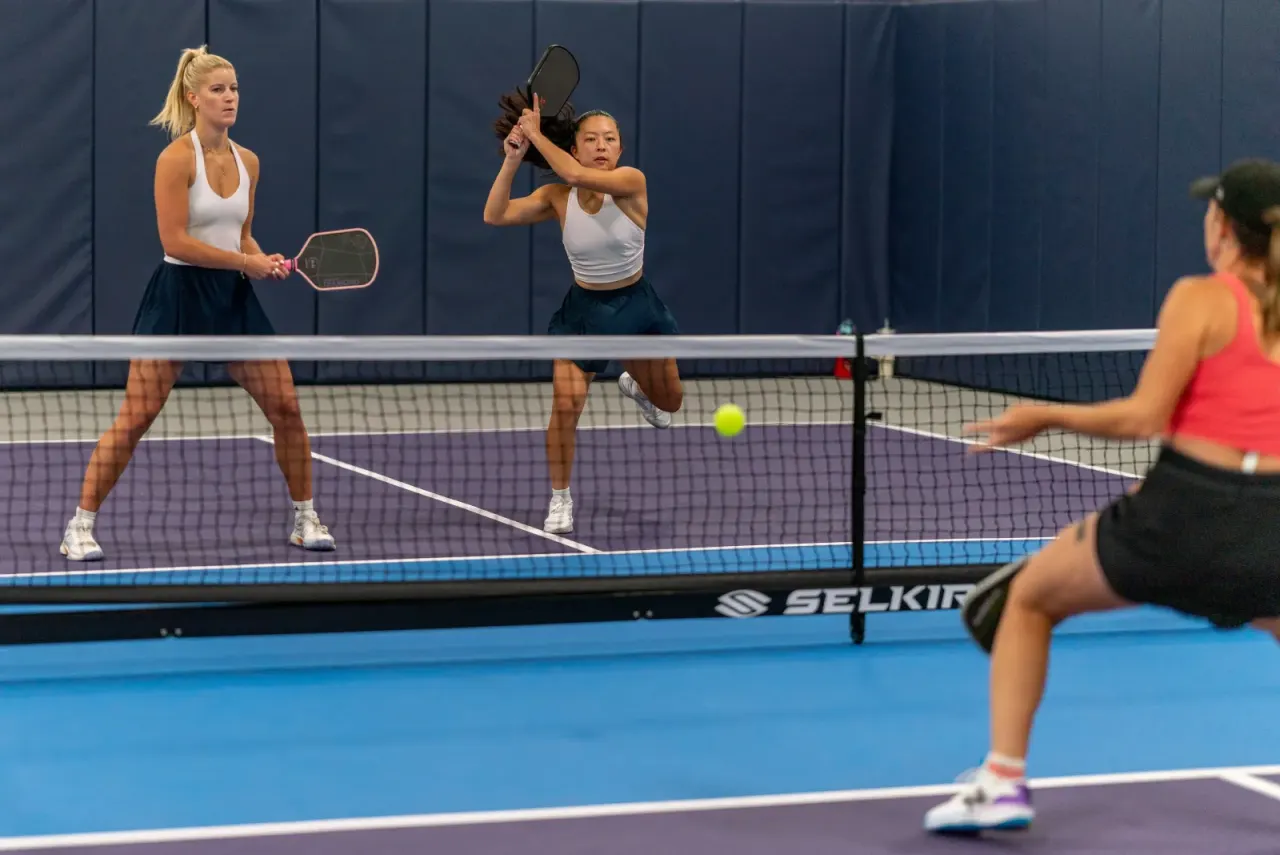
The most obvious trigger. When both opponents are leaning forward, poaching, and cutting off angles, going over them is the logical answer. The lob forces them to pivot, backpedal, and reset — exactly the discomfort you want to create.
You’re in a Deep Dink Exchange
A slow, patient dink battle creates the perfect disguise for a lob. Your paddle motion for a dink and for a topspin lob starts identically — once opponents stop watching your paddle carefully and relax into the rhythm, a lob off the same setup catches them flat-footed.
You’re Scrambling and Out of Position
A defensive float lob isn’t glamorous, but it beats trying to rip a ball from an impossible angle. When you’re wide, stretched, or behind the baseline, a high lob gives you three to five seconds to sprint back to a neutral position while your opponents have to track the ball overhead.
Your Opponents Have a Weak Overhead
Watch for cues: a player who struggles with balls hit to their non-dominant shoulder, or who backs up awkwardly when chasing a deep lob. Once you identify the vulnerability, the lob becomes a targeted weapon, not a random gamble.
How to Execute the Offensive Topspin Lob
The topspin lob is the more advanced shot and the one worth investing in if you’re playing at a 3.5 level or above.
Setup: Start from your normal dinking or third-shot drop stance. Your shoulders should be turned slightly sideways to the net.
Paddle path: Drop the paddle head below the ball, then accelerate steeply upward and forward in a low-to-high brushing motion — almost as if you’re trying to slice the back of the ball from 7 o’clock to 1 o’clock. This is what imparts topspin.
Contact point: Make contact slightly in front of your body at about waist height. Too late and you lose control of the arc; too early and you lose the brushing contact.
Follow-through: Your paddle should finish high, pointed toward the sky, not across your body. The follow-through drives the ball’s flight arc.
Target: The deeper the better — aim within 18 inches of the baseline on the opponent’s side. A lob that lands short in the middle of the court is easy to put away. A deep topspin lob that kicks off the baseline is genuinely difficult to handle.
How to Execute the Defensive Float Lob
The defensive lob doesn’t rely on topspin — it relies on height and depth.
Setup: You’re already out of position, so there’s no ideal setup. Get your paddle under the ball and open your face (tilt it skyward).
Contact: Lift through the ball rather than brushing it. The goal is to generate a high, slow arc that clears opponents by at least eight to ten feet at its peak.
Target: Aim deep to the center or to the opponent’s backhand corner. Deep center forces communication problems between partners. The backhand overhead is harder for most players than the forehand overhead.
Recovery: The moment you hit the lob, move. Don’t stand and watch it — get back to a neutral position at or near the transition zone so you’re not caught flatfooted on the smash return.
Countering the Lob: The Overhead Smash and Repositioning
If you’re on the receiving end of a lob, you have two options: overhead smash it, or let it bounce and reset from the baseline.
Reading the Lob Early
The biggest mistake is reacting late. Watch your opponent’s paddle path in a dink exchange — the low-to-high brushing motion of a topspin lob is readable if you’re looking for it. As soon as you see it, pivot and move back immediately.
Overhead Smash Mechanics
If the ball is close to your shoulder height and you have room behind you, the overhead smash is the put-away option:
- Pivot and turn: As soon as you spot the lob, turn your dominant shoulder toward the back fence. Don’t backpedal facing the net.
- Track with your non-paddle hand: Point at the ball with your free hand — it helps calibrate your timing and keeps your shoulders back.
- Contact above your head: Make contact at the highest comfortable point, snapping your wrist at impact to drive the ball down into the court.
- Aim for open space: Hit toward the opponent who lobbed you (they’re out of position) or at the feet of the non-lobber at the kitchen line.
When to Let It Bounce
If the lob is deep, has heavy topspin, or sails over your backhand shoulder, the overhead smash is low-percentage. Let it bounce:
- Bounce a short lob and reset to a third-shot-drop style approach to the net.
- Bounce a very deep lob that pushes you behind the baseline and transition patiently — don’t rush.
Stagger Your Positions
A common defensive lob target is the gap between partners. If you’ve trained yourself and your partner to stagger (one at the kitchen line, one slightly deeper), you close that vulnerability and take the best overhead position for whoever it’s headed toward.
Common Lob Mistakes
Lobbing too short: A lob that lands in the middle of the court is not a lob — it’s a setup ball. Commit to depth or don’t lob at all.
Telegraphing the shot: If you stand up straight before lobbing or change your footwork, experienced opponents will read it and start backpedaling before you even make contact. Disguise starts with your shoulders.
Lobbing into the wind: Outdoor play changes everything. A float lob with the wind behind you sails long; lobbing into the wind drops short. Indoor courts eliminate this variable entirely, which is one reason they’re ideal for developing consistent lob mechanics.
Over-lobbing: The lob is most effective when it’s unexpected. If you lob every three rallies, opponents anticipate it and position back from the kitchen — neutralizing your threat before you even hit it. Use it as a surprise, not a crutch.
Wrong moment: Lobbing when opponents are already back from the kitchen, or when your partner has advanced and left you behind, usually creates chaos. The lob is a net-crowded-opponent shot.
Lob Drills to Build Consistency
Depth Target Drill
Place a cone or towel 18 inches inside the baseline. From your kitchen line, practice lobbing a fed ball to land between the cone and the baseline. Repeat from multiple angles: straight-ahead, cross-court, and down-the-line. Aim for 7 out of 10 landing in the target zone before moving on.
Disguise Drill
Rally dinks with a partner, and on a random count (not signaled), lob instead of dinking. This builds the habit of keeping your setup motion consistent and teaches you to choose the right moment organically.
Overhead Response Drill
After the lob drill, practice the counter: one player lobs, the other practices turning, reading, and putting the overhead away. Alternate roles every 10 repetitions. This teaches both how to hit a lob under pressure and how to defend one cleanly.
Shadow Movement
Practice the pivot-and-track footwork without a ball. From the kitchen line, have a partner call “lob!” randomly — your job is to pivot, turn your dominant shoulder, point your free hand at an imaginary ball, and move into position. Good overhead mechanics start with good footwork, and footwork is trainable on its own.
Putting It Together
The lob is most effective when it’s woven into a rally intentionally — not as a last resort, but as a calculated disruption. Study your opponents early in a match. Are they leaning forward aggressively? That’s your cue. Are they positioned back? Save the lob for later when they’ve settled into a net-oriented pattern.
On defense, train yourself to pivot and track early. The worst position to be in when a lob comes is flat-footed and facing the net. Turn your shoulder, move, and make the decision — smash or let it bounce — before the ball peaks.
Get comfortable with the lob in a predictable environment first. Indoor courts remove wind, bounce variation, and sun glare, letting you focus purely on execution. If you’re based in the Austin area, Pickleland’s indoor courts are the easiest place to drill the shot consistently, with no weather variables to fight.
Also read:
- Third Shot Drop in Pickleball: How to Master It
- How to Improve Your Dinks
- Top Pickleball Drills: Serving, Dinking, and Fast Hands
FAQs
Is the lob legal in pickleball?
Yes. A lob is a standard shot under official USA Pickleball rules. There are no restrictions on shot height as long as the ball stays in bounds and clears the net.
What height should my lob clear the net at?
A good lob should peak at eight to twelve feet above the court — high enough to sail over an outstretched paddle at the kitchen line, but not so high that it becomes easy to track and reposition under. Topspin lobs can peak slightly lower because the forward kick makes them harder to handle.
Can I lob from anywhere on the court?
Technically yes, but the most effective lobs come from the kitchen line or transition zone, where you have the best disguise and depth. Baseline lobs often give opponents too much time to track and put away the overhead.
Should I use a lob in singles or doubles?
Both, but it’s more tactically common in doubles, where two opponents sharing the kitchen line create the crowded-net scenario the lob punishes most effectively. In singles, a well-placed lob to a deep corner can force a difficult running overhead.
How do I stop getting lobbed?
Don’t crowd the kitchen line so aggressively that you’re leaning forward. Maintain a comfortable athletic stance with your weight balanced so you can move backward quickly. Watch your opponents’ paddle paths during dink exchanges — the telltale low-to-high brushing motion is readable with practice.