

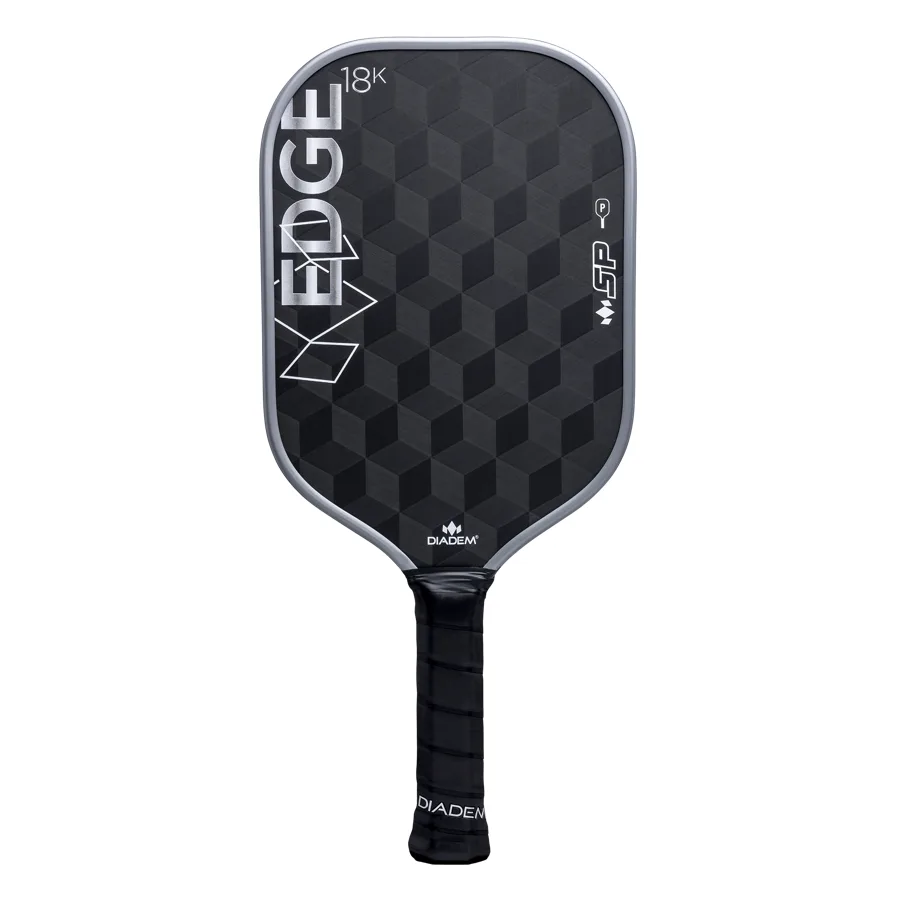
A paddle’s balance point is the spot along its length where it balances level, measured from the butt cap. The further it sits toward the tip, the more head-heavy the paddle feels. The closer it sits to your hand, the more head-light it feels. You can find it in a minute with a table edge and a ruler, and a few grams of tape will move it by several millimetres.
Balance point is related to swing weight but it is not the same thing, and the difference matters when you start adding tape. Our swing weight calculator works out both.
Maker-published balance points
Most paddle makers do not publish balance. Diadem does, in millimetres, in the spec table on each product page.
| Paddle | Published balance | Weight | Length | Core thickness |
|---|---|---|---|---|
| Diadem Edge 18K 14mm (sold by Diadem as the Edge 18K SP) | 240 mm | 8.0 oz | 16.4 in | 14 mm |
| Diadem Edge BluCore Pro 16mm | 235 mm | 8 oz | 16.5 in | 16 mm |
| Diadem Warrior BluCore (Pro 19) | 240 mm | 8.5 oz | 16.4 in | 19 mm |
Diadem's own spec tables, checked October 9, 2026. Diadem lists the figure as "Balance" and does not say where it measures from. The usual convention is from the end of the handle, and the sums below assume that.
A 16.4 inch paddle is 41.7 cm long, so its geometric middle is 20.8 cm from the butt cap. A 240 mm balance sits about 3 cm above the middle. That is normal for a paddle: the face, the edge guard and the core are all above the handle, so the weight sits toward the head.
Head-heavy vs head-light
There is no official line between the two. They are relative terms, and they are most useful for comparing two paddles of similar length and weight.
| Balance further from the hand (head-heavy) | Balance closer to the hand (head-light) | |
|---|---|---|
| Feel in the hand | The head pulls down when you hold it out | The paddle feels lighter than the scale says |
| On drives and serves | More mass arriving at the ball | Less help from the paddle |
| In fast exchanges | Slower to turn and reset | Quicker hands |
| On the arm | More load on the wrist and forearm | Easier over a long session |
This is why a paddle that weighs more on the scale can feel quicker than a lighter one. If the extra grams are in the handle, the balance point moves toward your hand and the head has less leverage over your wrist.
How to find your paddle’s balance point
You need a table with a clean, straight edge and a ruler or tape measure.
- Lay the paddle flat on the table with the handle on the table and the head pointing out over the edge, square to the edge.
- Slide it outward slowly until the head just starts to tip down. Ease it back until it sits level on the edge without help. That line is the balance point.
- Hold it there and measure from the butt cap to the table edge, in centimetres.
- Repeat two or three times and take the middle reading. A millimetre or two of scatter is normal.
Measure the paddle the way you play it. An overgrip adds a little weight at the handle and moves the balance point toward your hand, so measure with it on.
A thinner edge gives a sharper reading. If your table edge is rounded, rest the paddle across a ruler held on its edge, or across a pencil, and measure to that instead.
Balance point is not swing weight
Balance point tells you where the middle of the paddle’s mass is. Swing weight tells you how hard the paddle is to swing, and it depends on how the mass is spread out as well as where its middle is.
The two are linked by one formula, which is the one the pendulum tab of our calculator uses:
SW = I(balance) + m × (b − 5)²
m is the paddle’s mass in kilograms, b is the balance point in centimetres from the butt cap, and I(balance) is the paddle’s moment of inertia about its own balance point. The 5 is the swing weight axis, 5 cm from the butt cap.
The second term is where balance comes in. For an 8.0 oz paddle (0.2268 kg), moving the balance point from 24 cm to 25 cm with nothing else changing takes that term from 0.2268 × 19² = 81.9 to 0.2268 × 20² = 90.7. That is 8.8 points of swing weight from one centimetre of balance.
The first term is where the two part ways. Two paddles with the same weight and the same balance point can have different swing weights, because one has its mass bunched near the middle and the other has it spread toward both ends. The next section shows that happening with tape.
How tape moves the balance point
The new balance point is a weighted average of where the paddle balanced and where the tape went:
new balance = (M × b + g × x) ÷ (M + g)
M is the paddle’s mass in grams, b its current balance point, g the grams of tape and x the tape’s distance from the butt cap. Both distances are in centimetres.
Worked example: 6 grams at the head, then at the handle
Take an 8.0 oz paddle, which is 226.8 grams, balancing at 24.0 cm. Those are the weight and balance Diadem lists for the Edge 18K. The positions are our calculator’s presets for a 16.4 by 7.5 inch paddle.
Six grams at the upper corners, 37.7 cm from the butt cap:
- (226.8 × 24.0 + 6 × 37.7) ÷ (226.8 + 6) = 5,669.4 ÷ 232.8 = 24.35 cm
- The balance point moves 3.5 mm toward the head
Six grams on the handle at the butt cap, 2 cm up:
- (226.8 × 24.0 + 6 × 2) ÷ 232.8 = 5,455.2 ÷ 232.8 = 23.43 cm
- The balance point moves 5.7 mm toward the hand
| Where the 6 g goes | Distance from butt cap | New balance point | Swing weight change |
|---|---|---|---|
| Upper corners (10 and 2 o'clock) | 37.7 cm | 24.35 cm (+3.5 mm) | +6.4 |
| Sides (3 and 9 o'clock) | 27.5 cm | 24.09 cm (+0.9 mm) | +3.0 |
| Lower sides, near the throat | 17.5 cm | 23.83 cm (−1.7 mm) | +0.9 |
| Handle, at the butt cap | 2 cm | 23.43 cm (−5.7 mm) | +0.1 |
Two things stand out.
Handle tape moves the balance point further than head tape does. The tape’s leverage on balance is its distance from the current balance point. The butt cap is 22 cm from a 24 cm balance point. The upper corners are only 13.7 cm from it.
Swing weight behaves the opposite way. It is measured from the 5 cm axis and the distance is squared, so 6 grams at the corners adds 6.4 points and 6 grams on the handle adds almost nothing. Handle weight makes a paddle feel head-light without making it any lighter to swing in the strict sense. It changes the leverage on your wrist, not the swing weight.
Same balance, different swing weight
Now add both: 8 grams at the upper corners and 5 grams on the handle.
- Balance: (226.8 × 24.0 + 8 × 37.7 + 5 × 2) ÷ (226.8 + 13) = 5,754.8 ÷ 239.8 = 24.0 cm
- Swing weight: 0.008 × 32.7² + 0.005 × 3² = 8.6 points higher
- Static weight: 13 grams, or 0.46 oz, heavier
The balance point has not moved at all. The paddle is 8.6 points heavier to swing. If you only measured balance before and after, you would conclude nothing had changed. This is why balance point alone cannot stand in for swing weight, and why the calculator reports them separately.
Which way should you move it?
Move it toward the hand if your hands feel slow at the kitchen line, or your wrist or elbow is sore after long sessions. Weight on the handle or a heavier overgrip does this. Our grip guide and lead tape guide cover both.
Move it toward the head if drives and serves land short and you have time to swing. Tape at the upper corners does this, and it raises swing weight sharply at the same time, so add it 2 or 3 grams at a time.
Leave it alone if you have no specific complaint. Balance is a fine-tuning tool. If a paddle is far from what you want, a different length or shape will get you there faster than tape. Our paddle weight guide is the place to start, and you can demo paddles at Pickleland before you buy one.
FAQ
What is the balance point of a pickleball paddle?
It is the point along the paddle’s length where it balances level, measured from the butt cap. Diadem, one of the few makers that publishes it, lists 235 mm and 240 mm for the paddles in the chart above.
Is a head-heavy or head-light paddle better?
Neither is better in general. A balance point further from the hand puts more mass behind drives and serves and is slower in fast exchanges. A balance point closer to the hand is quicker and easier on the arm and gives less help on full swings.
How do I measure balance point at home?
Lay the paddle flat with its head hanging over a straight table edge, slide it out until it balances level, and measure from the butt cap to the edge. Repeat a few times. Measure with your overgrip on.
Does lead tape on the handle make a paddle head-light?
It moves the balance point toward the hand. On an 8.0 oz paddle balancing at 24 cm, 6 grams at the butt cap moves it about 5.7 mm. It adds almost nothing to swing weight, and it does not reduce swing weight either.
Is balance point the same as swing weight?
No. Balance point is where the centre of the paddle’s mass sits. Swing weight also depends on how far the mass is spread from that centre. Two paddles can share a weight and a balance point and still differ in swing weight.
Keep going
- Swing weight and lead tape calculator
- Pickleball Paddle Swing Weight vs Static Weight
- Pickleball Paddle Twist Weight
- Pickleball Lead Tape
- Paddle specs table
Sources: Diadem’s spec tables for the Edge 18K SP, Edge BluCore and Warrior BluCore, checked October 9, 2026.