
The roll volley is the shot that separates players who can attack a slightly high ball from players who can only dink it back. It’s a topspin volley, and topspin is what lets you swing up and still keep the ball in the court.
What it is and why topspin matters
A roll volley takes a ball at or just above net height and brushes up the back of it, adding topspin, driving it down into the opponents’ court.
The physics is the whole point. A flat drive from a ball just above the net has almost no margin — you’re hitting a nearly straight line into a 22-foot half-court. Add topspin and the ball dips as it travels, so you can hit up and hard and the ball still lands in. That’s the shot’s entire value: it converts a marginal attacking ball into a real attack.
When to hit it
The dink comes back a little high — above net height but below your shoulder. This is the classic roll volley ball. Too low to punch flat, too high to be worth dinking again.
You’re at the kitchen line and the ball is floating. A floaty ball with no pace is ideal for a roll: you supply the pace and the spin.
On a slightly high third shot drop. If their drop sits up, roll it rather than trying to flat-drive it.
In the transition zone on a ball at thigh-to-waist height as you’re moving forward. See pickleball transition zone.
Do not roll a ball below net height. From there you’re hitting up with no downward angle, and you’ll set up their attack — that’s a reset. See how to reset.
The technique
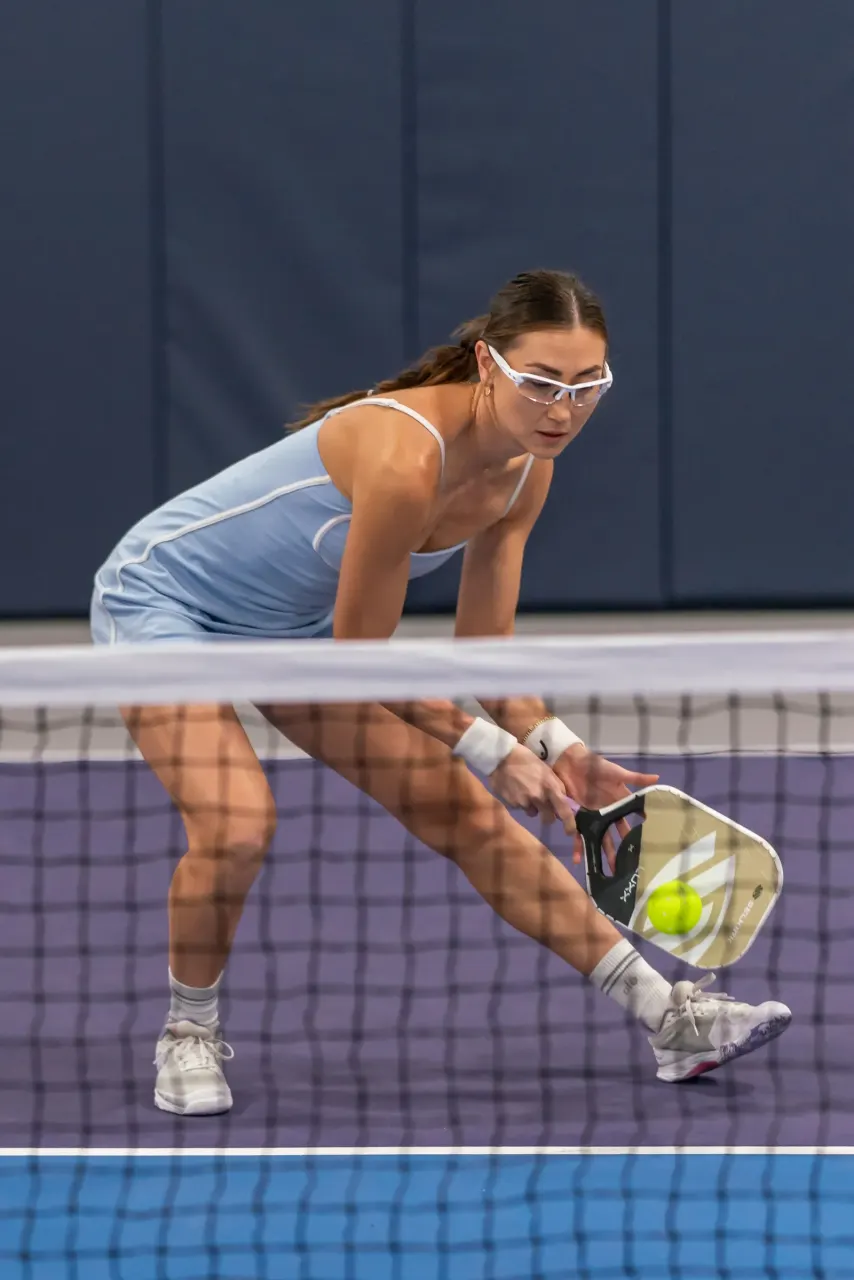
Low to high paddle path. The defining feature. Start the paddle below the ball and brush up the back of it. The face stays slightly closed, not open.
Loose wrist, accelerating. Unlike a punch volley, which wants a firm wrist, the roll needs some wrist and forearm rotation to generate spin. Grip pressure light, maybe four out of ten.
Contact out in front and on the rise if possible.
Short backswing, longer finish. Take the paddle back only slightly, then finish high — around shoulder or head height on the follow-through. The long finish is what tells you the brush happened.
Legs supply the lift. Bend your knees and come up through the shot. Arm-only rolls lack spin and pace.
The feel to chase: the ball should sound like it’s being brushed rather than struck, and you should see it dip late.
Where to aim
Crosscourt at the far hip. The highest-percentage roll. The diagonal gives you the most court length, and the ball travels over the lowest part of the net — which is 34 inches at the center.
Down the middle at the feet. Safe and effective, especially against opponents who don’t communicate.
At the backhand shoulder. A topspin ball climbing into someone’s backhand shoulder is genuinely awkward to handle.
Not the sideline. The roll has margin because of the spin, but not that much.
Common mistakes
Opening the paddle face. An open face slices under the ball and produces a floaty pop-up. The face should be square to slightly closed with the path going up.
Gripping too tight. Kills the wrist action that generates spin.
Rolling balls that are too low. The most common error. Below net height, roll becomes pop-up.
Swinging too big. The roll is a compact stroke with a long finish, not a full groundstroke at the net.
Standing up out of the shot. Legs go up, ball goes up.
Drills
Roll off a feed. Partner feeds soft balls just above net height from the opposite kitchen. Roll every one crosscourt. Watch for the dip — if the ball isn’t dipping, you’re not brushing.
Dink until high, then roll. Dink crosscourt with a partner. Whenever a dink comes back above net height, roll it. Trains the recognition, which is harder than the stroke.
High-low sort. Partner mixes feeds above and below net height. Roll the high ones, reset the low ones. Same decision drill as the punch volley and just as valuable.
Frequently Asked Questions
What is a roll volley in pickleball?
A topspin volley hit at the net, where the paddle brushes low to high up the back of a ball at or above net height. The topspin brings the ball down inside the court, so you can attack a marginal ball safely.
When should you hit a roll volley?
On a dink or drop that comes back above net height but below your shoulder, or on a floating ball at the kitchen line. Not on balls below net height — those should be reset.
How do you get topspin on a volley?
Start the paddle below the ball, keep the face square to slightly closed, and brush upward through contact with a loose wrist and a high finish. Bend your knees and rise through the shot.
What is the difference between a roll volley and a punch volley?
The roll brushes up the back of the ball to create topspin with a loose wrist and high finish. The punch is a short, firm, flat redirection with a still wrist. The roll attacks; the punch defends and counters.
Where should you aim a roll volley?
Crosscourt at the far hip is highest-percentage, since the diagonal gives the most court and crosses the lowest part of the net. Down the middle at the feet also works well.